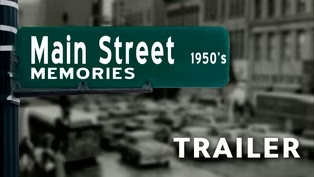
Main Street Memories: 1950's
Main Street Memories: 1950's
Special | 57m 46sVideo has Closed Captions
Take a nostalgic ride back to 1950's Peoria.
Take a nostalgic ride back to Peoria just a few decades ago with WTVP's original production Main Street Memories: Peoria in the 1950's.Cruise along with us as we explore the streets of downtown Peoria back in their heyday, with stores like Woolworth's, Grant's and Szolds. Music, sports, and industry are explored through heartwarming stories told by the Peorians who lived it.
Problems playing video? | Closed Captioning Feedback
Problems playing video? | Closed Captioning Feedback
Main Street Memories: 1950's is a local public television program presented by WTVP
Main Street Memories: 1950's
Main Street Memories: 1950's
Special | 57m 46sVideo has Closed Captions
Take a nostalgic ride back to Peoria just a few decades ago with WTVP's original production Main Street Memories: Peoria in the 1950's.Cruise along with us as we explore the streets of downtown Peoria back in their heyday, with stores like Woolworth's, Grant's and Szolds. Music, sports, and industry are explored through heartwarming stories told by the Peorians who lived it.
Problems playing video? | Closed Captioning Feedback
How to Watch Main Street Memories: 1950's
Main Street Memories: 1950's is available to stream on pbs.org and the free PBS App, available on iPhone, Apple TV, Android TV, Android smartphones, Amazon Fire TV, Amazon Fire Tablet, Roku, Samsung Smart TV, and Vizio.
- [Announcer] Support for Main Street Memories is made possible in part by Proctor Place.
It's simply better here.
Www.proctorplace.org, 309-566-4206.
Snyder Village.
Your place to call home.
Snydervillage.com.
309-367-4300.
And the Stacey Tomczyk Fund for Local Productions.
(soft music) The 1950s.
Impressions made during this era echo beyond the decade's years.
It was a time when champions set the bar.
Peoria would shed an old image.
The landscape was altered.
And a new medium arrived.
But it was also a time of division and the beginning of the end of downtown's dominance.
♪ Doo, doo-doo-doo-doo ♪ Doo, doo-doo-doo-doo ♪ Doo, doo-doo-doo-doo ♪ Doo, doo-doo-bop ♪ Wherever you go there's radio - [Announcer] Your four Jewel food stores in Peoria and Pekin are playing Santa Claus to your family.
- [Announcer] Egolf, your Oldsmobile dealer, 512 West Main at the top of the Main Street hill presents.
- [Announcer] The big sound on WIRL.
- [Announcer] Solved by the easy bishop's plan.
- [Announcer] Breakin' big all the classics xxx, music love, and landavarias on Radio One, WPEO... - [Announcer] The Dentino way.
Dentino Motors, 227 MacArthur Highway.
- [Announcer] It's music from the state of supernatural, you betcha, Ted Heath and his Swingin' Ghosts, a London waxing, kinda wrapping it up for now.
We'll be back in five right after the news with more.
- Downtown was busy.
Cars were parked along the streets and it was really a going place.
Most people did their shopping in downtown Peoria.
- My grandmother went downtown almost every day.
She'd get on the bus.
She had her shopping bag all tied up with a rubber band.
And she would go downtown sometimes just to look around.
- We walked donwtown here.
My aunt lived on Oak Street.
Oak Street was the beginning of prostituting and all that and we'd walk through the alley with the red light district.
We'd walk through the alley.
And Butternut Bakery was here at Boar and Paint, and we'd stop and get hot bread on the way home.
(soft music) - [Man] Think about it, we had Schlatzkys, Bergners, Black and Kool's.
- [Woman] We also had Montgomery Ward, and Peoria Dry Goods, and a store called Newberry's and Grant's.
- [Man] Penney's, you had your Sears, all your retail was downtown.
- Szolds was one of the big attractions, I mean every body that's our age would say Szolds, Friday night, or Saturday night, that was the place to be because you met all your friends there, that's where they went.
It was a very nice store.
It was like a combination of a dry goods store, they had candy in there, they had some toys, and stuff like that during Christmas time.
But it was really a store where you went and met your friends and sit around and talk.
(upbeat music) - [Man] A very special time of the year was Christmas time, when you could go downtown.
And you could look into all the windows at Bergners to see all of their toys, and the animated puppets.
- [Narrator] The start of the holiday season began with the annual Santa Claus Parade, bands, floats, marchers, lead Saint Nick along downtown streets, to the great white store, Block and Kool.
- Oh yeah, that was a big deal.
Christmas, and actually, we made money during the Christmas, especially that Christmas parade, shoot, we worked that, we got about $3, or $4 for marching in that parade, carrying these big things over your head, or whatever it was.
Block and Kool was the sponsor for that.
And you'd get your assignment, and you'd walk those blocks, or the parade routes.
And it usually was really cold, but hey, we got $3 or $4, we were in heaven.
(laughs) - And when santa would come to town, they would let him off at Block and Kool's on the side, and he'd climb the ladder up to a little marquee cover, and that's where he'd go into the building, and up to the fifth floor, to the toy land.
And of course then he'd bee seen at toy land, we could sit on his lap, and tell him how great you were all year.
- You'd go up on the floors there at Block and Kool's, and they had a little, like the old time organ grinder, and he had a little monkey that he had.
And little kids would put a nickel in your hand, or a dime, whatever your mom'd give ya.
And you'd hold it out, and he'd take that tip his hat to ya, I mean as a young kid that was a pretty neat.
- [Narrator] Despite the parade and stores, downtown's dominance as a shopping mecca would ebb during the decade, the biggest threat came in 1954 when the largest downstate shopping mall opened, Sheraton Village not only consisted of 23 stores, but more importantly, offered 2,003 parking spaces.
- I came back from service, and I will never forget I pulled in after two years, right down there at the Rock Island Depot, met my wife, family and so forth, and we went out Sheraton Road, and as we got to the, they didn't say a word, and I looked over and went, what in the world is that?
What happened to that field?
And they said this is Sheraton Village.
I said Sheraton Village, really?
And I said what's it do?
And they said it's a shopping center.
And so they drove in there.
It was at night when I got home.
And there were lights around, and I went, wow, that a happened, like that.
- And when Sheraton Village came, I guess everybody, my mom said I can't believe all these stores are in one place I can go shop at now.
So that was kind of earth shaking.
- [Narrator] Opening day festivities included sales, balloons, and a drawing for a free cocker spaniel puppy.
Downtown responded with its own system for free parking, at selected garages, where patrons could use stamps in lieu of money, whose value was based on purchases, later to woo shoppers, downtown merchants sponsored fiesta days.
A combination summer carnival, and sidewalk sale.
- It was like a carnival downtown.
But they had it on the street.
They would block off the street.
- And you'd come through there and you'd buy things, and they'd cut off all the traffic, and you could walk up and down the street.
- [Man] They could see some handwriting on the wall, and they were going to try to keep this traffic downtown.
- Sheraton Village was starting the go shop and get it over with, you didn't really go shopping.
You knew what you was after, so you went in and got it and you left, okay, that type of thing.
You shopped a little bit, but not like you did downtown.
Downtown was a slow pace, you went into the stores, you touched stuff, you looked at it, and you went upstairs, downstairs, wherever you wanted to look at it, but Sheraton Village was starting of the fast pace, you know you went and you grab it and go.
- When they started tearing down our stores downtown, and putting in other things, we lost something.
- [Narrator] Peoria was growing, shedding its past.
The Lyceum and Orpheum theaters were demolished for a building extension, and a parking lot.
On Adams, The Princess Theater was raised, to make room for the new Silco office building.
Among other construction projects were new homes for the YMCA, Peoria Players, and Journal Star, both Richwoods and the Limetone high schools were opened.
And on the Bradley campus two dorms, and engineering hall, and a student center were built.
On Main Street, Glen Oak Towers, the tallest apartment building outside of Chicago was completed, and estimated 15,000 people toured the building during an open house.
But the largest construction project, was happening next to downtown.
The new expressway, for the approximately 115 trucking companies in the Peoria area, the new connection to the national highway system held much promise, while motorists were anticipating less congestion crossing the river, after four years of construction the newly named Murray Baker Bridge was dedicated on a cold December morning, as temperatures hovered at three above zero, with gusting winds.
Governor William Stratton walked the entire span to join the ribbon cutting.
Prior to the new highway, there were only two downtown bridges crossing the river, one was the Franklin Street Bridge, rebuilt in 1913 after a portion had collapsed, the reincarnated structure had a bend where the road veered to more solid footing on the opposite bank.
- And so they said let's go this way, and this ground's better, and that's why they put a curve in the darn thing, right at the tender's shack on the bridge, who pulled the lever that raised the arms up.
(laughing) That was a dreaded sight, you'd be coming up on that thing, and there was that bridge going, and you'd go, oh no!
- And it took quite awhile to do that, and of course when you had boats coming, up the river or down the river, whatever, people had to wait in their cars, and they were backed up for a long way on both sides of the bridge.
I waited there many times, and sometimes in the morning, when you had to get to work, it was brutal.
- [Narrator] Traffic was especially bad during shift changes at the East Peoria Caterpillar facilities.
The company like Peoria, was growing, although Caterpillar was expanding across the state and worldwide.
- You came into the 1950's and there really was a shortage of products, kind of worldwide, one is you kind of still had the rebuild of Europe going on from after the war.
The other reason, you had these very large products, such as the Federal Highway Bill.
You had a lot of dams that were being built world wide.
You also had like the construction of the Saint Marks Seaway.
- Manufacturing, crawler tractors, and diesel engines of Peoria, motor trailers, and but trail wheel tractors of Decatur, earth moving equipment of Joliet.
Excavators and pipe layers of Milwaukee.
Fuel injection systems of San Leandro.
Track and related parts of New York.
Machines and parts in Brazil and Australia, parts in England, 10 domestic parts depots strategically located throughout the United States.
Four foreign licensed manufacturers in Melbourne, Australia, New Castle on Thine, England, Johannesburg, South Africa, and Paris, France.
- We really went from kind of an exporter of products to making those products within country.
- [Narrator] Along with global expansion Caterpillar also increased it's line of products.
Including among others, the DW20, and 21.
The 583 pipe layer, and the DA tractor.
- We made products at that time were used in Antarctica for Antarctic exploration.
They were D8 tractors, and these tractors were actually used from the '50's even up until even a couple of years ago, but one thing that you had out, that came out in the '50's, which is still on the line today is the wheel tractor scraper.
So really that was like one of the perfect products you would say to, like as you see, like an expansion of the freeway system.
(upbeat music) - [Narrator] But the most impressive product introduced that decade was the D9 tractor.
- Oh, yeah, the big G, the giant, I remember when that came out, what a monster that was.
- You would say our biggest model before that was the D8, but really the history of the D8 goes back to the CL Best company, and what they called the Best 60, and it became the Caterpillar 60, and then it involved into our first diesel tractor which was the diesel 60.
And that really started out in 1919.
So really you have our first newly designed tractor, and like many, many years, the D9 at that time was the world's largest tractor, and it really kind of brought us you would say into the industry of mining, it was a big evolution as far as in the world of the track type tractor.
- [Narrator] Evolution was also happening within Caterpillar, the most visible sign came in 1954 when Louis B. Neumiller was named chairman of the company.
- CL Best was our first chairman from 1925 to 1951, our second chairman was a man named Harry Fair, and Harry Fair was also from the Best organization.
Now these gentlemen who lived in San Leandro, and our headquarters was there, but what you really see in the mid 50's, the switch from which was a slow process, from San Leandro, to Peoria being the heart of Caterpillar.
And the third chairman was a gentlemen named Louis Neumiller.
Now Louis Neumiller was a native Peorian, he was president of Caterpillar for a long time.
But once he became chairman he really became you would say the first in the Peoria line of chairman.
- And there was no greater, greater humanitarian in this world than Louis Neumiller, he just stopped me in the hallway one day and I was new and I had a broom in my hand, by the way, and he said to me are you new here?
I said yes, so on and so forth, and I'm looking at this distinguished guy, those very kind eyes.
He said well, may I give you some advice?
And I never forgot this, he says make Caterpillar, and he went like this, a life satisfying experience.
And his eyes, and the way he said it, and he looked at me and he was so sincere, and I thought, wow, Socrates is alive.
(laughs) He's here!
- I think he was really trying to create, kind of a generational kind of experience, a family culture.
We would have family events, again, such as sports, or musical events and people were very encouraged to not only to attend those events as employees but to bring their family's.
- [Host] Neumiller attended many of those events, he also established a Safety Award, which was later named for him.
And came up with a popular acronym, I-T-A-B-W-O-D-I.
- And it was on these little things on people's desk.
ITABWODI, is there a better way of doing it?
And he was encouraging people to come up with better ways to do the job.
(upbeat music) - In 1955 Caterpillar had, what they called the World Wide Dealer Meeting, it was called the Caterpillar Exposition, and they brought their dealers in across the world.
But one of the things that I would argue, really had a huge impact on Peoria that came out of that meeting was, they did a thing called the Big Parade to all the dealers.
Which really became the Power Parade, to Caterpillar employees, which would happen 10 years later in 1965.
(upbeat music) - [Host] In sports the 1950's began on a high note, as the Bradley men's basketball team was ranked number one in the nation.
And played in both the NIT, and NCAA championship games.
Both times they faced the same team, and lost each time in close games.
On the team was Eugene "Squeaky" Maltory, who was named one of the two best offensive players in the country by Sports Album Magazine.
- Squeak was 5'9 1/2, he had huge hands.
And he was strong, what a player.
He was a magician on the floor.
- As a freshman, we saw film of some of Bradley teams of the past, so I got my first glimpse of Maltory, and I was just amazed, and I found it incredible that this young, short, man could do what he did with a basketball.
- I was a freshman, and we were playing against the varsity and Maltory and I was trying to guard him.
And I was moving and all of a sudden I couldn't move, and he had ahold of my pants.
(laughing) And I said what are you doing?
And he said, oh I was just watching where you were going.
(laughs) - He was drafted number one by the NBA.
You know, the only player we ever had drafted number one by the NBA.
But Dennis Campbell broke that string, and he never had a chance to play again in the NBA.
Maltory and several Bradley players were among the 32 athletes from seven schools accused of point shaving during the tournament.
- It was one of the most painful times.
People were literally crying on the streets here in Peoria, we struggled.
Because when we came back, we didn't have any seniors on the team.
I can remember we went up to Minnesota and we played up there and they blew us out.
And the coach said, no, no, Fordy Anderson was our coach, he said don't get discouraged, he said we're gonna get it together.
We're gonna keep working at it.
We lost more than half of our games that first year, when we came back.
But then we did kind of come together.
And by our senior year it was amazing.
We got invited to play in the NCAA tournament.
Elderly man kind of comes down into our dressing room after the game was over, he said I just want to thank you guys.
Because now one of the teams that have went through this tough time has now risen back and he said now we can be proud to back in the tournaments again, you know, and he said thank you and left.
And I said who is that?
(laughs) That was the coach of the Kentucky team.
- [Host] In 1954 and '55, the Braves reached the final four and final eight of the NCAA tournament.
But as an independent, not as representatives of the Missouri Valley.
Bradley had left the conference due to an incident during a Drake-Oklahoma A and M football game in 1951.
Playing for Drake was Johnny Bright, who was a pre-season favorite to be a Heisman trophy candidate.
Targeted due to his race, he was knocked unconscious three times, and in an illegal hit away from the play, his jaw was broken.
When neither the Valley, nor Oklahoma A and M took disciplinary action, both Drake and Bradley left the conference.
(upbeat music) Peoria was a basketball town.
The field house was home to both the Bradley Braves, and the Caterpillar Diesels.
In 1952 the Diesels won the Amateur Athletic Union Championship, and then beat Kansas for the right to represent the United States in the Olympics.
On returning they were met at the airport by fans and family.
And escorted downtown for a celebration parade.
Five members of that team, along with their coach, went on to Helsinki where they won the gold.
Peoria once again celebrated the basketball championship at the airport when Bradley Braves returned home after winning the 1957 NIT championship, when they beat Memphis State by a single point.
One member of that team was Bobby Joe Mason.
- Bobby Joe was a great passer, a great scorer, couldn't guard Bobby one on one, I mean you could try, but he was just real good.
And he proved that by being the lead ball handler on the Globe Trotters for 13 years.
- We played full court press, and we were terrific defensive players, fast break players.
Plus we had some great player who could shoot the ball.
It was a very exciting team that we fielded back in those years.
We had a very good tactitian as a coach.
Chuck Orsborn was a good tactitian.
He believed in match up.
- And I asked him once, Dan, I said if you really had to think about this, who would've been your most outstanding player?
And he said, well how do you mean that?
He said you mean desire wise, or do you mean just natural ability?
And I said probably natural ability.
And he said probably Bobby Joe Mason.
And I said well, how about desire?
Gene Morris, he's said he just worked himself half to death.
- [Host] While the Bradley players at the time were talented, the team might have received extra help during the season from the planted omen.
- The players were not really excited about occasionally, having a black cat in their locker room.
The main opponent that was privy to that was Cincinnati.
And Oscar Robinson never went on the field house floor.
But apparently someone, and dad told me he checked, the locker room himself to make sure, that no one had put a black cat in the opponents locker room, and I'll be darned if when Ed Decker opened the door, why out strolled a black cat.
- [Host] In addition to winning the NIT the '57 squad held another distinction.
On the roster were the first African Americans to play on a Bradley University men's basketball team.
- I remember cutting out an article, in 1954, '55 there was only about 16, major, white universities that had black players.
Bradley was one of those 16 teams that had the most, four players.
- [Host] As progressive as Bradley was with its support of Johnny Bright, and recruiting, the university along with Peoria, had a long way to go.
- Social intercourse with other students were limited.
Association with white females were forbidden.
On game days, things were fanta, we were heroes.
It was great, the rest of the day of the week people were indifferent to us, and some of the players, for instance Shawn McMillan had some emotional problems.
And spent at least half a year in the psychiatric ward because he could not deal with the discrimination he encountered on Bradley campus.
On those other days, where about on game day, he was a hero.
- When I was in high school when I picked nursing, I won't mention the name, but she was the counselor.
And she said you would be better off taking the home economics.
I said, well no, I want to take nursing, you know.
So she said, okay, so she just let me pick out, she didn't really help me, she said but you'd be better, 'cause there's no black nurses in Peoria, and so you'd be wasting your time.
- I had this big idea, I said you know, if I went into the service and served my country I'll be more of an American, I'd have more rights.
Served two years, came back and that's when I had the rude awakening, in 1957 we didn't have nobody driving buses, fire department, police department we had a couple on the police department.
We were limited where we could live.
We didn't have black teachers, we didn't have black principals.
- In the summer we had Ethiopians mainly would come here, and other foreigners for grad school.
And some of them were more dark skinned than we were.
They could go and stay in the Peoria campus, but we couldn't, so Shelly who's a great jokester, he wrapped a towel around his head, and he went down to Peoria campus and starts speaking gibberish, and they thought he was a foreigner, and they let him in, and you know, but, had they known that was Shelley, the black basketball player, he wouldn't of got in.
- [Host] Many restaurants refused to seat blacks, only allowing take out.
Downtown theaters enforced segregated seating.
Restricting African Americans to the balcony.
- It was unspoken, but it was a policy that was followed.
I mean if you sat downstairs, or you know what I mean, you'd be told you have to go upstairs.
- Plus there was an old theater called Warner, and the price I remember was .09, to go to that theater.
And that's mainly the only theater we went to.
Because it was in walking distance, close to Warner Homes, they didn't have a balcony thing at Warner, it was all one floor.
And so they separated you by aisles, and African Americans was on one side, and whites was on the other side.
- It was discrimination and racism.
- That was really the worst part of the '50's.
'Cause we had a lot of fun going to school and friends and stuff.
- And so you didn't notice that there were any problems, I had a great life.
I had a blessed life.
- [Host] For many African American children the focus for afternoon, weekend, and summer activities was the Carver Center.
- We centered around Carver Center, because that was the only place we went for recreation.
And basically they had everything that we needed.
They had basketball , they had boy scouts, girl scouts.
- But it was structured activities, I learned how to play everything from checkers to chess.
Badminton, archery, was in the boy scouts, went camping, in plays, I mean, so there was a lot of exposure.
- I took tap dancing lessons.
I took piano lessons at the Carver Center.
And all I had to pay was $2.25 for each thing.
And when I went to the Carver Center it wasn't in that new building, that was built, little bitty building, and we had a gym.
They made it so we had a stage in the gym room.
And when we had dances they had the chairs all around the room, and then we had dances on Friday, Saturday nights, or whenever.
- Even to the point that we had - [Man] Prom.
- proms there, because I mean we could go to the proms at our regular high school, but a lot of 'em people felt uncomfortable when they went.
And so they would have prom at the Carver Center, so you could dress up and come.
- [Host] Because of the reception at some establishments many African Americans felt more comfortable patronizing black owned businesses within their own community.
One that has left fond memories was the restaurant run by Mrs.
Gains.
- They Gains end up being a big part of our community.
Probably, they probably had 10, 12 tables, restaurant tables.
- And those checkered table cloths, and they were plastic.
But they were clean, that was the main thing, was the cleanliness.
- That's some of the best soul food in town.
You can get every dish.
You know, greens, cornbread, beans, fried chicken, fish.
They just had all the dishes, that, well, at that time we were used to it at home.
- Chicken, baked chicken, smothered chicken, short ribs, meatloaf, neck bones, ham, liver and onions, that was the basic dinners.
Ms.
Gains loved to cook, and she was very nice, she'd help everybody, she helps everybody.
- She was pretty much like a mother to people.
She'd talk to you and tell you, don't do that, girl.
Or you ought to know better than that.
She was just very protective.
But you honored, you respected her, because whatever she said, she was down to earth, just like your extended mother.
- [Host] In Peoria the most famous restaurant owned by an African American was known not only for its owner and secret sauce, but also for transcending the race line, Big John's Barbecue.
- Big John's, oh, the greatest barbecue you ever ate, yep, yes sir.
- They had the best beef sandwich, you get a beef sandwich, you better have a couple of extra slices of bread, 'cause you're gonna, that's how much beef they gave ya.
- He'd come around to all the tables, and there was never a more personable fella.
And he used to always say, y'all get plenty to eat?
Y'all doing this, y'all alright?
- And for those people who took advantage of that, and said no I could use some more, they got some more, but he said you better eat it.
(laughs) - That's the way he was, very personable.
Well loved by the Peoria people.
- Originally it was just John's Barbecue.
But my father had huge hands, and he had a big frame.
My father stood about 6'1, about 240 pounds.
So he was a big man, but he had a much larger presence, even than just his natural size.
So, just later on John's Barbecue just became Big John's Barbecue.
My father never drank or smoke or any of that.
But he liked to shoot pool, he liked to be a mixed past time.
Now, a little bit later on, he started buying his own pool tables.
He had a large one in the restaurant.
A full nine foot table in the restaurant.
And one at the house, when we finally built another house out on Chippewa Drive.
He loved to shoot pool, and he was pretty good at it.
- He called me up, and here I was, 15, 16 years old at the time, and I'd say to him, I'm busy now John, I'm working with my dad, no you're not busy, stop what you're doing and come over here, and shoot some pool with me.
So I had to go over there, and he was my friend so I did that, went back and shot pool together.
He just loved to beat me, that was about the light of his day, play eight ball.
In the back of Big John's restaurant.
- The original Big John's Barbecue was located at 719 North Monson, which is now Comf Boulevard.
We lived above the restaurant.
My father was quite the builder.
Every year he would build a room or add onto the restaurant or the house, sometimes the restaurant, and the house.
He started putting his money into real estate.
By the time I got to high school.
We owned every house on that block.
The original restaurant seated around about maybe 100 people.
With a great deal of carry out and delivery.
We were one of the few people that focused on delivery.
As I look back on it now, I just was very proud of my father, at that time you don't think about it, you're just a kid growing up.
Not realizing that my father was doing something that would become historic in nature.
It was a time when a big old black guy from Mississippi kind of transcended this community and made it just a Peoria community.
Not black, not white, just Peoria.
- [Host] Big John's was not the only restaurant with its own specialty, on Farmington Road, there was Hunt's.
- That was a great restaurant.
It really was, and who was there to greet you?
Gordon Hunt, I mean that guy could talk your head off.
I always liked running into Gordon Hunt.
Try the tenderloins, that's what you were down for was the tenderloins.
(laughing) - An tenderloin, humongous tenderloin, I mean big like that.
Hanging over the bread, you could hardly get a bite to get it in your mouth.
- Oh and the relish was a family recipe.
You didn't have to ask for ketchup and pickles separately it was all very nicely mixed together, and it was delicious.
- And ice cream sodas, wonderful chocolate, strawberry sodas, and he had some technique of hanging the bowl of ice cream on the side of the glass, so here'd come this tall soda glass, filled up with ice cream and soda syrup and then two balls of ice cream hanging on the, you think if you move your glass they'd fall off, but they didn't.
I never did, I always wanted to know the secret, of how he got those ice cream balls to hang on the glass.
But it was some great days, 'cause those were the days of curbys, right?
You'd park your car and they'd come out with a tray, an aluminum tray, that hangs on your window, and take your order, and you'd eat in your car.
- If it was real busy Mr.
Hunt would come out and kinda direct traffic with the curbys, you know, you'd go here, and go there, make sure, give your ticket, and I'll run it in for you type of thing.
He wasn't really heavy on, cruising through, let's put it that way.
You stop, stop and eat, but it was, we all did it, you know, but you always had block up, people couldn't get in or out.
- And then of course in the '50's and 60's Gordon had put up a tower.
And he used to bark at the kids who would drive through his restaurant too fast.
Because there was so many, young, teenage boys and girls driving their cars around there.
Either going down there to find a date, or going there with a date, and it was continued, like a race track through his lot.
Of course he got a little irate, and some of the teenagers didn't like what he said to them, and one night they came there with a rope and pulled down his tower.
(laughing) So that was a big hurt to Gordon, I don't think he put it back up after that.
- [Host] Just down the road from Hunt's was the Pig and Whistle.
- Usually when people went by in their cars, the name Pig and Whistle and they'd go (snorts) (whistles) - That's right, I forgot all about that, they'd go oink, oink.
(laughs) That was good stuff, I'll be darned.
- And I can remember in there as a 12 or 13 year old kid sitting there at the counter with my dad, and Eddie Piper would come up and say son, he says do you like ice cream?
Yes I do Mr.
Piper, I like ice cream.
- Well I want you to eat this, this is custard.
This is soft served custard.
And of course I said soft serve, I don't know what that is.
He said well nobody does because it's not been in Peoria, I'm the first one bringing soft serve ice cream to Peoria.
He told me he went to the Taylor Ice Cream Company at a convention, and they had just brought this machine out to serve soft serve, and he bought it and he brought to Peoria.
And he featured a sundae probably a quart of the product in the sundae, and he called it a pig's trough.
It was a great big glass dish, we call it a banana split today, but it was a monstrous banana split sundae, and he had advertised if you can eat one of these, I'll give you the second one free.
(laughs) - [Host] One eatery that was the destination of patients after a show, or in the late evening was the Downy Flake, which offered a bit of entertainment.
- It was about where the Twin Towers is at now.
It was a bowling alley up above it.
And you went in there, and they served great donuts in there, we always went for the hamburgers and french fries in there.
- Downy Flake was, Tony and Alex Sutter, a nice Greek family and he was the first guy in Peoria to have a robot building machine.
And this robot machine was maybe 20 feet long.
And I used to stand, and when I was little of course I could barely look over the case.
But you could follow the donut from its inception when it dropped out of the dispenser into the grease, and then there was a tray in the grease going to the left and it floated down the frying oil.
And then it went to another area and dried for a second or two, and then it got coated.
And dropped off at the end.
- And they had a poster on the wall, let's see, as you ramble on through life brother, whatever be your goal, keep your eye upon the donut, and not upon the hole.
(laughs) - [Host] Hunter's was a popular after school hang out.
Especially for Spaulding students.
- 105 Perry, Bob Babcock is the owner, and people in the Peoria area loved to go there for popcorn, and his famous hotdogs.
I loved to have hotdogs with relish and mustard.
And so I'd say to Bob, hey can I have one of my favorite hotdogs?
And he's say, one hotdog, yellow and green.
That was his mustard and relish, yellow and green.
(laughs) - They had the greatest hotdogs in the world.
And they had buttered popcorn, that when you got done eating a bag of that you were so greasy, you couldn't touch anything.
'Cause I can remember when we'd go downtown in the car my mother would say, don't you touch a thing after you eat that popcorn!
You put your hands up in the air.
(upbeat music) - When I heard he was going to close, very disturbing for me, 'cause that's one of my favorite eating places as a teenager.
And so I asked 'em if I could have the last hotdog out of their steam table.
So I went at 3:30 that day, we got his last hot dog, brought it to the store baked it at 400 degrees for a few minutes, and then shellacked it,.
Of course I will tell one story that some Peorians probably know, but you could place a bet on a horse, there's a little horse betting going on there, that was back of the counter.
(laughs) So you had to get Bob aside.
But not with kids, with adults of course.
- [Host] Betting was occurring not just at Hunter's, but at a myriad of establishments around town.
Peoria was still considered a wide open town, catering to adult male vices.
There were also the nightclubs such as Faust, offering female entertainment nightly.
And the infamous red light district with its houses of prostitution.
- And we lived close to those districts.
You'd walk through the alley, and the women pecking on the windows for clients.
- Well you drove through it.
As a young kid you drove through it.
And ladies of the evening we'll call 'em would knock on the window, or wave at ya, or something like that.
You always thought you was a big shot, and wave back, you know, but yeah, they were there.
And it was just part of Peoria.
- And then China B was right up the street, she was first class, and every Monday she'd have her girls to go to doctors to be checked.
- The dress shop, down there where, it's where the ballpark's at now in Peoria, it was right next to it, it was called Sunflower Acres, and it was a brothel, I mean that's what it was.
Everybody in town knew that.
Okay, well when I worked at Beullers up there on Main Street, Pam Miller was the lady's name that ran it, she would bring a few of the girls with her into the grocery store, and she would do her shopping.
Okay, well we as young 17 year old kid, 18, well about 17, anyhow we'd be looking around the corner, watching the girls, we thought that was pretty slick.
Well then from there, she would buy stuff like coffee, and donuts, and stuff like this.
Then she would buy her own groceries, and she would probably tell ya, this is for my business, and this is for me.
- [Host] But business as usual came to an end.
In 1953 Robert Morton was elected the 49th mayor of Peoria, who had campaigned on a pledge to rid Peoria of illegal vice.
As he pursued his goals anonymous threats were made on his life, and his home was damaged one evening when dynamite was exploded next to the gas meter.
But Peoria and its image were changing.
Parts of Washington Street, which had been home to several brothels, were demolished to make way for the new highway bridge.
Eventually Peoria was recognized as one of the nation's all American cities.
Vice was not the only entertainment in Peoria, in the fall there was Bradley University football.
Each Thanksgiving there was the turkey day game, which in 1954 featured the unbeaten teams Emanuel, and Peoria High, the Lions won, 26 to 6.
In the summer the visiting paddle wheeler, Avalon offered river excursions, there were also water shows featured at Eckwood Park, and at least once at Peoria Stadium.
Plus there was racing, at the Peoria Speedway, by the Van Hawley Airport in East Peoria.
Expo Gardens, and even on a Peoria road, for the annual soapbox derby.
Every year Abingdon Street, next to Glen Oak Park, was cordoned off to make a downhill track.
In 1956 over 80 racers competed for the right to advance to the National Soap Box Derby Championship, in Akron, Ohio.
Racing was also a part of entertainment at the new Heart of Illinois Fair, which began in 1950.
And during the summer evening, teens created their own entertainment, with cars.
As they cruised a circuit anchored by two Steak and Shakes.
- The two Steak and Shakes that you always went to, one down the south end, and then you went to the one up on Main Street and you made the tour, we called it the tour.
You'd take your car and you would drive up, you would drive through and see who was there.
See if your friends were there.
And kind of a side note, the south end Steak and Shake we all would of course spin our tires, screech our tires as we were passing by, so the manager come out, maybe on Saturday and he would water that down, so you couldn't spin your tires.
- Well that's 'bout the most thing you had to do.
You know in the city, there wasn't much to do, so we'd just drive around, have fun.
See all of our friends, honk the horns.
- On University it was called Marty K's, it was about where the other television station was at, on University, and that was another late night place, a late evening place you'd go to.
And you just made a circle, 'cause all your friends were there.
- [Host] And the music on those car radios, that was changing.
During the early 1950's places like the Ing, and the Hub featured the sounds of big bands, but that was being replaced by a new caravan of stars, that change was reflected in the radio ratings as well.
By the end of the decade WPEO was number one.
- [Radio Singers] WPEO 1020.
- They became number one just because of the music that they played, the style of music was more popular with the younger listeners.
That would be the time that Tom Stores bought out the station group through the Dandy Broadcasting Corporation, so there were the ones to develop that style, where you had the jingles, and the music.
It was a very tight play list, so they would only play about 40 songs, and even though WPEO called it top twenty, because of their call letters, and their frequency, 1020, they actually did actually play the top 40 hits.
♪ Here's a record that's gone beep beep ♪ Driving big across the nation ♪ Here's the inside information ♪ The big hit of the week.
- WIRL would be their closest competitor, because WIRL at that time was playing top 40.
They were just limiting their music to the more conservative songs.
Their general manager Fritz Frederick at the time, he says that WIRL will not carry music with the honking saxophone and so on.
Saxophone was the more progressive style.
- [Fritz] We will not play rock and roll, featuring honking saxophones, and screaming vocalists, and we're not being arbitrary, we feel that teenagers deserve to listen to rock and roll if they want to.
But to establish the music policy, adults, the people who buy things to live with, we chose the thousands of tunes that make sense, instead of the 40 that make noise.
- [Host] Besides the music selection, WPEO had the number one morning personality in Peoria.
Harry Harrison, who came from Chicago for a little seasoning, fame, and fortune.
- When Harry came to WPEO they offered him a salary of $65 a week.
Harry was real laid back, he was very genuine, personable, he connected with his audience.
He liked to give birthday announcements, anniversaries, births, and he would, he was just sincere, and people could just identify with him.
He was like your friend on the radio.
- [Harry] How you do it by Dean Martin, a familiar melody, now it's called I ain't gonna lead this life no more, and how do you do to you?
Harrison's back again, the Morning Mayor, with a lot of music for ya on the radio one in Peoria, Illinois, WPEO.
- The Dandy Group gave him the moniker, or the nickname the Morning Mayor, and he carried that through Peoria, and he took that with him to New York, when he went there later.
He had 44 years in New York City, before he retired.
- [Harry] A lot of people ask me, how did you get to New York anyway, Harry?
Well I came here by way of Chicago, and there is a Peoria, Illinois.
- [Host] During the '50's radio lost its dominance over the airwaves to a new medium, one that was displayed at the first Heart Of Illinois Fair.
Television, on Sunday, February 1, 1953, the first TV station signed on in Peoria.
Channel 43, WEK, television sales escalated now that television viewers didn't have to try to receive distant stations.
- Small screen, was in a great big box.
And my dad put up an antenna that probably would look like the Eiffel Tower.
- We went out and we spread the word.
We were getting a TV, and so everybody, I mean even adults, everybody was at that house that day.
- Me being the youngest in the family, I learned how to change the channel.
I was a remote control for my older sister, my older brother, and my parents.
- I remember sitting down and watching the first entertainment program that was broadcast here, which was the movie Stagecoach, starring John Wayne.
- [Host] In a time before video tape, all local shows, and even the commercials were live, with left the on air talent at the mercy of the staff and engineers.
- There'd be a commercial for instance, that had a cap on it, like a bottle cap, and the boys got together with the soldering iron, and soldered that cap on, and I thought he'd go crazy trying to get that cap off.
(laughing) - A gal by the name of Barbara Berry used to do a exercise program in our noon to 12:30 slot.
She came on about 12:20, the engineers, the camera guys and stuff like that would always find bugs, crickets, and all sorts of little bugs.
And then flip them on the carpet there where Barbara was exercising, she was constantly kind of scrunching around on the carpet to avoid the bugs, but, it was just one heck of a great time, working on live television here.
- [Host] Bob Arthur was Peoria's first TV newscaster.
He was joined by Chuck Hearn who reported on sports.
And Bill Houlihan with the weather.
Besides the news there was Coffee Time with Dick and Beverly Vance.
The High Flying Club hosted by Houlihan.
And later came the most beloved characters ever created for Peoria television.
Captain Jinx, and Salty Sam.
- They were very heartwarming with the children.
They were really involved, and really got into their characters, and was so good to everybody.
Kept everybody's attention going, kept the children laughing.
- I watched the show everyday.
The whole neighborhood watched the show everyday.
It was quite, he had quite the following throughout central Illinois.
I had to live in Bloomington, and even over there in Bloomington normal the show was huge.
- [Man] It was a kids show, but it really engaged the whole family the parents in the home at three o'clock they sat and watched, my mom sat and watched it, with us and got as big a kick out of some of the things that Captain and Salty were doing as we did.
And that's why I think the show had a very wide appeal.
- Oh they used to write in for tickets, and they'd mail out tickets to the people, and they'd come in and watch.
They were so valuable that you had to write in in advance, almost six months ahead of time to get on.
- Captain Jinx played by Stan Lonagan, was one of the most meek people I've ever known.
Had a wonderful voice.
From Chicago, but his marriage fell apart.
He had two daughters so it was a heart breaker to him.
Ran across an ad for a place called WEEK in Peoria Illinois, and so he came down and applied and got the radio job.
George Baseleon was Salty Sam, did a radio program where he read love letters, and poetry to women at night, and George was very, very vain.
And just a very nice guy, and but he used to call his wife, just about every time that a cartoon would be shown, and say how was I, my darling?
- We used to write the show in the studio, every afternoon, (laughs) write, I say, we used to get an outline and it said do this, do this, and do this.
- It was absolutely shot from the hip.
And Captain had a way of stumbling into some pretty sharp retorts.
Salty actually could stumble into the most innocent comments, that Captain could play upon.
- And they were, just give 'em an idea, give 'em a prop, give 'em anything, and they were up and going.
- The joke barrel was a big hit, and the jokes were submitted by viewers, and reach in and pull one out, and they were just really silly, but a bit entertaining.
- Well he used one everyday, he used it as his sign off.
He said excellent purchase Salty, meaning goodbye, (laughs) it's a goodbye.
- [Host] During the winter of '59 a combination of ice, snow, and below freezing temperatures paralyzed the city, Caterpillar was forced to close for two shifts, and along with Laterno, Westing House, loaned both equipment and operators to help dig out Peoria.
The city that emerged from the ethereal wintry shroud was a different place, than it had been at the beginning of the decade.
No longer was downtown the dominant center.
The city had grown, and expectations had changed.
What happened then, still colors perspectives today.
- I still miss going downtown, the cars on Perry Scott, and Berdners, and then you would have lunch in their cafeterias, which was very elegant.
- One by one, their stores started to disappear.
Started moving away or out.
For the most part they were moving away from where African Americans mostly lived.
Because now there's a transportation problem.
Now if the bus don't run there, they couldn't get there.
- I think especially in the early '50's that we became more aware of the world, and what was happening in it, and aware of what we didn't have, and what we could pursue.
- Can't really appreciate Bradley basketball, unless you know about that '50-'51 team.
And what they did what they accomplished.
- [Man] Really where we are today, was really set up from what we did in the 1950's.
- World Drug, oh it was so much fun to go in there and hop up on the bar stool and have a strawberry soda.
Oh, I miss those days.
(upbeat music) - [Host] Also during the '50's Hollywood came to Peoria, when Jack Lemon married his first wife, Peoria's Cynthia Stone, and Richard Pryor began performing in front of audiences at the Carver Center.
Ozark Airlines began service to Peoria, and the interurban rail seized operations.
Spaulding Gym opened, and Eisenhower visited Peoria during his presidential bids.
The ABC washing plant closed.
In 1951 the first street lamps in Peoria were turned on.
And in 1953 bus fare was raised to .15.
(upbeat music) - [Narrator] Support for Main Street Memories is made possible in part by, Proctor Place, it's simply better here.
Www.procotorplace.org, 309-566-4206.
Synder Village, your place to call home, snydervillage.com, 309-367-4300.
And the Stacey Tomczyk Fund for Local Productions.
- [Host] The 1950's it was a time when champions set the bar, Peoria would shed an old image.
The landscape was altered, and a new medium arrived.
But it was also a time of division, and the beginning of the end of downtown's dominance.
- [Man] Where we are today, was really set up from what we did in the '50's.
- [Host] WP TV presents a new local documentary Main Street Memories, the 1950's.
- [Man] Big John, oh great barbecue there, yep.
- Humongous tenderloin, big like that.
- We spread the word, we were getting a TV.
- [Man] You had to write in in advance, almost six months ahead of time to get on.
- [Man] What a player, he was a magician on the floor.
- [Host] It was a decade that defined Peoria, WP TV presents a new local documentary Main Street Memories, the 1950's.
Providing Support for PBS.org
Learn Moreabout PBS online sponsorship











Support for PBS provided by:
Main Street Memories: 1950's is a local public television program presented by WTVP