
Book documents war experience for Ukraine’s LGBTQ+ community
Clip: 6/23/2026 | 4m 42sVideo has Closed Captions
'The Queer Face of War' chronicles hardships for Ukraine’s LGBTQ+ community during war
It’s been more than four years since Russia launched a full-scale invasion of Ukraine. While war has impacted the lives of nearly all Ukrainians, life has been especially challenging for members of the LGBTQ+ community. Author and photojournalist J. Lester Feder’s book chronicles some of those lives. Amna Nawaz sat down with Feder to discuss "The Queer Face of War."
Problems playing video? | Closed Captioning Feedback
Problems playing video? | Closed Captioning Feedback
Major corporate funding for the PBS News Hour is provided by BDO, BNSF, Consumer Cellular, American Cruise Lines, and Raymond James. Funding for the PBS NewsHour Weekend is provided by...
Book documents war experience for Ukraine’s LGBTQ+ community
Clip: 6/23/2026 | 4m 42sVideo has Closed Captions
It’s been more than four years since Russia launched a full-scale invasion of Ukraine. While war has impacted the lives of nearly all Ukrainians, life has been especially challenging for members of the LGBTQ+ community. Author and photojournalist J. Lester Feder’s book chronicles some of those lives. Amna Nawaz sat down with Feder to discuss "The Queer Face of War."
Problems playing video? | Closed Captioning Feedback
Where to Watch PBS News Hour
PBS News Hour is available to stream on pbs.org and the PBS app.
Providing Support for PBS.org
Learn Moreabout PBS online sponsorshipGEOFF BENNETT: It has been more than four years# since Russia launched a full-scale invasion of## Ukraine.
And while the war has affected# the daily lives of nearly all Ukrainians,## life has been especially challenging# for members of its LGBTQ community.
Author and photojournalist J. Lester Feder# recent book chronicles some of those lives.## Here's our conversation with him.
J. LESTER FEDER, Author, "The Queer Face of# War: Portraits and S.. My name is J. Lester Feder.
I'm a reporter# that's pri.. And I'm the author of "The Queer Face of# War: Portraits and Stories from Ukraine."
LGBT people have been targeted in wars in# well-documented ways going back at least## as far as World War II.
But we don't have a lot# of stories about what actually happened to them,## because, in most wars, it hasn't been# safe for LGBT people to speak publicly.
So, when the war in Ukraine began, I immediately# went over there to begin interviewing people to## find out what issues they might be having.
And# we were particularly concerned, because Russia## had used so much anti-LGBT propaganda, that they# might be targeting queer Ukrainians on the ground.
I did not plan to do a book# or to do a photo project.## I assumed, like the reporting I'd# done in Afghanistan or Iraq or Syria,## that people would not want to be photographed# or even necessarily share their full identities.## And I asked people if they could be# photographed really as an afterthought.
But people started saying yes.
And# when a number of people had said yes,## I realized that I was building what# I think is the first visual history## of a queer community in war.
So there isn't# one LGBT experience of war.
There are many.
And one of the reasons why I chose# to do the book as a series of## vignettes of individual people was to capture# this range.
I talked to one guy who was in the## Army as a cook.
And I talked to drag queens in the# military administration supporting armed forces.## And then there are the soldiers that are in# the trenches and really fighting directly.
And that's everything from Viktor Pylypenko,# who founded the LGBT military organization,## has spent most of the war on the front lines,# and has been quite accepted and celebrated for## his work, to a woman named Emilia, who is# transgender, joined the military initially## because she thought it was the only way that# she could afford gender-confirming surgery.
And then when she did finally# start transitioning after being an## intelligence officer and spending 10 years in# the armed forces, her commanders stripped her## of her security clearance, and ultimately she# was forced to leave the military altogether.
And this made me think a lot about the fights over## gay people being able to serve in# the military when I was a teenager,## and today the Trump administration's# efforts to remove trans people from service.
It's really important for marginalized# groups to be able to serve in the military,## because it is a way of demonstrating that there is# an ability to bear the full weight of citizenship,## and therefore they're entitled to# the full rights of as citizens.
And that denial of service is saying that# marginalized people are somehow less than## other citizens, they're not truly equal, and,# therefore, can't make those demands.
And it's not## just the queer community that has recognized this,# but I also think about the civil rights movement## and African American soldiers coming back# to the United States and that being a real## spark that helped mobilize the# civil rights movement here.
The treatment of queer people, like the# treatment of all marginalized groups,## is a real measure of the health of a democracy.# One of the values of democracy and pluralism## is that it can -- has room for# many different kinds of people,## and everybody can still be full citizens,# even though they're not the same.
Ukrainians are not different from Americans or# Europeans, in that the fight that they are having## to remain safe as a queer community in a democracy# that supports their rights is a global struggle,## because the model that Putin has perfected# of using homophobia to attack democracy## is something that we are seeing in otherwise# healthy democracies all over the world right now.
One of the activists that I spoke to# said there's really only two options## here.
Either Ukraine will be a democracy and# LGBT people will have rights, or it will be a## dictatorship and no one will have rights.
And I# think that really captures the stakes for today.
A decade after Brexit, UK voters reflect on break from EU
Video has Closed Captions
A decade after Brexit, UK voters reflect on decision to break from European Union (8m 32s)
Farmers struggle as shifting weather patterns disrupt crops
Video has Closed Captions
Farmers struggle with crops as climate change makes weather less predictable (7m 45s)
How the federal student loan changes could impact borrowers
Video has Closed Captions
How the federal student loan changes could impact borrowers (6m 52s)
Moniz breaks down challenges of nuclear talks with Iran
Video has Closed Captions
Ex-Energy Secretary Moniz breaks down challenges of nuclear negotiations with Iran (8m 29s)
News Wrap: SCOTUS sides with Trump in deportation case
Video has Closed Captions
News Wrap: Supreme Court sides with Trump administration in deportations case (4m 26s)
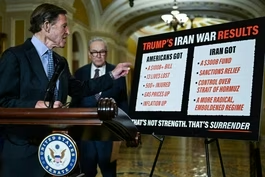
Senate votes to limit Trump’s war powers in Iran
Video has Closed Captions
In rare rebuke, Senate votes to limit Trump’s war powers in Iran (6m 27s)
U.S. and Iran at odds over nuclear inspections
Video has Closed Captions
U.S. and Iran at odds over nuclear inspections, Strait of Hormuz fees (4m 7s)
Providing Support for PBS.org
Learn Moreabout PBS online sponsorship New Episode
- News and Public Affairs

Today's top journalists discuss Washington's current political events and public affairs.

- News and Public Affairs

FRONTLINE is investigative journalism that questions, explains and changes our world.
 New Season

 New Episode
 New Episode
 New Episode
 New Episode
 New Episode

Support for PBS provided by:
Major corporate funding for the PBS News Hour is provided by BDO, BNSF, Consumer Cellular, American Cruise Lines, and Raymond James. Funding for the PBS NewsHour Weekend is provided by...