At Issue with Mark Welp
Artificial Intelligence: Jobs, Ethics and the Human Factor
Season 4 Episode 5 | 26m 30sVideo has Closed Captions
Bradley professors explore how AI is changing work, education and everyday decisions.
Mark Welp talks with Bradley University professors Rob Prescott and Yun Wang about artificial intelligence and its growing role in everyday life. They discuss workplace efficiency, jobs, classroom use, critical thinking, ethics, bias and why human judgment still matters as AI becomes more common.
Problems playing video? | Closed Captioning Feedback
Problems playing video? | Closed Captioning Feedback
At Issue with Mark Welp is a local public television program presented by WTVP
At Issue with Mark Welp
Artificial Intelligence: Jobs, Ethics and the Human Factor
Season 4 Episode 5 | 26m 30sVideo has Closed Captions
Mark Welp talks with Bradley University professors Rob Prescott and Yun Wang about artificial intelligence and its growing role in everyday life. They discuss workplace efficiency, jobs, classroom use, critical thinking, ethics, bias and why human judgment still matters as AI becomes more common.
Problems playing video? | Closed Captioning Feedback
Where to Watch At Issue with Mark Welp
At Issue with Mark Welp is available to stream on pbs.org and the PBS app.
Providing Support for PBS.org
Learn Moreabout PBS online sponsorship(bright music) (bright music continues) - AI.
We're not talking about "At Issue" but artificial intelligence.
Whether you're running a Fortune 500 company, just browsing social media, or using a search engine, chances are you've come across it or even used it, maybe without realizing it.
So, what is the big deal about AI?
Well, we're joined by two Bradley professors.
Dr.
Rob Prescott is the Interim Director, or Dean, I should say, for the College of Liberal Arts and Sciences.
And Dr.
Yun Wang is the Department Chair of Computer Science and Information Systems, which is a part of the College of Liberal Arts and Sciences.
Thank you both for coming on.
- [Professors] Thank you.
- So, AI.
Some people are confused by it, there's a lot to it.
Let's start with you, Dr.
Prescott.
Tell us, what is AI?
(Prescott chuckles) - Well, I'm the neophyte in this team, but AI is this powerful system.
It's really an information search tool.
AI is a tool that can do unthinkable searches for information because over the years our colleagues in computer science built the infrastructure, so that you can ask a question in really arcane subjects and within seconds you have a computerized answer to that question.
And so it has so many applications in so many different industries, and college students today need to be prepared to use artificial intelligence in their budding careers.
No matter what you're doing, it's touched somehow by AI.
And so we're at this incredibly exciting time when higher education is figuring out, how do we help our students be career ready to use AI in their personal lives, in all of their majors?
And at Bradley, my colleague and her department built one of the first AI majors in the country.
We're kind of at the tip of the spear now thanks to Dr.
Wang.
- Yeah, we're gonna talk about that in a few minutes.
That's a great explanation but I'm curious, and maybe some other people are curious too.
How is that different than just getting on Google or Yahoo and doing a search for whatever topic you're doing?
How is AI more than just a search engine?
- Very good question.
So, the AI is an intelligent system.
It is do more than just Google.
So we can think about AI as a, you know, big engine, which is including thousands or millions of Google search engines.
It's gonna get the basic information from them and process the data and provide people the useful information for whatever question they're asking about AI.
So it's a huge system.
- Now, I've heard, I don't know whether this is true or not, that with AI, it learns and it learns and it learns.
So it's not just doing a search but it's learning from other pages.
Is that right?
- Correct, yes.
So it is a artificial intelligence.
So it's not just to read the information, it's actually find out the patterns among the data.
It'll learn from the, like models will be able to find out the logic among these kind of models and also be able to provide the solution for a given problem.
For example, yeah, like, we have the medical records for a patient.
So like the typical disease, they have similar symptoms on certain, like, the results.
So by studying those kind of results, we will be able to map specific symptoms with the specific disease, and those information will be provided to doctor for reference.
And that doctor will be able to utilize the information to make decision on which solution is the best fit for that given patient.
This is one example about how to use AI.
- And that's definitely a positive example.
- Exactly, yeah.
- We'll talk about some other examples soon, but I guess I'm curious.
For the average person out there right now in 2026, if you're on social media, you've seen a lot of AI.
Now everyone's a graphic artist.
It looks good or bad depending on what your taste is.
But for the average person, what do you think they're using it for or maybe should they be using it for?
- Well, I would say now we are already in the age of AI.
So AI has become part of our everyday life.
We can use AI to, for example, plan a vacation, find the information or solve problems at the workplace.
So AI is everywhere.
It's just like the car.
Everybody drives a car for work, for life.
Now everybody using AI for life and for work.
So we're already in the age of AI, it is the reality.
- Okay.
Either one of you can grab this question.
Can you tell us how businesses and companies are using this to, I don't know, either make more money, be more profitable, or streamline the way they make products?
Can you give us some examples of maybe how that works?
- I heard one just today from our CEO, or CFO at Bradley.
He had worked at Caterpillar and was a CFO for a parts area of the company.
And he used to have to do inventories to find certain kinds of parts to make recommendations to people in his unit.
"You purchase this with this quality of metal."
And there were things he would have to do by hand that might take, he said, 18 months to get done.
And with AI, it's 18 minutes.
Think of all of the labor just in the searching and combing through all of that information to come up with what was necessary for that unit's leader to make a decision and to invest there.
Often it's about time saving.
But I have other alumni I talk to regularly who are just thrilled with the applications.
Sometimes it's in communications and just making it easier to shape a message.
Or they felt insecure in their own language use and so they start with ChatGPT, then make sure everything is true and do the final edit and proofreading.
And again, it makes them more efficient.
Maybe they sound even more professional than they would on their own.
So there are just so many applications.
There's hardly a workplace where it doesn't have some positive potential.
- So, you brought up some interesting things there that are beneficial, but some people say could potentially be negative.
Now, 18 months to 18 minutes, that sounds great, but is that gonna take away somebody's job potentially?
If you're streamlining that much, are you gonna need fewer people to get things done maybe at a company?
- Wow, this is a really good question and many people have already asked me about it.
Okay, so, AI is going to change jobs for sure, yeah.
Meanwhile, it's gonna too create new job opportunities.
Think about cyber and IT in the past.
So that is the previous technology innovation.
See how many?
Now, literally every company, every organization, they have an IT department.
They support the cyber, cyber security across their company, across the organization.
Similarly, now we are in the age of AI.
So like all the IT department and they either are going to have a component of AI or they are going to establish a new AI department.
The purpose is to help the business, the organization to best utilize AI responsibly and effectively.
So AI is just a tool.
It does not have responsibility.
It is eventually, it's the people who use it take the responsibility and accountability and make decision whether the output or the information provided by AI is true or not.
Sometimes they give people wrong information, yeah.
- That was my next question, Rob, because you mentioned checking after ChatGPT or whatever spits out the information.
How do you know what you're getting is legitimate or moral or anything else?
- There are two things I'd like to say about that.
You asked about new jobs because of AI.
Philosophy PhDs are getting, you know, taken into the IT AI world now because ethics are so incredibly important, and there are all sorts of ethical questions that are raised by AI.
We have a new course out of computer science called "AI for Everyone," and it's looking at innovation, the computer science that you need to use AI without being a programmer, and the ethics of it.
It's very, very important.
So, you know, ChatGPT students, as soon as it came out, students started using it to write papers for them.
- What?
- Imagine.
- What?
- Yes, I know it's hard to believe, Mark.
But we are all learning together, professors and students both, that AI doesn't do the critical thinking.
It is a type of intelligence, but it is still our responsibility in the university to teach students how to think.
It's not enough to have the data.
It's, what does it mean?
How do we interpret this?
What are the implications?
How do you know it's true?
How do you fact check it?
How do you ground it in truth?
Then you still have to decide, is that ethical or not?
You had talked about, you know, just because it's in AI doesn't mean it's true.
- Exactly.
- So I feel no threat from AI as an educator.
I think it's really exciting as students find new applications.
Well, we talk about it, you know?
You gave me this paper but you didn't know what six of the words mean.
(laughs) Let's talk about that.
- So then do you take your student's paper and put it into AI to see if it's been plagiarized or anything like that?
I guess you could.
- Actually, the AI checkers are notoriously bad.
- Really?
- But I don't need an AI checker to know.
The signs of an AI, a ChatGPT paper, is that it's written in inflated rhetoric, like an Oxford don, making sweeping generalizations and reference to lots of data, but it's not necessarily on the prompt of the paper, and the arguments aren't grounded in specific evidence typically.
If a paper is just informational, ChatGPT would probably do a very good job.
- Yes.
- But if it requires original thought and evidence-based argument, sometimes it's completely useless or counterproductive.
- So, I just used AI for the first time about a week ago to prepare for this interview and I used... I keep saying ChatGPT but there's plenty of others.
There's Gemini and whatever.
And a friend of mine said, "Put your resume in there and see what happens."
So I picked a random job description, put it in there, put my resume in there, and it tailored my resume to that job.
But then I looked at it and it was very... Overly intelligent maybe?
(professors laugh) You know?
Talk about artificial intelligence.
But it obviously was not written by me.
Maybe it was a better resume, but if someone who knows me looks at that, they're gonna say, "Hmm, this was written by a computer."
So I guess we have to be careful about how we use AI and what we're using it for because it may, in some instances, be a hindrance.
Maybe it makes me look better on paper but maybe not in person.
- Yeah, exactly.
So, the AI is much like a car.
It is a tool.
We can drive our car to a place sooner, faster, and similarly, we can use AI to help with many basic tasks.
But it is eventually it's the people who use it who has to make decision, who has to take responsibility and accountability about which solution is good or which solution is not good.
For example, go back to the example like for doctors.
They use AI.
They use AI for the preliminary information.
It is the doctor themself to make decision on which treatment is the best one for a given patient.
Only doctor with systematic training in the medical field that they will be able to make that decision.
The AI cannot make decision for people.
They are just a, like a very smart assistant, I would say.
- Okay.
What do you say to someone who maybe is not very computer literate and they hear these stories about AI and they're a little freaked out?
What advice would you give them, you know, in terms of using it, not using it, how to use it?
- Well, I think, you know, for the new technology, when it comes along, it is natural for people to either, you know, feel excited about it or feel kind of very concerned about it, because everything has pros and cons.
As a result, I think now we are already in the age of AI.
It is important for us to start using it, interact with it and test it to see if it's really that smart.
- Okay.
- Okay.
- With Bradley offering these new majors surrounding AI, can you give us an idea of what kind of jobs someone with a degree in this could get?
- Okay, very good question.
So, the AI major we launched at Bradley is gonna prepare our students or prepare the next generations of professions and the leaders for the AI age.
So pretty much the typical job title would be AI scientists, AI engineer, data scientists, and the AI analytics, and machine learning engineers.
So those are the typical titles.
Another thing I like to point out is AI is everywhere.
Every organization, every company, they are going to have an AI component or department.
As a result, the graduates, they will be able to find the jobs in those kind of, like, different kinds of disciplines.
It's just like we have IT departments in all organization similarly.
- Sure, and I'm guessing these jobs will probably pay pretty well.
- Yeah, of course, yeah, yeah.
- I know what IT people make and, you know, that's not bad at all.
- It's the next generation of IT and cyber.
- What about human connection, you know?
We already started texting each other more now than we talk on the phone.
With AI, you're not dealing with a human face-to-face.
Any worries about maybe people becoming more insulated as the technology grows?
- I'm not so sure that AI is gonna have any more effect on that than phones already have, the extent to which young people are spending so much time on screens and not talking to each other.
The advent of AirPods so that students walking across a quad are lost in their phones and aren't greeting each other, that it's cut down on the time that people are together.
- [Mark] So that horse is already out of the barn?
- I think so, but there are new things that as people can get more attached to their screens, you will get more deeply attached.
In terms of the humanity of it, my concern is people relying so much on ChatGPT that they don't rely on their hearts.
I saw a presentation on the ethics of AI and this professor posed the question, "Is it okay to use ChatGPT to write a eulogy?"
You know, if you think about it, you were asked to write a eulogy for someone because of your relationship, because the family and friends believe that you're important to that person and they wanna hear from you.
Does AI go to engines and look at a hundred million sources that talk about why you love that person or what people in that room need to hear so that they can grieve and appreciate that person and celebrate that life?
There are things AI can do and things AI should not do, not even try to do that come to being a human being, not just an information gatherer.
- You may need to edit whatever AI spits out.
Now, for someone who is interested in doing this and, you know, like we said, it's not going anywhere, how computer literate and how techie does one need to be for this?
Because I know with IT, you know, I talked to our IT guy and it's like he knows what he's doing but it's like a different language to me.
So what do we do with AI?
Do you have to be a very technical person, very computer savvy?
- Well, this is a really good question.
Well, so for everyone, it's important for them to know the basics of AI.
If I use AI, like use car as a analogy, so everybody needs to have a driver license to be able to drive a car.
Now in the age of AI, everybody should be able to utilize AI responsibly and effectively.
That means everybody needs to understand the AI literacy in terms of how to best use it with responsibility and ethics.
So that's why in our curriculum we have introduced a CS 111.
That course is AI For All, AI for everybody.
It's open to all majors.
It's open to every student at Bradley.
That course is to equip our students with the AI literacy that is necessary knowledge for being able to do well in the age of AI.
So that is also just like we need the people to, everybody needs to drive a car, but not everybody should build a car, okay?
So we have mechanical engineers and the different engineers they are working on building a car.
So the AI major is offered to prepare AI builders.
Okay, the AI builders, they will need to build it, they will need to evaluate it, they will need to refine it, they will need to safeguard it and shape it.
So that's the jobs for AI major students.
But for all students in an AI era, it is imperative for them to have the AI literacy to be able to do well and best utilize AI technology.
- And you can be an old person like me and use AI and run into the issue, do you have to be tech savvy?
I would say no.
As a matter of fact, you're probably using it now and you don't know because there are people who are tech savvy who have made it so easy.
- Sure.
Does AI have bias?
- Yes.
Yes.
- Oh yeah.
- That's why we- - In what way?
- AI sometimes will try to please you.
Yeah, they will try to make you happy so that you will keep using it.
That's why we will lead people's critical thinking, problem-solving capability to tell, is this the true answer?
It is the right answer or some, you know, kind of the opposite.
- Now, these companies that develop AI, and there are a lot of them, are they ethically sound, do you think?
Are they thinking about these things as they do it or are they just putting everything out there for people to use?
- You do know that's a loaded question.
(all laugh) Is it a human organization, is it profit driven?
I said that high-tech AI companies are turning to graduates of PhD programs in philosophy looking for high-end ethics.
They're running into new questions and whole new fields of ethical uncertainty that need to be examined.
So I applaud actually the AI innovators for being aware of that.
But I also know that it is part of the human condition that people look for self-advantage and self-interest and often consumer, the good of the consumer is not what comes first.
So I think you were asking about the companies... - Right.
Yeah.
- And that's why there have to be consumer protection laws and regulators.
- Understood.
- So yeah.
- And I gotta ask one more question, it may sound silly but I've heard people discuss this.
That AI can get so smart that it's gonna, you know, be a Terminator type situation where the computers take over the world.
I mean, is there any worry about that at all?
- No, I don't have the worry because they are just tools.
They're built by people.
They cannot master people.
I don't have the... I heard of that for many, many years when cyber was invented, IT was invented.
It's like people always have those kind of concerns, but no, no, I don't think so, because we are the creator.
- As always, we just have to worry about the creators.
Right?
- Yes.
- Well, this is very fascinating.
How could people find out more information about these new majors that Bradley's offering?
- Check our website.
- Okay.
- Yeah.
- Bradley.edu, I believe.
- And then just pursue, you can find the Computer Science, Computer Information Systems Department and the new major is there.
- Or use AI to find us, yeah.
- There you go, there you go.
- Good answer.
- Yeah.
- And just to be clear, you don't think this is a fad or a bubble that's gonna burst eventually?
AI is here to stay?
- No.
- Quite the opposite.
- Quite the opposite, it's gonna create a lot of new jobs, just like how many new jobs have been created when IT and the cyber becomes the trend.
Now we are just in a new era of AI.
It is because of the technology like advancement, yeah.
- I go back to the slide rule days.
I remember when the first handheld calculator came out, the Texas Instruments SR-10, and I had to buy the SR-11 because it had a pi key, 3.1415927.
- Fancy.
- And then within two years, I had this handheld calculator that did printouts and ran logarithms and... I have lived through multiple technological revolutions in communications and computing and what we're seeing now just boggles the imagination, what we can do now, how AI just affects every one of my computer searches.
It's phenomenal, and I think it's very exciting.
- [Wang] Yes, agree.
- Interesting stuff, that's for sure.
Dr.
Rob Prescott and Dr.
Yun Wang, they are with Bradley University, and we appreciate you giving us more insight on what AI is all about.
And I'm sure we'll have you on again as AI progresses and we see more issues, both pro and con, pop up.
- It's fun to watch.
- Thanks for coming on.
- Thank you for having us.
- No problem.
And thank you for joining us.
You can watch this segment again.
Just go to wtvp.org, click on "At Issue" or just go to a search engine, artificial intelligence, ask them what the best local show is in Peoria.
"At Issue" pops up, take it from there.
Thanks for joining us, have a good night.
(bright music) (bright music continues) (bright music continues) (bright music fades out)
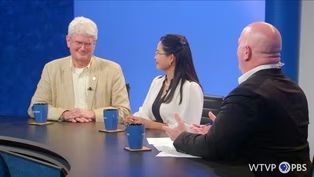
AI in the Classroom: Who Does the Thinking?
Video has Closed Captions
Clip: S4 Ep5 | 2m 47s | AI can write a paper, but Bradley professors say it cannot replace critical thinking. (2m 47s)
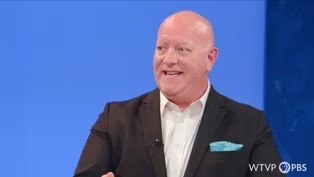
From 18 Months to 18 Minutes: AI at Work
Video has Closed Captions
Clip: S4 Ep5 | 3m 31s | One workplace task reportedly fell from 18 months to 18 minutes with help from AI. (3m 31s)

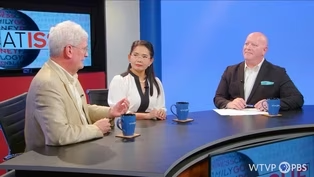
Video has Closed Captions
Clip: S4 Ep5 | 2m 3s | Should AI write a eulogy? One professor says some human work should stay human. (2m 3s)
Providing Support for PBS.org
Learn Moreabout PBS online sponsorship New Episode
- News and Public Affairs

Top journalists deliver compelling original analysis of the hour's headlines.
 New Episode
- News and Public Affairs

FRONTLINE is investigative journalism that questions, explains and changes our world.
 New Episode
 New Episode
 New Episode
 New Episode
 New Episode
 New Episode
 New Episode
 New Episode
Support for PBS provided by:
At Issue with Mark Welp is a local public television program presented by WTVP