WTVP EcoWatch
Balancing the Costs and Benefits of Data Centers
Clip: Season 3 Episode 3 | 8m 22sVideo has Closed Captions
Experts examine how data centers affect energy, water, jobs and Illinois communities.
Experts examine the rapid growth of data centers and their effects on Illinois energy and water resources. They consider the demands created by artificial intelligence, potential economic benefits and the need for transparency, oversight and responsible infrastructure planning to ensure communities understand the costs and opportunities.
Problems playing video? | Closed Captioning Feedback
Problems playing video? | Closed Captioning Feedback
WTVP EcoWatch is a local public television program presented by WTVP
Support for Ecowatch is provided by the Backlund Charitable Trust
WTVP EcoWatch
Balancing the Costs and Benefits of Data Centers
Clip: Season 3 Episode 3 | 8m 22sVideo has Closed Captions
Experts examine the rapid growth of data centers and their effects on Illinois energy and water resources. They consider the demands created by artificial intelligence, potential economic benefits and the need for transparency, oversight and responsible infrastructure planning to ensure communities understand the costs and opportunities.
Problems playing video? | Closed Captioning Feedback
Where to Watch WTVP EcoWatch
WTVP EcoWatch is available to stream on pbs.org and the PBS app.
Providing Support for PBS.org
Learn Moreabout PBS online sponsorshipAs we rely more and more on cloud computing, corporate IT operations, and artificial intelligence, we need data centers to house the storage and processing systems that support all those services that make our lives easier.
However, with that convenience comes a lot of issues.
Now we're going to focus on the environmental concerns and hear from both sides of the issue.
We start with Andrew Rehn, the climate policy director with the Champaign-based Prairie Rivers Network.
- As we've been working on the energy sector, data centers have sort of emerged as the big new threat, both on energy and water, because of their genuinely unprecedented energy demand.
And with that comes a massive amount of water demand as well.
And so these could have pretty major impacts on our resources.
And to be clear, the big data centers, the ones we're talking about aren't the ones hosting the internet.
They're not the ones providing the services that we use every day.
It's really the workhorses for training AI data sets are what the biggest of the big AI data centers are and the ones that are really driving this concern.
- What are some of the concerns about all of this water usage?
- Yeah, so the water use is one of those areas where nationally there has not been a ton of transparency.
And so we don't really know as much as we'd like to know.
We do know that a data center using evaporative cooling is gonna use a ton of water.
And some of these larger data centers, if they were using evaporative cooling, which means that the water comes through the plant, it absorbs the heat, and then a bunch of it evaporates away because it's absorbed that heat, I mean, it can use, half of the water it pulls through can go away.
And that can be... That means that the data center looks like a small town or larger depending on how big the data center is.
And I think for these hyperscalers, like the one in Joliet, which is a 1,800-megawatt data center, which is an insane amount of energy usage, that energy creates heat, heat needs to be cooled, you use water as part of your cooling process, but if you were using evaporative cooling, that would consume an insane amount of water.
So they switched to technologies like closed-loop cooling, which do better on water use, but then they actually increase the energy use.
And we don't really know how often they're gonna be flushing that system and replacing it.
And when they flush the system, we don't know where that fluid that's in the closed-loop system is going.
And I say fluid because if it's a closed-loop system, it's probably gonna be things like glycerol, or, like, it's not just water in there.
It's stuff that takes heat away from their chips more effectively.
And then on the other end... So you've got your chips generating heat.
On the other end, you've gotta get rid of that heat.
It's still gotta go somewhere.
And so if you've got a chiller tower on the other end of that loop, that closed loop that's using evaporative cooling, you're still using water at your chiller towers, unless it's an air-chilled tower.
And so there's just a lot of questions.
And this is why we're proposing at the state level, and we'll be working on this in Champaign County, we're just proposing that they tell us what they're doing and set out a baseline of responsibility for water use so that we know, okay, you are using technology that responsibly uses our water.
We have a sense of how much that's gonna be.
We have an understanding from the state water survey of how that might impact our water resources.
- So with all the concerns about water and electricity, is there anything positive that can come out of building data centers?
- Illinois has set climate targets to attempt to decarbonize our electric sector, and data centers pose a real challenge to that, but they can also be an opportunity.
If data centers are bringing renewable energy with them, if they build enough renewable energy to meet their demand, not only do they not increase our electricity costs, because they're meeting their own demand, they also build out renewables on our grid.
And that has economic impacts.
That builds up a sector.
that means we can have more trained workers, more trained companies able to build that reduces the cost of build for everyone.
So we have a path here where data centers can help us meet climate targets if we have them bring their own new clean energy, which is the key policy in the POWER Act.
- Data center and AI infrastructure expert Kirk Offel is the CEO of OVERWATCH Mission Critical and host of the "Data Center Revolution Podcast."
He's worked in the data center industry for more than 20 years.
He talks about the benefits of data centers, but also says governments and communities should insist on transparency from developers and know what they're getting into.
- So the concerns that people have, the "not in my backyard" argument, the NIMBY argument, those are valid, but it's not to stop.
And that's not what America does.
This is what's called transformational infrastructure.
The very first transformational infrastructure program was the railways, and there was a lot of resistance and pushback on the impact on the environment and what we were gonna do for energy.
The second was gas, I mean, was the way that we electrified the US grid.
Think about the pushback that people would've had when we were rolling electricity across the grid, connecting what is now the NFL cities of the United States.
And that is now the backbone of the US internet.
So if you think about it, there are cities in Illinois today that we've never heard of, because they were swept off the face of the state because they opposed the interstate highways, which came as a byproduct of the automobile revolution.
We're living in a cloud revolution and an AI revolution.
And this infrastructure, we don't want it to stop.
We want it to be done with governance and oversight and ethics.
But we don't want these to stop, because Illinois competes against 49 other states, and you don't want those programs to go to either another state or another country, where not only will that technology go there, but the jobs will follow.
The beauty about data centers in your market is you, if you're living in any town, and they wanna put a data center in your market, the best thing you could do is demand that all the costs for the infrastructure gets pushed onto the developer.
I'm telling you the developer's building a utility, and it's like every other utility; we will pay for it as consumers.
There's a reason why your Netflix went from 6.99 a month to 11.99 a month to 14.99 a month to 19.99 a month.
It's because they're investing in that infrastructure, and we are paying for it as a service.
So if we want data centers to bring jobs and a tax basis of revenue to our communities, we need to force certain things upon them, and that should be one.
Build behind the meter first, but build it in a way that you could do a closed transition into my utility, which means not only are you adding more reliability to the utility, but eventually, you could put more power capacity on the utility and bring the price of energy to the left.
You can move the needle to the left.
And on water, it's very simple.
Force the data centers that are coming into your markets to go to closed loop.
Closed loop means zero water design.
It means we use a fluid like a glycol fluid or a mineral oil in our system, because it absorbs the heat and rejects it better than water can.
The only water that we would ever need at this point is called gray water.
That's the water that hits your drains and you don't wanna touch ever again.
Without data centers, you have no cloud.
We are the sky for the cloud, and now we're also the home for AI.
So this digital infrastructure has always been out there.
It's prevalent, and it's been around since we've been using technology.
It's just now arriving onto the mainstream because the volume and velocity in which we build at now requires us to engage with these local communities specifically around the way we embrace other utilities, most specifically energy.
And the second would be the environmental impact or the way that we use water.
So because the demand of data centers and the size for them continues to grow, we are now in a collision course with a whole nother utility, which is energy.
And now people are paying a lot more attention to what it is that we're doing.
As a byproduct of that, we didn't do a very good job.
In fact, I testified in Capitol Hill in January, where I even spoke to the committee and said we've failed as an industry to communicate to these communities what it is that we're building.
'Cause today they only see it as consumers.
They see us as consumers of the utilities, and they need to see us not only as a utility ourselves, but we're a partner to the other utilities.
- The Illinois Environmental Protection Agency
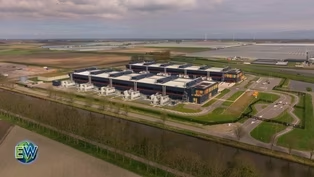
Data Centers and Solar Grazing | EcoWatch Preview
Preview: S3 Ep3 | 55s | Explore data center concerns, Illinois environmental policy and solar grazing. (55s)

Expanding Emiquon National Wildlife Refuge
Video has Closed Captions
Clip: S3 Ep3 | 1m 3s | A federal investment will expand Emiquon National Wildlife Refuge in Fulton County. (1m 3s)
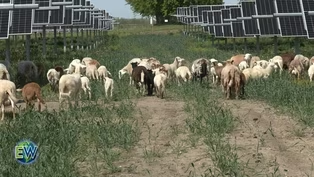
Sheep at Work on a Central Illinois Solar Farm
Video has Closed Captions
Clip: S3 Ep3 | 5m 51s | Sheep help manage a Central Illinois solar farm while keeping the land productive. (5m 51s)
Providing Support for PBS.org
Learn Moreabout PBS online sponsorship New Episode
- Science and Nature

Explore scientific discoveries on television's most acclaimed science documentary series.
 New Episode
- Science and Nature

Capturing the splendor of the natural world, from the African plains to the Antarctic ice.
 New Episode
 New Episode








Support for PBS provided by:
WTVP EcoWatch is a local public television program presented by WTVP
Support for Ecowatch is provided by the Backlund Charitable Trust