Consider This with Christine Zak Edmonds
Dr. James McGee on the Changing Face of Cancer Care
Season 7 Episode 7 | 26m 34sVideo has Closed Captions
Dr. James McGee discusses cancer care, proton therapy and the role of AI at OSF.
Christine Zak-Edmonds talks with Dr. James McGee about his path into radiation oncology and the development of the OSF Cancer Institute. McGee explains how proton therapy works, reflects on the human impact of a cancer diagnosis and describes how his team uses AI to gather information while leaving treatment decisions to medical professionals.
Problems playing video? | Closed Captioning Feedback
Problems playing video? | Closed Captioning Feedback
Consider This with Christine Zak Edmonds is a local public television program presented by WTVP
Consider This with Christine Zak Edmonds
Dr. James McGee on the Changing Face of Cancer Care
Season 7 Episode 7 | 26m 34sVideo has Closed Captions
Christine Zak-Edmonds talks with Dr. James McGee about his path into radiation oncology and the development of the OSF Cancer Institute. McGee explains how proton therapy works, reflects on the human impact of a cancer diagnosis and describes how his team uses AI to gather information while leaving treatment decisions to medical professionals.
Problems playing video? | Closed Captioning Feedback
Where to Watch Consider This with Christine Zak Edmonds
Consider This with Christine Zak Edmonds is available to stream on pbs.org and the PBS app.
Providing Support for PBS.org
Learn Moreabout PBS online sponsorship(bright music) (bright music continues) (bright cheerful music) - Will you consider this?
There are people who are problem solvers and this gentleman with me right now is a problem solver.
He can detect the problem, and then try to figure out how to get to the bottom of it.
This is Dr.
James McGee and he is Radiologist in town.
And first of all, let's just hear a little bit about you.
You just told me you're from Illiopolis.
- Well, farm outside Illiopolis, of course, in between Springfield and Decatur, the geographic center of the state.
Grew up on a small farm that my grandfather homesteaded in 1884, and my dad had maintained and so forth and so on.
- What did you farm?
Corn and soybeans?
- Corn, beans, but at that time, Black Angus cattle, 'cause my other grandfather had been a Founder of the Illinois Black Angus Association.
And corn, wheat and beans, and oats, and everything else, hay, baled a lot of hay.
And so all of that was just multi-cropping, and natural, and organic and all the things that should be still today.
- Right, yeah, should be.
You're right about that.
And then what inspired you to be a doctor?
You're an only child, and then you just grew up, said, "I don't want the farm anymore, I wanna-" - No, I didn't say that, but my dad said that.
- Oh, okay (laughs).
- He said that I would never be any good at it, and he was right.
And the observation was clear to me that the doctor in town always had work to do.
And so other people would come and go in terms of their jobs and things, but he always had a job.
So that was the attraction was just simply to have consistent work.
- And then how did you veer into radiology?
You have to go through a lot of different- - Well, I went into actually oncology.
And after medical school, I spent an externship at Zulu hospital in Natal Province in South Africa.
And I wrote, at that time, there were only seven comprehensive cancer centers in the United States, but I had seen some cases of cancer there that were very unusual.
And so I thought that was kind of an interesting disease.
So I wrote to the person who was head of the University of Chicago Comprehensive Cancer Center, again, one of seven in the country at that time.
And I said, "Well, I can't really come for an interview, but I'd sure like to go into oncology.
And I don't wanna really decide which branch.
Can't you create something for a couple years so I can just kind of see all that?"
- Move into it, slither into it, right, okay.
- And somehow or another, he managed to do that.
He wouldn't be able to do that today, I'm sure.
But back in that day, well, he was able to do that.
And I fell in love with radiation oncology.
I mean, I loved oncology.
To me, it was the most fascinating thing because at that point people were getting cancers and you had no idea- - What to do, how to treat it.
- What to do, or what it was, or why did they get it.
So little was really known.
We're rolling back to 1975.
So in that timeframe then I was working in one of the rotations was radiation oncology and the people teaching that physics associated with that had been Enrico Fermi's grad students when they did the first controlled nuclear reaction just a block from the hospital.
And so that was fascinating.
So when you have something as fascinating as cancer and as fascinating as all this stuff with physics and that science, and then you can add the biology in as needed.
I was sold.
I thought that was stuff you could really get interested in.
- That wet your appetite.
All right, so then you did get to do a little bit of practice, you said in Decatur.
- Well, so I always wanted to actually, I mean, I was all over the world, Paris, and all this other stuff with fellowship and one thing and another, but I always wanted to practice in central Illinois.
And that was the population that I was comfortable with.
That was the population that I liked to interact with.
And so at that time, Decatur was forming a new cancer center.
And so I went there and was happily in practice there with a wonderful group of older doctors for about eight years who really took care of me, taught me stuff in all the different specialties and just really brought me along.
- Well, and they had taken baby steps along the way, so then you could take bigger leaps after what they taught you.
- Yeah, you always work off of what other people have given you.
- Exactly, so then from Decatur, you went to St.
Joseph's Hospital in Bloomington or?
- So it was clear that some of my ambitions needed a bigger stage, shall we say.
So I actually approached St.
Francis Hospital in Peoria because they were the largest hospital in the nation that didn't have a radiation oncology cancer program.
- [Christine] And that was what year?
- I approached them in 1985.
- Okay.
- And so we worked, and in 1987, gave a presentation to the board of OSF, which led to the development of a ministry-wide cancer program, which started with nothing but a cobalt vault in the basement of St.
Joe's Hospital in Bloomington and kind of went from there.
- Gosh, yeah, well, and then today now, and I called it a dream, but you corrected me, the OSF Cancer Institute, which is this magnificent building over on the OSF campus, and it's a destination.
You can do everything there.
- We're getting to that point.
I mean, that's the goal obviously is to have everything under one roof because of the synergies exist.
And so we're still building capabilities in various areas and we'll be doing that for a few years yet.
We're developing a very active theranostics program, which is using radioactive materials that are infused in order to both diagnose, stage, and ultimately treat cancers with that.
And that's a developing area where we're going to be a leader.
- [Christine] So how does that work?
- Well, you can find various materials, molecules that will find, for example, a prostate cancer cell.
It'll ignore a normal prostate cell.
It'll ignore most everything else, but a malignant prostate cell, it can identify from looking at the surface.
So that binding agent or ligand can be given a radioactive material tracer with it that when it finds a cancer, it sends out a signal to create a PET scan.
Or it can have a different radioactive material attached to it so that it goes there and doesn't leave, but stays there and kills the cancer.
So it's called theranostics because it's something that can be diagnostic, but also therapeutic.
- Right, wow.
- So that's the- - [Christine] That's fascinating.
- That's the- - So, that's the newest thing?
- That's one of the many new things, yes.
- Well, I remember hearing you make a presentation about the proton beam.
Now, at one time it was, and maybe it still is, it is the latest version state-of-the-art proton beam.
Is it still or have they installed another one somewhere?
- It is very much state-of-the-art, absolutely.
It's made by the premier company in the field, Varian/Siemens, and that unit really is superb.
Because of the complexity of the machine and the things required to keep it in top shape and all the materials, the company decided to have 10 in the Americas, 10 in Europe, 10 in Asia.
And so we were very fortunate to get one of those allocated to us.
- And as I recall, you explained it that the proton beam, radiation can destroy on the way in to where it needs to go fix things, but the proton beam doesn't destroy anything that's in front of the tumor or whatever it is.
Is that correct?
It just knows exactly how to get to the center of whatever.
- Our proton unit treats spot by spot.
So if you can think of a small P area being treated and then it moves to the next small P area.
And you might treat 3,000 spots in the course of a treatment, which can take virtually no time at all.
- [Christine] Really?
- Yeah, because we're in a different dimension of time and space.
But protons, unlike x-rays that come in and start giving up all their energy right away, they come in, give a little energy up on the way in, and then when they slow down, they stop and that's when they give up their energy in the so-called bragged peak effect that's taught in school.
So it's a matter when you can control all those little spots, you can really get that radiation to be shaped to the shape of what you're trying to treat.
And because they stop, they don't just keep going and treat everything else behind them.
We're also looking at using the proton unit in flash mode.
And in flash mode, it would treat an extremely high rate of speed.
So instead of a treatment taking five minutes, it might take three milliseconds.
- [Christine] Holy cow.
- And what happens there is that the normal tissues don't react to the radiation like they usually would.
- Only the cancers do?
- Just the cancers do.
Now, this is all in phase one trials.
We did participate, thanks to Cincinnati Children's Hospital, we were able to participate in the second trial in humans.
We didn't actually treat those patients.
We've been treating phantoms and doing a lot of basic science on these things, but we did participate in the second trial in humans.
There have been 20 patients treated, 10 in the first study, 10 in the one we participated in, and that has led to continued development of clinical trials.
So we're looking at things like inoperable and previously untreatable brain tumors in children where radiation might be able to be used more effectively because it could be given without affecting the normal brain.
- It'd be more focused.
- Right.
- All right.
- Well, you're able to spare tissue two ways, spatially, which means focusing and getting it just on the spot, but you're also able to spare tissue in this temporal manner by giving it so fast that the normal tissues that the tumor's infiltrating don't react, only the tumor cells do.
- Just really fascinating.
All right, so we have- - You see why I went into this.
- I can see because you just turn over another rock every day.
So the Spirit of Hope mass is coming up October 24th.
This is something, and I won't say it's a dream of yours, I will say that it's your job because that's how you like to identify it, but it's for cancer affects not only the patient, but everyone around them.
And today, there's cancer everywhere.
- Right, right, I had asked Bishop Jenky about doing this and he did one mass for us.
And then when Bishop Lou arrived, I approached him after Christmas Day Mass.
- [Christine] Oh, good idea.
- His first year as a bishop.
And I said, "Hey, how would you like to pick this up, doing a mass for reducing the burden of cancer in our society?"
And that really struck a chord with him.
He's a wonderful fellow.
If you don't know him personally, he's a wonderful fellow.
We're so lucky to have him in town.
And so we'll be having our fifth Spirit of Hope Mass.
It's designed because it really is about the fact that we have so much as a community to think about, to gather about how this really affects all of us in so many ways.
And OSF is obviously a Catholic organization, very based in faith.
And I think that it's only appropriate that we have this, given that whole tradition.
We can't just do a great job scientifically or whatever.
We have to really do a job in terms of the whole person, the whole family, the whole thing.
- The community.
- And we're trying to build all that in the Cancer Institute, and the mass just builds that support and tries to engage other people.
I know some people are maybe uncomfortable to come to a Catholic mass, but I'm uncomfortable to go on the golf course 'cause I play so bad.
(Christine laughs) - I mean, it evens the score.
- So get over it.
I mean, there's nothing about this that's ultra hyper.
- Cancer doesn't only affect only Catholics.
- Cancer doesn't care.
- So this is for families?
This is for families, friends, caregivers.
It's for the community.
- It's for the community.
I remember at the very first one we had, I was very touched because a woman who was really down and out, who wasn't anybody you'd ever think of in the sense of having connections, this, that, and the other.
And she showed up at the mass and she sat to the front, and she took it in and I think it was wonderful for her.
So yes, it's for families, but it's also for the person who feels alone and isolated.
It really is.
- And it's called the Spirit of Hope.
So when a cancer diagnosis is given, I mean, it's difficult for a doctor to give that diagnosis, and it's just as difficult for the patient to hear.
- And sometimes there isn't the type of hope that this is all going to be fine.
And that's where Bishop Lou is so wonderful because he has lost a mother and sister to cancer, and those deaths that occurred fairly close to the time that I asked him about doing this.
So he identifies with this very much, I would say.
And he gives wonderful sermons at the mass that really tie what we go through as people suffering from cancer or being caregivers to people with cancer.
He does a wonderful job of tying that to the religious traditions of Christianity and Christ suffering.
And he does a wonderful job of making all of this into a context that I think is helpful- - [Christine] That can make sense.
- For people as they try to go forward.
- And it gives them hope.
So I know that a diagnosis can, I mean, pull the rug out from under you and you lose hope.
It's like, so what have I got to live for?
- Sometimes in the hospital, I'll be going off somewhere and people say, where are you going?
And I'll somewhat facetiously, but not completely facetiously say, "I'm off to bring hope where there is none."
- I like that, I like that.
And then everything that you're doing at the Cancer Institute, and how is AI impacting treatments today at the Cancer Institute?
- Well, it saves us some time.
If I wanna know some detail from the literature, I can use a dedicated medical AI to get that data brought out pretty quickly.
So that can save me quite a bit of time.
But the other thing we're looking at is we're building a medical oncology practice, and so we're looking at being able to organize that and help know which types of cancers we're dealing with or where those are at and then bring those to the right doctors.
We're also looking at using that to analyze why certain people get certain cancers.
Is it related to what's in the water?
- Is it genetics?
- Is it related to the chemicals?
So there are research questions like that that we can ask.
But right now, it's mainly some time saving and convenience uses that are being employed.
- Did you expect that going into it?
Or were you a little bit hesitant about AI determinations?
- We don't use it for the intelligence part.
- [Christine] Okay (laughs), that's fair.
- We don't use it for medical decision making.
We use it for information gathering, presentation.
We use it for formatting some documents in the chart and things like that to avoid a lot of busy work.
But we're not using it to decide whether to treat patient with regimen A or B on the face of giving that choice to the system.
We're taking information, evaluating that information and then making the decision as a professional.
- So you're not an oncologist, you're a Radiologist.
- I'm an Oncologist.
- Oh, you are also.
- [James] I'm a Radiation Oncologist.
- Okay, nevermind, I apologize.
- There you go.
That's all right.
- Mea Culpa.
But you work also with the patient's primary doctor, their oncologist as well in order to use some of the services at the institute, correct?
- Cancer care is a team sport, so to speak.
And so our emphasis has been since 1988, '89 when we opened, the emphasis has always been on multidisciplinary thinking, multidisciplinary tumor boards, multidisciplinary clinics for some diseases where patients can see a medical oncologist, radiation oncologist, surgeon, and have their stuff reviewed by a radiologist and pathologist all in one setting.
- Right, and at the Cancer Institute, you have that kind of conference room with them.
- And that's why we built the Cancer Institute as we did, to be able to house those facilities.
And those types of options are growing and extending.
We're starting to be able to open up the tumor boards to other OSF facilities.
So if you're a patient in our facility in Galesburg or Bloomington or Rockford, and it's a case that would benefit from some of the specialists here that aren't in those communities, then that case can be presented at the tumor board and the doctor there can participate or not.
But at least we're starting to use those resources to push all of this out to the rest of the ministry.
- Well, and it's important because you have the medical community behind you and then you have the patient's family also, and they all have a lot of questions.
- Yeah, and it's a very different situation.
The University of Illinois in Chicago, they have one square mile.
That's really what they have to effectively get into and manage.
I mean, they have other stuff, but that's their main focus.
Our main focus is like 43 counties.
- [Christine] Correct.
- So it is a different proposition.
And this cancer program doesn't really fit neatly into anything like the National Cancer Institute has described for cancer programs, so we're developing our own category and we'll do a great job of that, I promise you that.
The community deserves that.
The support the community's given deserves nothing less.
And the support that the entire OSF healthcare system has given deserves all that.
So this is, everything kind of starts in a sense in the Cancer Institute, but then through the primary care network and through the other 16 hospitals and the 150 clinics, all of this, that's our work is to take this out to all of those other branches.
And that's gonna take a few more years to really play all this out, to develop malignant hematology services and more specialties and so forth at the Cancer Institute, but also then to find ways to take the basics of this out and to use the wonderful digital assets we have through on-call and so forth to help manage all that.
That's another way we use AI is work with digital resources and on-call and such to really find ways to bring these resources out to the other communities at some distance from us.
- Right, it's just overwhelming.
All right, we have to get back to the Spirit of Hope Mass.
Now, it'll be at the cathedral?
- This year it's at Sacred Heart, which is of course right by the Civic Center.
- Yes, okay, and we always have the sisters praying.
- We got bumped because of the Beatification that had to adjust the bishop's schedule.
- Because of a saint just getting into our lives, which is really fortunate.
- The miracle baby's grandmother was our front desk person for many years.
- [Christine] Really?
- Yeah.
- I didn't know that.
- Yeah, so we're all- - Very excited about this.
- [James] Very tuned into this, yeah.
- Fulton J. Sheen, that's awesome.
But at the mass, you're bringing in a special guest.
You said you don't sing, so you have somebody filling in for you.
- Well, John McDermott, who's helped us with a Christmas event, special program for 20 years has also been coming and singing hymns starting about 3:30.
And then that adds a nice element to the setting.
- It does, and again, just music is healing and you have found that also in some of your treatments, correct?
- Oh yeah, absolutely, yeah.
And we have different ways that we're trying to bring more music into the institute as far as patient support and so forth.
So music and art are healing.
- The same.
So what's the most memorable patients kind of situation that you've had in your years?
Or maybe let's just narrow it down to the institute itself, so that's been two and a half years.
- Well, if you ask me what the most memorable patient I've ever had is, it could be my own daughter, but I'll go to one that was really where I was the doctor.
And that was I went up to see a patient who had head and neck cancer, and he was not doing well, had lost a lot of weight, couldn't swallow, had really need for like a feeding tube.
And I remember going up and he was in his room by himself trying to eat something.
And for whatever reason, that just struck me.
Now, we have proton therapy that can reduce the toxicities immensely from radiation to the head and neck area and improve cure rates by 10%, reduce the incidence of feeding tubes dramatically from 80, 90% to less than 10%.
And really allow those people to be cured, not die of toxicities of the combined chemotherapy, radiation, and surgery, and the cancer.
So I think back to that patient a lot.
I don't remember his name.
I don't remember any of the particulars.
I just remember his wife being with him there, looking so helpless.
- And you were able to give him some hope.
A little bit for a while.
Okay, all right, so the future is looking better for people who need treatment and you do the whole thing.
You cover emotional, physical, medical.
It's the whole big onion.
I guess, I don't know what else would I call it.
- And all ages.
We obviously deal with a lot of children with cancers.
We deal with a lot of very senior people with cancers.
And so it takes many forms, so many things are needed.
Yeah, and it's gotten better, but it's not nearly good enough.
- But you're working on that and you've been working on it since 1975, so it's all good.
Thank you very much, Dr.
James McGee, for being here, for being my guest, for doing such wonderful things for the community and looking forward to the mass at Sacred Heart on October 24th at what time?
- Hymns at 3:30, Mass at 4:00.
Bishop Blue will be there.
He'll give the homily.
It'll be worth coming.
- He'll take a little time away from Beatified.
- Well, he'll be over and he'll have a chance to recover for a little bit.
- Good, all right.
- He's very busy with that.
- He is, yes.
Well, thank you very much for being here.
- Thank you.
- Thank you for joining us.
I hope you learned a little bit about what all is going on when it comes to hope in Peoria and Central Illinois.
Until next time, be well.
(bright cheerful music) (bright cheerful music continues) (bright cheerful music continues) (bright cheerful music continues) (bright cheerful music continues) (bright music) (no audio)
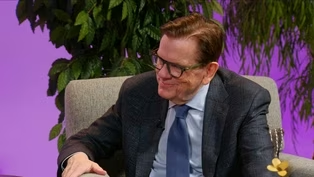
How AI Helps Doctors Without Making the Decisions
Video has Closed Captions
Clip: S7 Ep7 | 1m 45s | Dr. McGee explains where AI saves time in cancer care and where doctors remain in charge. (1m 45s)
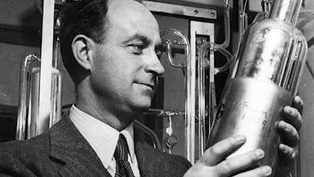
How Dr. McGee Found His Calling in Cancer Care
Video has Closed Captions
Clip: S7 Ep7 | 1m 55s | Dr. McGee recalls the experiences that drew him to radiation oncology. (1m 55s)
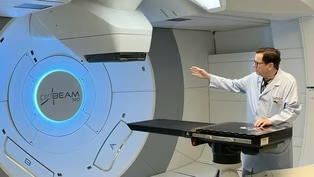
How Proton Therapy Targets Cancer
Video has Closed Captions
Clip: S7 Ep7 | 1m 45s | Dr. McGee explains how proton therapy delivers radiation to a tumor. (1m 45s)
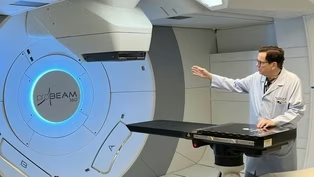
Providing Support for PBS.org
Learn Moreabout PBS online sponsorship New Episode
- News and Public Affairs

Top journalists deliver compelling original analysis of the hour's headlines.

- News and Public Affairs

Today's top journalists discuss Washington's current political events and public affairs.
 New Episode
 New Episode

 New Episode


 New Episode


Support for PBS provided by:
Consider This with Christine Zak Edmonds is a local public television program presented by WTVP