You Gotta See This!
Dream Home | Libraries | Curling | PT
Season 5 Episode 10 | 27m 44sVideo has Closed Captions
Special spaces that open our eyes to new sights, new skills, new movement and new worlds!
Take a tour of some special spaces across central Illinois. In Bloomington, a man’s dream home uses unconventional materials. The Peoria Public Library offers programs, classes and a place where people’s needs are truly met. The Waltham Curling Club invites you to try a new sport. And the Bradley Physical Therapy & Health Science Department combines compassionate care with real-world training.
Problems playing video? | Closed Captioning Feedback
Problems playing video? | Closed Captioning Feedback
You Gotta See This! is a local public television program presented by WTVP
You Gotta See This!
Dream Home | Libraries | Curling | PT
Season 5 Episode 10 | 27m 44sVideo has Closed Captions
Take a tour of some special spaces across central Illinois. In Bloomington, a man’s dream home uses unconventional materials. The Peoria Public Library offers programs, classes and a place where people’s needs are truly met. The Waltham Curling Club invites you to try a new sport. And the Bradley Physical Therapy & Health Science Department combines compassionate care with real-world training.
Problems playing video? | Closed Captioning Feedback
How to Watch You Gotta See This!
You Gotta See This! is available to stream on pbs.org and the free PBS App, available on iPhone, Apple TV, Android TV, Android smartphones, Amazon Fire TV, Amazon Fire Tablet, Roku, Samsung Smart TV, LG TV, and Vizio.
Providing Support for PBS.org
Learn Moreabout PBS online sponsorship(exciting music) (exciting music continues) (exciting music continues) (gentle music) (people chattering) - Our clinic is really kind of two purposes.
One, it's for hands-on learning for our students, but also it's ways that we can serve the community.
It really does benefit both the students and the community.
(gentle music continues) (people chattering) - My childhood and adulthood even now is so much richer because of the stories that I read, and I want other people to experience that as well.
(gentle music continues) - What could you ask for that's better than that?
To work side by side with somebody that you love and you care for, and you just want to spend time with them.
(gentle music continues) - That's what's so great about this sport, I think.
Grandma can curl with grandsons.
(curling stone sliding) (gentle music continues) (gentle music continues) (relaxing music) - [Darus] Working with the physical therapist at Bradley University has been one of the most important parts of my recovery journey.
After my stroke, from the very beginning, I wasn't just treated like a patient, I was treated like a person with goals, strength, and potential to get back to where I was before.
- All right, we're gonna do our balloon keep up.
So we're gonna try to keep the balloon up as long as possible.
(people chattering) - [Speaker] There we go.
(gentle music) - There we go, keep driving those feet up.
- I'm Melissa Peterson.
Welcome to the Glen and Poly Barton Clinic for Fitness and Function at Bradley University.
- [Assistant] Up and forward.
There we go.
(upbeat music) - [Speaker] One, two, three, and up.
- This space has been really built up from the ground up.
We were over in Olin Hall when I started.
We had our anatomy lab there and classes there.
And really to see it grow, not just physically in the space that we have, but just grow in our knowledge and really reach a greater population is amazing.
- [Speaker] Good job.
Nice.
(people applaud) - So this space is multi-use.
It is where we learn, it is where we serve the community, but it's the home of Bradley's Doctor of Physical Therapy program.
- This is a space that captures everything we do, both from the academic side and the clinical side of the Department of Physical Therapy and Health Science.
So we are able to have all three cohorts of our DPT program all in one place at one time.
They have space for lecture-based classes, they have space for lab-based classes.
We have our faculty offices.
Our students have a lounge space because they tend to be here a lot.
So our students have 24/7 access to this space, so they can come practice on the weekends if they have an exam coming up.
We also make it a really welcoming space for our clients.
So we have a lot of space for our PT students to work with our clinic clients.
(people chattering) - [Assistant] Good job, Larry.
Breathe.
- Yeah, it's very unique in the sense that the students benefit, the patients benefit, the community benefits, and really we're just trying to be a bright spot in the sense of, you know, good physical therapy.
- We don't deal with insurance, and we don't ask for any payment or reimbursement for our services.
So the participants who come in are typically people who have run out of insurance benefits or don't have insurance benefits.
We specialize in neurologic patients.
They're a population with those chronic neurologic disorders that are deemed plateaued or at a certain point insurance doesn't continue to pay for therapy.
(people chattering and laughing) - So when I had my stroke, my mother heard about this place, heard about the Bradley therapy and also PTS, which is where I go as well too.
So immediately they got me right into it because I was doing therapy in Kansas City, but I wanted to up it a little bit so I can get back to myself.
And so they bought me here so I can live with them, not worry about paying bills or anything.
- One of the hard things for Darus is his age.
And so there's a tendency to not wanna participate because there's a lot of sediment and with age that comes along and he didn't.
He was like, "That's not me, that's not my profile."
So when we came here it was like, oh, there are people my age.
There are activities that are different.
There are students.
And the students were like the major difference because they were his age.
So they were engaging, they were doing things he wanted to do and had done and could discuss and be a part of, and it was just like he felt his people.
(people chattering) (upbeat music) - I think it offers people hope.
It gives them the opportunity to know that there's something beyond what insurance will pay for.
And, again, it's that sense of community, that belonging, that these people, you know, if somebody misses a day because they're sick, everybody's saying like, "Where's Rick?
Where's Darus?
Where's Derrick?"
People look out for each other and really get to know each other.
They love working with the students because the students are excited to be here.
They're always so fun and interactive, and I think the students gain that perspective too.
They're able to step away from the books.
It's become a really kind of almost source of stress relief because they might have tests this week, but it's relieving to get to come into the clinic and just do an hour of patient care and you can really see the students, they're so invested, they're so bought in, and it's just another good reminder of their why and why they're really doing physical therapy.
It's great for all involved.
- No, you're good.
We're driving the left up and down so we're not swaying.
- What this does for the community.
I want it to be a thing that kind of provides hope and I think it has.
I think the people that come in here through the pro bono clinic or through the FITBUNS class that we have, I think it provides a space for them to be vulnerable and, you know, feel safe to get work done and get better with their physical therapy.
But also just, you know, become the best version of themselves physically, mentally, emotionally.
And I love that we can be a resource for people.
So I'm just very thankful that I get to be a part of that.
(people chattering) - Being part of the learning experience also gave me purpose knowing that my journey was helping shape future physical therapists, made the hard days meaningful, and reminded me that setbacks don't define me and perseverance does.
My time at Bradley have helped me move forward, not just physical therapy but mentally and emotionally.
I'm stronger, I'm more determined, and more grateful than ever.
I may still be on the road to recovery to getting fully back to where I was, but because that experience, I know I'm capable of getting there.
I will always carry the gratitude for the students and faculty who played a role in helping me rebuild my strength and my life.
And I will forever be grateful.
(upbeat music) - I wanna say thank you.
I want to say thank you to the many, many people who have had personal relationships with my son, who have helped shape him, who continue to shape him.
Thank you.
Yeah.
(relaxing music) (relaxing music continues) (people chattering) - A big group squish.
I think the library is a really interesting institution because there are not too many institutions that are truly for the entire community.
- Oh, a chapter book.
- With your hands.
(people clap) If you're happy and you know, clap your hands.
(people clap) I think the biggest misconception is that the library is the place that holds the books.
We are a place for information, and that information can be in many forms.
That can be in books.
That can also be in the programs that we share.
But it can also be in the communities that we help build.
(people chattering) We offer so many things.
Some of the basics that I think everybody thinks of are story times for the little ones.
I like to do tail claps.
Book clubs for adults.
We have a lot of craft programs.
Lately, we've been more fitness programs such as yoga and Zumba.
We've also got a number of author visits that are coming in this next year that we're very excited about.
And we have some non-traditional programs or what I consider non-traditional programs.
We have a support group for neurodivergent adults.
- We actually have a museum area downstairs for artists to display their things.
We have local history and genealogy.
- For your family member, these are the city directories, and they're alphabetical by last name.
- Another thing that we offer is job resources, continuing education resources like GED, resume help.
And we can point you to different resources that we have in that regard.
I teach classes on AI.
I teach classes on computer basics.
We have groups of people playing "Dungeons and Dragons" a few times a month.
- We're starting to do more programming for non-English language speakers and for our homeless population as well.
We are hoping to reach people that were not otherwise getting the services that they needed.
The library is for everybody, and so a lot of people can come to the library and use the resources that are there, but if you can't, we're still gonna do what we can to bring the library to wherever you are.
- [Student 1] I wanna see, is this a new one?
- [Student 2] This is a new one.
- [Student 1] It is!
Oh my gosh!
(people chattering) - We are doing a pop-up library for Whittier School today.
So our outreach staff curates a collection of books and then brings them into the school and teachers bring down individual classes, and then the students who have their cards are able to choose a book.
(people chattering) I really do like seeing the kids.
They just get so excited.
They show their friends like, "Look at this one."
"Oh, you're getting that one, that one's fun," you know?
And so just having that chance that they get to have whatever choice they want.
- Peoria Public Library reference services, how can I help you?
I think the library is good for the community for several reasons.
It's a place where people can feel safe.
It's a place where people can get either warm or cool.
It's a place where we offer, you know, computers they can use.
Equipment like that.
We've got wifi.
And it's a place where it's kind of comfortable to be.
It's an easy atmosphere to be in.
- The library is a great place to go and encounter people, and if you're a person who doesn't necessarily want to join in a group activity, but you still want to be with other people, you know, it's a great place to just come and sit and grab a book.
- Monday at two o'clock, lower level two computer lab.
- [Visitor] Thank you.
- I've always loved helping people.
When I'm helping somebody here apply for a job, you know, they don't know what they're doing when they come in.
And as a librarian I can help them along the way.
I can get them applied for the job.
I can get them signed up for courses.
I can get them signed up for classes.
And they'll come back in and say, "I've got a job.
I've got a place to stay now.
I've got stable income.
Thank you so much."
And that's the most rewarding thing is being able to see someone from A to Z. And that's the best part about working at the library.
You can change lives.
(gentle music) I think it cannot be understated that the public knows that they have a place provided by the city that connects with them, that they can consider like their friends.
I know many, many patrons on a first name basis and they come in, they ask how I'm doing, I find out how they're doing and, you know, it's kind of a thing where you develop relationships.
- I have patrons who will tell me that this is their respite.
That this is where they feel they have community, where they feel understood.
And that means a lot to me that we have a space where people feel safe, and they feel like they have a place that welcomes them.
I really want to help our patrons find information, find the help that they need, and find the enjoyment of books.
My childhood and adulthood even now is so much richer because of the stories that I read, and I want other people to experience that as well.
(funky music) (funky music continues) (funky music continues) - Hello, I'm Tom and welcome to the House on Garling.
(exciting music) - We like to call it like the Art House, but some people call it like the Crazy House.
- If you really drive through the neighborhood, most of these houses look the same, and it looked like all the other houses.
(exciting music) The process that I went through was not understanding it at the time, but it was just a healing process.
I bought the home and for the first year and a half-ish, I actually remodeled the house.
I had an idea to do this neat looking beam thing in the kitchen area to hold up this new support that I put in.
So I cut a hole in the floor and when I cut a hole in the floor, and I'm down there laying in the crawl space, I'm like, "Man, if I remove the floor..." I had no plan or no intention of doing what it is that you see.
- It was like a normal house.
Like, I had my own bedroom, Avery had her own bedroom, my dad had his own bedroom.
And I just remember like the first big thing he ever did, he took out our floor.
We came back, the floor was lower.
And he was just like, "Be careful when you walk in.
Like there's no steps."
(exciting music continues) (torch sizzling) - When I started this project, I already had the skills, the abilities, the talents from my occupation, from my career.
I'm a really good mechanic.
I understand how things are built backwards.
And by that I mean I was in the demolition industry for a really long time.
(exciting music continues) My family, I have three daughters.
I have a 19-year-old Addison.
I have 18-year-old Avery.
And a 2.5 year old Ivy.
And when you say their names out quickly, I get confused when I get angry.
So I call them all three names, depends on where they're at.
How I recall it starting for Addison and Avery both I'd be like, "Hey, I need help, and this is what we're gonna do."
So I would have them pulled something in place or push something.
That's how I feel I introduced both of them to it, and Addison had more of an interest.
- I think I started learning, kind of helping my dad in welding and everything, I wanna say probably when I was 14, like my freshman year of high school.
And I never started doing anything too crazy until my junior year in high school is when I got into the BACC program, and that's when I really started learning how to weld.
And I was like 16.
I always remember because the first thing my dad ever did was our spiral staircase and like that was up to my room.
So I just really love like the sparks and like the fire, the way the like sparks looked were really pretty.
And I was like, "I think I wanna try that."
Like, it looks really interesting.
So I was like, "I think this is the perfect job for me."
The process has been really fun.
Like, I feel since I work with my dad, I'm not afraid to try like to mess up I guess.
And I feel like I can definitely express my own opinions, and I'm really proud of him.
Like, he's definitely came a long way, and I can definitely see his vision now of what he's trying to do.
- So I've been building this house for 10 to 11 years.
Somebody else recently said how they think I see this house and this person said, "I don't think you see that it's different."
And he said, "I don't think you see what it is that you've done."
I don't know that I see it any different than probably however it is that you see your home.
(uplifting music) I'm living the life that I wanna live.
I wake up every day and I do what I want to do.
But I didn't get there by doing only what I wanted to do.
I worked really hard every single day.
I gave it 100% every single day.
I went down a path that most people told me I would fail or couldn't be done, and I did not give up and I gave it my all.
Working on this house with Addison, what could you ask for that's better than that?
To work side by side with somebody that you love and you care for and you just wanna spend time with them.
You know, I don't even have the words for it.
It's just, it's a wonderful thing.
- Yeah, I love spending time with my dad.
Like, it definitely gets us a better bond, and we can be closer together.
Like, we eat lunch together every day, and we're pretty much like side by side working.
We can talk all the time, just go over our day, our past, just memories.
So I get to know a lot about my dad.
My dad kinda always just gave me this job.
He always told me there'd be a place here for me, but he's very accepting and encouraging of like if I wanted to go somewhere else.
I really chose to work here with my dad because it's really fun.
Like, it's definitely not something everybody does, and I'm really grateful for the opportunity he gave me.
- Just nothing but warm and fuzzy feelings to see somebody become better at something that you do is pretty cool.
(relaxing music) - Hi, welcome to the Waltham Curling Club.
I'm Scott Tizzy.
Currently I'm president of the Waltham Curling Club.
I got started 20 years ago.
A coworker had seen an article on the Waltham Curling Club, and he sent it to me and said, "Here's something we can do."
So I've been coming up here now for probably close to 18 years curling.
Right now we're currently, so we're probably about 80 members or so.
Some of these are multi-generational curlers where I'm a new newbie at this and stuff, but there's people who have been curling for, you know, 30, 40, 50, 60 years.
- I'm Bev Scharlau, I'm a team member.
I'm part of Waltham Curling Club.
(curling broom scraping) I'm 85.
I still curl.
I no longer get down on (indistinct), but I curl with a cue stick and it's wonderful.
I can still run up and down and sweep.
(upbeat music) - It's something you can play for years.
My mother played until she was 90.
- I love it.
It's great exercise.
It's a great game.
We can play with eight year olds and 90 year olds, youngsters and people my age and all in between.
(curling rock sliding) (upbeat music continues) - My dad's grandfather was one of the original members, so I was kind of born into the game.
There has been a Wilson Curl in this curling club since 1884.
My sister's great-granddaughter is starting now.
She's about 9 or 10, which would make her about our at least seven generations.
- That's what's so great about this sport, I think.
Grandma can curl with grandsons.
- Yes, yes, yes, yes, yes.
- Curling can be a very strategic game to play.
You're using a stone, a granite stone and pushing it down the ice.
- [Bev] There's four people on each team.
Each team member delivers two stones.
The goal is to get it closer to the center.
- We don't have a lot of items we need.
We have our stones, which are the granite stones.
They come out of a quarry in Scotland.
You have a broom that you're gonna sweep with, which will kind of help the rock either go further or take less of a curl and sub each time.
And that's what you're trying to really manage is that line and the speed that the rock is going on.
The experience when you're curling is celebrating the good shots.
Whether it's yours or whether it's the opponent.
Say, "Hey, good job."
You know, because there's nothing that I can do that will affect their shot directly.
- You compliment your opposing teammates when they make a great shot.
It's an honor thing.
You know, if you fall a stone you say so.
- I'm going to quote my father.
He said, "By God I've been watching and playing this game for over 65 years, and I have still not seen one where the outcome was decided by a guy in a striped shirt blowing a whistle."
They are their own umpires out there.
How old is curling?
- [Interviewer] Yeah.
- Supposedly there's a curling stone that they found in Scotland.
It's got 1515 carved into it.
The oldest club was 1668.
So Scotland is definitely the birthplace of the game as we know it now.
- [Bev] The Scott's brought it over to the area.
Older gentleman curled on the ponds, bundled up and brought their own two rocks.
Nobody's rocks look like the other guy's rocks.
- There are three other curling clubs in Illinois.
We are the oldest registered one.
- The original club started in 1884, and where they originally started playing was on the Tomahawk Creek where it flowed out of Waltham into Dimmick.
When they built this building in 1940, there were doors that folded out so that the wind could blow through.
- [Bev] The sides opened up, it was natural ice.
- And then we had the artificial ice put in, I think it was in the mid '50s.
- The best part about this club, there were years where it was the competition, there were years where it was the camaraderie.
See those two girls over there on the wall?
They won a trip to Scotland two years ago because they won the mixed nationals.
- We'll usually do two bonspiels a year, which is sort of a tournament, a men's and then a mixed.
We'll have clubs from Wisconsin, Iowa.
You know, we have some coming from Canada and stuff at our bonspiels.
I think the best part about doing it is the camaraderie you get, because once we're done you, you're gonna say, "Okay, good curling.
You know what?
Everybody did a good job."
And then you're gonna go back and sit and just talk with the people and stuff.
So it's a very friendly atmosphere for that.
- Curling friendships develop really, really quickly and they do last.
- Just the friendships I've made.
We have curling friends from Wisconsin, and we have curling friends from Scotland.
- I just like people to come out and give it a try.
It's walthamcurling.org, and you can try the game yourself and see what it's like.
- Every game is a good time.
- Oh, you just have to come and try.
- My hope: I hope it lasts for another 200 years.
(serene music) (serene music continues) (bright music) (bright music continues) (bright music continues) (bright music continues) (bright music continues)
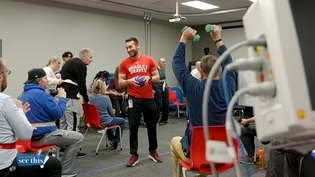
Video has Closed Captions
Clip: S5 Ep10 | 6m 45s | Bradley's Physical Therapy & Health Science Dept. links compassionate care with real-world training. (6m 45s)
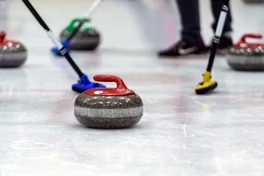
Video has Closed Captions
Clip: S5 Ep10 | 6m 15s | You don’t have to travel far! You can try curling right here in Central Illinois! (6m 15s)
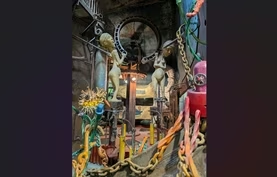
Video has Closed Captions
Clip: S5 Ep10 | 6m 1s | A man discovers his passion and builds a dream house like no other. (6m 1s)
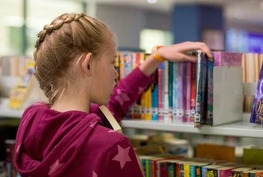
Video has Closed Captions
Clip: S5 Ep10 | 6m 15s | Behind every good community is a good library! (6m 15s)
Providing Support for PBS.org
Learn Moreabout PBS online sponsorship
- News and Public Affairs

Top journalists deliver compelling original analysis of the hour's headlines.

- News and Public Affairs

Today's top journalists discuss Washington's current political events and public affairs.












Support for PBS provided by:
You Gotta See This! is a local public television program presented by WTVP