You Gotta See This!
Growing Up at the A. Lincoln Motel
Clip: Season 6 Episode 1 | 5m 47sVideo has Closed Captions
Mary Alice Davis recalls the family business her parents built beside Route 66.
Mary Alice Davis was 10 when her parents opened the A. Lincoln Tourist Court along Route 66 after World War II. She recalls rented bedrooms, late-night doorbells, a coveted “No Vacancy” sign and the family ingenuity that turned her father’s gamble into a thriving motel and a lifetime of stories.
Problems playing video? | Closed Captioning Feedback
Problems playing video? | Closed Captioning Feedback
You Gotta See This! is a local public television program presented by WTVP
You Gotta See This!
Growing Up at the A. Lincoln Motel
Clip: Season 6 Episode 1 | 5m 47sVideo has Closed Captions
Mary Alice Davis was 10 when her parents opened the A. Lincoln Tourist Court along Route 66 after World War II. She recalls rented bedrooms, late-night doorbells, a coveted “No Vacancy” sign and the family ingenuity that turned her father’s gamble into a thriving motel and a lifetime of stories.
Problems playing video? | Closed Captioning Feedback
Where to Watch You Gotta See This!
You Gotta See This! is available to stream on pbs.org and the PBS app.
Providing Support for PBS.org
Learn Moreabout PBS online sponsorship(gentle music) - I'm Mary Alice Davis and my parents Bill and Helen Posegate, built the A. Lincoln Motel on Route 66 right after World War II ended because dad thought that people would start traveling again.
And, fortunately, he was correct Dad was an industrial arts teach with a master's in architecture, and he decided after the end of World War II that people would start travelin He loved to travel himself, so he had the idea of building a So he quit his paying job with a wife and two small childr First, he looked for a nice lot outside the city limits on Route and found a large lot with a big house in the middle of it and bought that and started buil and moved the four of us out to so we would be there on site so they could work the motel.
It was in 1946, so I was 10.
I'm 90, going to be in a couple My brother's six years younger, so he was only four.
He did a lot of research and wanted to name it exactly how Lincoln signed his name.
So he discovered that Lincoln always signed his name A. Lincol The original sign is not the one that was on the Rose Bowl float or on the cover of th Department of Transportation map It was a wooden sign with planks and on the second to the bottom there were two small hooks, and there was a no sign made out of the wooden material that was the rest of the sign.
And my brother and I used to arg when the motel was filled who would run out there and hang the "No" on the little That was called the A. Lincoln Tourist Court because in the '40s, they weren' they were tourist courts.
So he decided to change it to the A. Lincoln Motel.
It was the first neon sign that a sign company made was the neon sign when w changed it to A. Lincoln Motel.
Well, he did it in stages, and he built six units and then and he was big on conserving spa So the first 12 units were six around three carports, but then later he discovered that he could put two motel rooms into the carports and have eight units in a section instead of six.
Also in the house, he closed out the dining room and put a outside entrance in.
And when the motel was full, he rented out the old dining roo which was now a motel room with a private bathroom.
The upstairs, the second floor of the house were four bedrooms.
My parents had one, my brother had one, I had one.
Of course, one bathroom.
It was a clawfoot tub, no shower And we rented out the fourth bed when the motel and the old dining room were full.
We rented that out.
And in fair time at th beginning, to make a little mone my brother and I would slee on cots in my parents' bedroom and we rented out our bedrooms.
I was always afraid somebody was to go through my dresser in my c so up to 10 people would use this bathroom.
Conservating space was his motto Well, dad took care of th construction and the maintenance and mother rented the rooms.
And bear in mind the office was especially if there was a vacanc So the doorbell would ring sometimes in the middle of the n middle of when we were having a It didn't matter.
But mother would answer the door Occasionally, performers at the which was a club out toward where the motel was located sout but we would have the opening ac and one was a blind whistler called Fred Lowery, and he actually made records, which I have some of them.
Whenever he'd make a ne record, he'd send it to mother.
He and his wife came there for y Just been a great adventure.
I'm glad that I can remember so much of it.
When you start out, you don't start at the top.
You have to make your own way, and you're not entitled to anyth So I enjoy telling all these sto to my two daughters and my four because I want them to know what it is like to start a business with no expe So, yes, I am grateful.
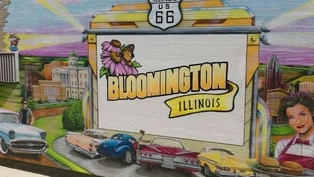
Cruisin’ with Lincoln on Route 66
Video has Closed Captions
Clip: S6 Ep1 | 5m 52s | Bloomington connects Abraham Lincoln, local history and the enduring story of Route 66. (5m 52s)
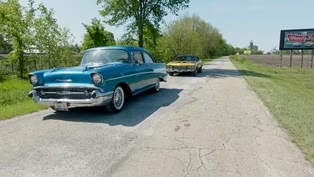
Video has Closed Captions
Clip: S6 Ep1 | 3m 23s | Lexington preserves an original stretch of Route 66 and the memories built along it. (3m 23s)
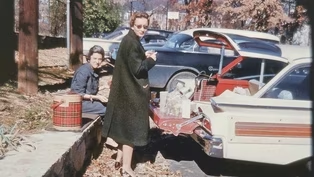
Video has Closed Captions
Clip: S6 Ep1 | 3m 22s | Kathryn Harris remembers a family road trip to California along Route 66 in the 1960s. (3m 22s)
The People Who Made the Mother Road
Video has Closed Captions
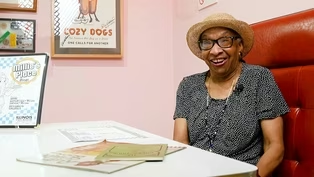
Clip: S6 Ep1 | 4m 57s | The Illinois State Museum preserves personal memories from Route 66’s first century. (4m 57s)
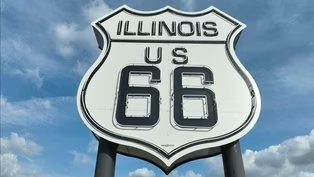
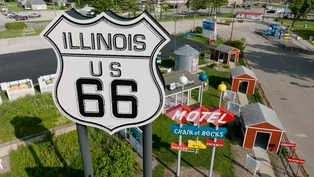
A Road Trip Across Illinois in One Stop
Video has Closed Captions
Clip: S6 Ep1 | 4m 17s | Springfield’s Route 66 Experience previews the historic road across Illinois. (4m 17s)
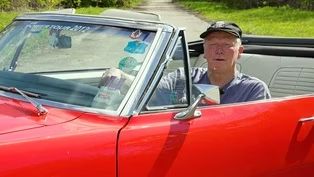
Clip: S6 Ep1 | 2m 22s | Big Dave Sullivan shares a lifelong Route 66 connection and a journey to California. (2m 22s)
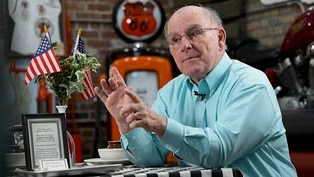
The Stories Inside Pontiac’s Route 66 Museum
Video has Closed Captions
Clip: S6 Ep1 | 4m 32s | Pontiac’s Route 66 museum preserves the people, vehicles and memories of the Mother Road. (4m 32s)
Providing Support for PBS.org
Learn Moreabout PBS online sponsorship New Episode
- News and Public Affairs

Top journalists deliver compelling original analysis of the hour's headlines.

- News and Public Affairs

FRONTLINE is investigative journalism that questions, explains and changes our world.
 New Episode
 New Episode
 New Episode
 New Episode
 New Episode
 New Episode
 New Episode
 New Episode

Support for PBS provided by:
You Gotta See This! is a local public television program presented by WTVP