At Issue with Mark Welp
Helping Veterans Get the Benefits They’ve Earned
Season 4 Episode 9 | 26m 46sVideo has Closed Captions
Veterans in Tazewell County learn how to access benefits and find local support.
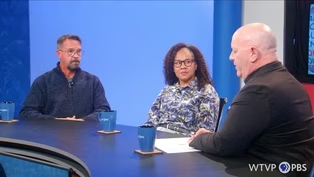
Mark Welp talks with CJ Pulcher and Heather Carreathers of the Tazewell County Veterans Assistance Commission about connecting veterans with benefits and local support. They discuss disability claims, financial assistance, education, mental health resources and the barriers that keep some veterans from asking for help.
Problems playing video? | Closed Captioning Feedback
Problems playing video? | Closed Captioning Feedback
At Issue with Mark Welp is a local public television program presented by WTVP
At Issue with Mark Welp
Helping Veterans Get the Benefits They’ve Earned
Season 4 Episode 9 | 26m 46sVideo has Closed Captions
Mark Welp talks with CJ Pulcher and Heather Carreathers of the Tazewell County Veterans Assistance Commission about connecting veterans with benefits and local support. They discuss disability claims, financial assistance, education, mental health resources and the barriers that keep some veterans from asking for help.
Problems playing video? | Closed Captioning Feedback
Where to Watch At Issue with Mark Welp
At Issue with Mark Welp is available to stream on pbs.org and the PBS app.
Providing Support for PBS.org
Learn Moreabout PBS online sponsorship(bright music) (bright music continues) (bright music continues) (bright music continues) - There are more than 500,000 veterans living in Illinois.
Half of those Illinois vets are senior citizens, and there's help in central Illinois for vets of all ages, and one organization locally is ramping up their efforts to help our ex-servicemen and women.
Joining us from the Tazewell County Veterans Assistance Commission, our Superintendent CJ Pulcher and Veterans Service Officer Heather Carreathers.
Thank you both for coming in.
- Thank you, Mark.
- Thank you, Mark.
- Appreciate it.
Heather, let's start with you.
You both were in the service.
Can you tell us a little bit about what you did?
- Well, Mark, I just recently retired from the Illinois Army National Guard after 26 years of service.
22 of those years were active federal.
I spent the last 11 years of my career in recruiting command as a recruiter, then a team leader, first sergeant, and then the operations NCO at our battalion.
I was... - [Mark] Sounds like you did a little bit of everything.
- Yes, I did.
(chuckles) - Yeah.
We're going to talk about how you transitioned into this position, but CJ, tell us a little bit about your service.
- Yes, sir.
I had the privilege and honor to serve this great nation for just shy of 26 years, over 20 of which was active.
I retired in 2017 as the director of aviation and safety for the state.
Deployed twice in support of Operation Enduring Freedom in 2009, 2013.
I consider it an honor to have been able to serve.
- Well, we appreciate both of your services to the country.
And I want to talk a little bit about the Veterans Assistance Commission.
CJ, kind of give us an overview of what that does in Tazewell County.
- Absolutely, Mark.
And I would be remiss if I didn't tell you two and a half, three years ago, I was asking the same question.
What is a Veterans Assistance Commission?
I like to think of us as a conduit, a resource center for veterans to come to, to be able to connect them with community, local, state and federal resources.
We have two primary functions, first of which is to provide just and necessary assistance for those that find themselves in financial hardship due to no fault of their own.
And most recently, due to changes in Illinois statutes, we also provide assistance for going after claims with Veterans Affairs, compensation, healthcare, education benefits.
It's a unique opportunity to help pay back the veterans for the service that they gave to this country.
- Yeah, and as you mentioned the VA and it seems like, you know, there are plenty of opportunities and benefits out there for veterans, but nothing's easy.
(Mark chuckling) You know, a lot of red tape, a lot of paperwork, things like that.
- Yes, sir.
- So do other counties around the state have similar commissions?
- They do.
Absolutely.
It's actually an Illinois statute, 330 ILCS 45 or commonly referred to as the Military Veterans Assistance Act.
And if I may, a unique bit of history for Illinois, back in the late 1800s, Illinois recognized a need to assist their local indigent veterans about 40 years ahead of the federal government.
The progenitor of today's Military Veterans Assistance Act is actually the Bogardus Act of 1907, which formalized the Military Veterans Assistance Act.
But each county is charged with standing up a VAC if they have two or more veteran service organizations within.
And so we're not unique to Tazewell.
All our surrounding counties have a VAC as well.
- Okay.
And Heather, you mentioned that you're fairly new on the job.
Tell us how you transitioned from your service into a position like this and why you decided to do it.
- Well, Mark, I retired 31 August and I started this position on 1 September.
I decided to pursue being a veteran service officer because throughout, as I mentioned, the last 11 years of my career, I was a recruiter and I worked and helped individuals get into the military.
And now I have the opportunity to help them on the back end to get everything that they deserve for their service.
- And typically, you both can answer this if you want, what kind of benefits do people in the military get when they are done with their service?
Or what are they entitled to and what are their options?
- Well, there's quite a number of benefits.
We primarily focus on the veteran disability claims.
There are multiple service connected disabilities that veterans have that maybe you or other people cannot see, right, and they are owed treatment for that, for the rest of their life.
So we want to help them.
And a lot of veterans don't know that they qualify for these services and that's what we're here for, to support them, to help educate them, guide them through the process on that.
We also discuss with them and assist them with education benefits, survivor benefits, spousal benefits, so dependency compensation and pensions, because most of the time, especially with these older vets that you've mentioned at the beginning, their spouses are taking care of them as they begin to age.
But one thing we really wanna focus on in Tazewell County are the veterans that don't think or don't understand that they deserve these benefits.
I mean, they served our country, they raised their right hand.
It doesn't matter if you served one year or 30 years, Mark.
They deserve all of the benefits that we can offer them.
- Yeah, any other benefits that you can think of that Heather didn't mention?
- Heather did a fantastic job answering the question.
- So how much of, and I know you're new, so you probably haven't done a lot of this yet, but how much of this, obviously you want to get the word out, which is why you're here today, but how much of this is proactively seeking out veterans to see if they need help and how much of it is people finding you and saying, "I need help"?
- That's a good question.
And, right now, I think it's probably about a 70/30, 75/25 split.
I was very careful in advertising.
I wanted to scale our advertising up with our capabilities.
When I took the chair June 1st, we had one full-time and one part-time veteran service officer.
In the last five months, we've grown from one and a half to six certified veteran service officers now, which has tripled our capabilities of serving the veterans of Tazewell.
I didn't want us to get overwhelmed or overran in the first couple of months, but now we're, our doors are open.
We got a bunch of hard chargers, a lot of good folks that are excited about helping the veterans.
- And roughly how many vets do we have in Tazewell County?
- Depending on which census you read, anywhere between 7,000 and 7,300.
- Wow, so it's a good thing you have more than two employees now.
- Yes, sir.
- Wow.
That seems like a high number.
I mean, for the total population of the county, how does that... Is that a high number or is that average, typical?
- Per our surrounding counties, we're on par with Peoria.
I think we're shy of about six or 700 compared to Peoria, McLean County, Sangamon County, we're fairly on par with, but it is a good population density of veterans.
- Sure, sure.
And of those people, you know, we talked about how a lot of our veterans getting older, unfortunately, and the greatest generation is slowly going away.
Do you have any idea of those roughly 7,000, the ages and how many are Korea, Vietnam, World War II compared to some of the younger folks?
- Well, I can tell you, I think we're down to six World War II now in Tazewell.
Just lost a great one a couple of weeks ago.
As far as the numbers of the others, I do not have those numbers on the tip of my mind.
- Sure.
So tell us about your month or so now that you've been working.
(Heather chuckling) Are you, in your job, physically going out to folks to help them?
I mean, do you make house calls as they say?
- Well, Mark, I'm definitely open to making house calls.
We'll do whatever it takes to take care of our local vets.
It has been an interesting couple of months.
I've had the opportunity already to go through veteran service, the veteran service officer training that we need.
I've been to a conference that included all the VSOs and superintendents for all of the counties in Illinois.
But I think the greatest thing that I've gotten to do is just help local vets that have came into the office with, you know, financial needs, medical needs, setting up different types of benefits for their spouse because maybe they know that their time is limited.
Getting out into the community, going to events and meeting veterans, it is one of the highlights of my job in talking to them, finding out if they're getting their benefits or not.
And then if not, being able to, hey, come see us and have that conversation with them and then seeing them in the next week in the office, getting the help that they need is amazing.
And then the other thing that I've done recently that just really, I just want to get out and do it more is meeting with veterans.
There's a lot of veterans in the area that meet up and there's Honor Flight alumni that meet up in East Peoria, a group of veterans, and I got to meet them and I want to, you know, get out there, hear their issues, help them with whatever they need and they can help get the word out as well.
So I think that it's just been an honor and a privilege to meet those veterans, hear their stories.
They deserve all the support that we can give them and it's just an honor to hear about their history and their story.
- Yeah, and speaking of that, we've got a lot of VFW posts around the area, so I would think that would be a help for you and the veterans to be able to interact.
One of the things, I mean, I know a lot of veterans and they're all very proud people.
Is that something that you have to kind of overcome, you know, folks that maybe are too proud to ask for help or like you said earlier, don't think that they necessarily are entitled to it?
- Oh, absolutely.
I've got one that I've considered a mentor and a friend, and a lot of us had that mindset when we first came out, that we want to save this for those that truly deserve it or need it.
And the pure simple fact is we've all given and dedicated our lives to the service of this great nation.
So yes, that definitely is a barrier that we're learning to feel and talk our way through with these veterans and explain to them that it's there for them.
- They've earned this.
This is hard.
- What's the best way to go about that, you know, when you're talking one-on-one with a vet who may be hesitant to ask for help?
- Families.
- Yeah.
Maybe talk to the spouse.
Have the spouse talk some sense into the veteran maybe?
- Or other veterans, you know, the older generation of veterans, I feel like they're more open to hearing from their generation of veterans, you know, And we have a great VSO in the office.
He's a Vietnam War air vet, you know, and he can connect with some of those people, but just really just reiterating that you earned this, you know, You earned the right to have these benefits.
It's no different than what we did to earn our retirement that we're going to receive from the military.
You raised your right hand and this country is obligated to take care of our veterans.
You're not, you know, you can put that pride in front of it, but really you deserve this.
You're entitled to this and we're going to help you get it.
- You mentioned the gentleman that you work with that served, you both served.
Is that typical for veterans commissions like this in the different counties to have veterans helping veterans?
- Absolutely, it is.
While it's not statutorily mandated that employees of a VAC be veterans, veterans connect better with veterans.
It makes conversations much easier.
- Yeah, just makes sense.
Tell us a little bit about how you work with the state, federal government, what kind of, I know you're kind of boots on the ground here in Tazewell County, but how do you interact with them or do you interact with them?
- We primarily act with the county.
We're funded by the county.
We've got three primary funding sources.
Well, we have three funding sources, one of which is our primary taxes levied through the county's code 5-2006 and the public aid code 12-21.13, I believe, which is supposed to be 0.02% of the EAV.
So we're interacting with our county board quite a bit.
As a matter of fact, we've got our monthly county board meeting tomorrow evening, which fingers crossed, we'll see our budget for '27 be stamped approved.
As far as the state level, we do interact with IDVA.
IDVA is a great partner with us, but there's a stark contrast between what we do and what they do.
We're statutorily mandated as previously mentioned by the MVAA, but the IDVA, they're focused on the entire state and state programs.
They run state veteran homes.
They do provide VSOs for claims benefits, but the counties, we're more of that local resource for the veterans.
We're that face.
We're the friends and family that the veterans of the local community have come to know and trust.
- I guess let's go through some examples of an issue a veteran might have.
I mean, part of the reason why I asked that question was, let's say a veteran is having trouble with the VA hospital that they have to go to.
Do you give them advice on how to handle it?
Would you intervene on their behalf?
How would that work?
- We do become agents for the veterans in the county and interact with VA on their behalf, absolutely.
So in that aspect, you're 100% correct.
We do act at the federal level as well when it comes to interacting with the VA.
And we are actually going to get to participate in a veteran service round table on Veterans Day with a sitting US senator.
So we do have a voice at the federal level as well.
- Sure, and can you give us some other examples of issues that veterans have had?
I mean, not too specific, but things that they're trying to work out and things that maybe they're having a hard time dealing with.
- Whether it be filing an initial claim, and it goes beyond filing initial claims because claims get denied.
We're also registered agents to help them through the appeals process.
There's three different avenues from which we can appeal, and that's whether we help them file a supplemental claim, introduce new and relevant evidence to prove a service connection.
There's a higher level review.
Maybe we don't necessarily agree with the initial reviewer's decision.
And then there's always the Board of Veterans Appeals, which is presided over by a veteran judge.
So there are multiple avenues that we have the capabilities and the honor of representing veterans in front of Veterans Affairs.
We also help them obtain and go after the education benefits that they've earned.
And when it comes to healthcare, yeah, we're there for them as well.
- I would think healthcare is probably one of the bigger issues that we all deal with, but especially veterans.
- Absolutely.
- Tell us a little bit about the educational aspect of this and what veterans can get, you know, when they're done with their service.
- [Heather] You want to answer that or?
- I can, if you want to.
- I can.
- Are you talking about like continuing education or... - There are continuing education benefits through federal avenues that we can help link them up with.
There's also for veterans that are with certain disabilities or certain ratings, their children have access to education, which is a Chapter 35 benefit that they offer that will give them basically like a stipend while they're going to school in Illinois.
And also there's some state benefits in Illinois that offer the dependents the ability to go to school for free at most of our state funded schools and for our veterans.
So we do, Illinois does have the veterans... (Heather faintly speaking) - Illinois.
- The Illinois Veterans Grant.
Thank you.
I had the- - IVG.
- Thank you, the IVG, right?
- There's a lot to remember.
- And so if you've served number one year of active duty, then you're eligible for that.
So we can help them set them up with those benefits.
There's different programs for... I mean, it doesn't have to just be college.
It can be a technical degree or whatever that we can help them obtain access to.
- Sure.
- Go ahead.
- Part of an initiative, if I may, sir, in expanding our capabilities in the office, we want to take a holistic approach at helping the veterans of Tazewell.
We're creating community partnerships.
We just entered a great partnership with Trouble Free, HVAC, to be able to provide other sources of education or skilled trades training for veterans to be able to get more stable and financially independent.
We're looking to expand those partnerships as well and be able to provide other educational opportunities that may not be statutorily mandated or federally funded.
- Yeah, that's great.
We've come a long way in the last decade or so when talking about mental health.
And I think when people talk about folks that have been in the military, they expect if you were in action, you may have a physical disability from seeing action, but a lot of men and women deal with PTSD and other issues.
Is that something that, you know, you guys have seen?
And if, you know, say someone comes to you and they haven't gotten help, can you refer them to say psychiatrist, group, whatever in that situation?
- Absolutely, and we're rapidly expanding our capabilities and building partnerships to handle that.
That's something we have seen.
I've personally seen in the office in the short five months I've been there, and there's a definite need for that.
But yeah, we reach out and help make those connections to ensure the veterans get the support that they need.
- Yeah.
It's definitely something important.
And I'm sure a lot of vets too, unless, they're, you know, at the VFW post hanging out with other vets, it's hard to talk to people who weren't in the service because there's probably a lot that they just don't understand.
- And every veteran, regardless of their disability status, they don't have to have any type of VA disability benefits.
They are entitled to go to receive VA healthcare and mental health, you know, is the number one priority.
So if they go into any VA center, somebody will be there to give them help.
- As far as VA hospitals, where's the closest one around here?
Do you know?
- We have a Community-Based Outpatient Clinic, a CBOC, the Bob Michael out on Orange Prairie Road here on the north side of Peoria.
As far as a major hospital, probably Illiana and Danville.
And then you've got Hines and Jesse Brown, I believe, up in Chicago, and then Iowa City, and then down in St.
Louis.
- So other than the outpatient one here in Peoria, it's kind of a haul, you know, to get to these places.
Is that something that, you know, veterans have an issue with, especially ones who may not have a lot of money or a lot of resources?
Is it hard for them to get what they need when it could be several hundred miles away to the hospital?
- Transportation's actually a very interesting topic that we've started tackling in the office.
And there are different resources out there that we've pursued.
The Bob Michael does have transportation services.
You've got to notify them 48 hours out, I believe.
We want to become a little bit more self-sufficient as a VAC in Tazewell.
So we are pursuing avenues to stand up our own transportation section to be able to meet the demands that I anticipate are going to be coming, to be able to get veterans to examinations or to appointments.
So we want to be ready and capable to meet those needs.
- Yeah, when we talk about the roughly 70,000, 70,000, 7,000 veterans in Tazewell County, what are you seeing in terms of, you know, obviously the World War II veterans are getting older and then we've got younger vets coming in.
Do the younger vets who maybe were, you know, over in Iraq or Afghanistan, are they better informed than maybe the older vets about the services that they can get or are they kind of the same?
What do you think about that, Heather?
- For the most part, I believe they are better informed.
They're more getting out over the last few years is part of the process, you know, whether they're just ETSing out or retiring out.
There's different courses and different things that you have to take when you're transitioning out, so it helps them.
I think with the Vietnam vets, there was a time when they weren't getting taken care of as well as they are now, and they are still assuming that we're operating over those old terms.
So that's another thing that we're definitely focusing on, getting that information out to specifically that generation who may just think, "Well, this is what happened to me, or we got denied any help, you know, 20 years ago, so we never went back where things have changed and there's way more additional help."
And we want to do everything possible to take care of those veterans, you know, especially after what they went through when they came home.
- Yeah, I didn't think about that.
I guess if you come home and you don't get that hero's welcome, you may be hesitant to try and find help.
What else can you tell us about the Assistance Commission that is important for folks to know, whether they be veterans or not veterans?
- We're open.
Our doors are open.
Walk-ins are available.
I anticipate here in the coming months we may have to resort to an appointment.
Call and make us an appointment.
- Good problem to have.
- That's a great problem to have, but we want veterans to know that they're welcome to come in anytime.
Well, we'll be there Monday through Friday, eight through four.
Call us, leave us a message, email us, or just walk in.
We're happy to greet anybody that walks in the door.
- Where are you located at?
- We're located at 414 Court Street in Pekin currently.
- Okay.
And your website is?
Put you on the spot here.
- You can find us on the Tazewell County government, the county board page.
- Okay.
- And then, we have a Facebook page, Tazewell County Veterans Assistance Commission.
Heather's been doing an absolutely phenomenal job getting a word out and managing our social media.
- That's excellent.
Is there anything the community can do to help you all out?
I know you mentioned a partnership with Trouble Free and anything else that is on your wishlist?
- Well, if anyone in the community has or want to help veterans or assist veterans or connect their organization to veterans, they should definitely reach out to us so that we can partner with them on, you know, we can definitely sit down.
I would love to have a round table with a lot of the community organizers and businesses and just see what they can do for our local veterans.
So please, please reach out to us at the commission or on our Facebook page.
I do put out posts quite a bit, just asking for anybody in the community that wants to connect their services to the local veterans.
- All right.
Well, we appreciate your time.
Heather Carreathers and CJ Pulcher with the Tazewell County Veterans Assistance Commission.
Thank you for your service and thank you for what you're doing for our vets here in Central Illinois.
- Thanks for having us, Mark.
- Thank you, sir.
- All right.
Appreciate it.
And thank you for joining us.
We appreciate you.
Just go to wtvp.org.
If you want to find out more about our shows, maybe watch this show again and share it with a friend.
Have a good night.
(bright music) (bright music continues) (bright music continues) (bright music continues)
Providing Support for PBS.org
Learn Moreabout PBS online sponsorship New Episode
- News and Public Affairs

Top journalists deliver compelling original analysis of the hour's headlines.

- News and Public Affairs

FRONTLINE is investigative journalism that questions, explains and changes our world.
 New Episode
 New Episode


 New Episode

 New Episode
 New Episode

 New Episode


Support for PBS provided by:
At Issue with Mark Welp is a local public television program presented by WTVP