Docs on Call
How Sleep Studies Diagnose Sleep Apnea
Clip: 8/20/2026 | 1m 43sVideo has Closed Captions
A sleep specialist explains how in-lab and home sleep studies test for sleep apnea.
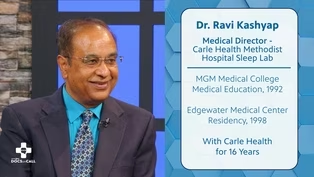
Dr. Ravi Kashyap explains the two main ways doctors test for sleep apnea. An in-lab sleep study can monitor brain waves, heart activity, breathing, movement and more, while a home sleep study uses fewer sensors to evaluate breathing and oxygen levels in a familiar setting.
Problems playing video? | Closed Captioning Feedback
Problems playing video? | Closed Captioning Feedback
Docs on Call is a local public television program presented by WTVP
Docs on Call
How Sleep Studies Diagnose Sleep Apnea
Clip: 8/20/2026 | 1m 43sVideo has Closed Captions
Dr. Ravi Kashyap explains the two main ways doctors test for sleep apnea. An in-lab sleep study can monitor brain waves, heart activity, breathing, movement and more, while a home sleep study uses fewer sensors to evaluate breathing and oxygen levels in a familiar setting.
Problems playing video? | Closed Captioning Feedback
Where to Watch Docs on Call
Docs on Call is available to stream on pbs.org and the PBS app.
Providing Support for PBS.org
Learn Moreabout PBS online sponsorshipTell us a little bit about the sleep test that people do to see if they have sleep apnea.
What all goes into that?
- So there are two major variety of sleep studies.
One is called polysomnography or the polysomnogram or in-lab sleep study where the people go to the lab, sleep lab and go to sleep there and have a sleep study done.
Shorter version would be home sleep study when they can get the sleep apnea study done at home.
So in-lab sleep study, polysomnogram is much more detailed.
It is done in one of the sleep centers where we can do the EEG looking for the brain waves.
EKG are looking for the heart monitoring, snoring monitoring, airflow monitoring, chest wall movement, abdominal movement, leg movement.
So there are a lot of wires hooked all over the body, right?
So much more detailed.
Of course, the main purpose is to diagnose sleep apnea but occasionally we have noticed or diagnosed some patients with unknown seizure disorder because there's an EEG going on or unknown atrial fibrillation which patients were not aware but we look at the heart monitoring, et cetera.
Sometimes REM behavior disorder as well.
On the other hand, home sleep study is much more shorter.
It has a chest belt, we look for the chest wall movement and there's something on the finger to look at the pulse oximetry and something in the nostril to look for the airflow.
So it's a very good study for sleep apnea as well but not as detailed as that would be done in the sleep lab.
But it has its own advantages because then you are getting it done at home.
So you sleep at your known surroundings.
So it makes it easier for many of the patients.
How Blue Light Can Disrupt Your Sleep
Video has Closed Captions
A sleep specialist explains why screens before bed can make it harder to fall asleep. (48s)
What Happens During Sleep Apnea?
Video has Closed Captions
A sleep specialist explains what happens when sleep apnea stops breathing during sleep. (2m 10s)
Providing Support for PBS.org
Learn Moreabout PBS online sponsorship New Episode
- Science and Nature

Explore scientific discoveries on television's most acclaimed science documentary series.

 New Episode
 New Season








Support for PBS provided by:
Docs on Call is a local public television program presented by WTVP