Consider This with Christine Zak Edmonds
Inside the Historic Peoria Women’s Club
Season 7 Episode 5 | 27m 47sVideo has Closed Captions
Explore the history, restoration and future of the historic Peoria Women’s Club.
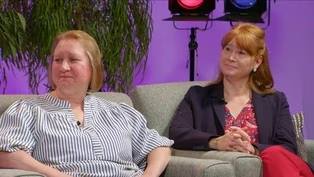
Christine Zak-Edmonds welcomes Lynette Steger and Anne Schutt of the Peoria Women’s Club to explore an organization dating back to 1878. They discuss its historic clubhouse and theater, the role women played in shaping Peoria, ongoing restoration efforts and how the club is evolving to serve new generations of women and the community.
Problems playing video? | Closed Captioning Feedback
Problems playing video? | Closed Captioning Feedback
Consider This with Christine Zak Edmonds is a local public television program presented by WTVP
Consider This with Christine Zak Edmonds
Inside the Historic Peoria Women’s Club
Season 7 Episode 5 | 27m 47sVideo has Closed Captions
Christine Zak-Edmonds welcomes Lynette Steger and Anne Schutt of the Peoria Women’s Club to explore an organization dating back to 1878. They discuss its historic clubhouse and theater, the role women played in shaping Peoria, ongoing restoration efforts and how the club is evolving to serve new generations of women and the community.
Problems playing video? | Closed Captioning Feedback
Where to Watch Consider This with Christine Zak Edmonds
Consider This with Christine Zak Edmonds is available to stream on pbs.org and the PBS app.
Providing Support for PBS.org
Learn Moreabout PBS online sponsorship(soft guitar music) - Will you consider this?
It's been around town for the longest amount of time and still so many people don't know about it or what it's about.
I know where it is, but I am just finding out what it's about.
It's the Peoria Women's Club and Lynette Steger is here.
She's the first vice president and Anne Schutt is a committee member and has been involved with the Peoria Women's Club for many, many years.
Welcome ladies.
Thank you for being here.
- [Anne] Thanks for having us.
- So tell me about Peoria Women's Club.
It is located at the corner of.
- [Lynette] Fayette and Madison.
- Fayette and Madison.
I couldn't remember if it was Madison or Monroe.
I knew it was an M. And it's been there, the actual building itself has been there since-- - [Lynette] 1893.
- 1893.
But the club itself was established when?
- [Lynette] 1878.
So Clara Parsons Bourland, who was our founder, initially had people come to her house and meet in her living room.
And as the club grew, they started going to the hotels in downtown Peoria and it kept growing and growing in part because of our Shakespeare Club, which has been a fascinating thing to discover recently.
They got to the point that they needed to build a clubhouse.
And so by 1892, they built a stock company before women could even own businesses.
- [Christine] Or vote.
- Or vote.
- [Christine] Or vote.
- Sold $10 shares of stock and actually built their own clubhouse, the first in Illinois, in downtown Peoria.
- Wow.
So Anne, what would $10 back then be worth today?
You're kind of a finance person.
- Oh gosh, I don't even know if I could even do that math, but $10 back then, oh, I don't know.
Several thousand probably would be-- - [Christine] Gosh.
- Today, so.
- And they came up with it.
They figured out a way to put some money aside because their husbands were working and they were probably home and did that.
That's really good.
So the club itself has a theater.
Has how many rooms?
And it's got a couple meeting rooms, like a kitchen.
- It does.
So in 1893, the building opens up and the second floor was added in part because Lydia Moss-Bradley donated a third of the cost to add a music hall upstairs.
So we have a 432 seat theater on the second floor.
Today it is the oldest theater in Peoria that still exists.
In fact, our clubhouse is the second oldest in the nation that's been in continuous ownership by its members.
And the first floor does have a kitchen.
It's a part of a major restoration piece that we are yet to accomplish.
I think Anne can talk a little bit about the coffee that is behind that project.
And then, in addition, there is a dining room, a parlor, a president's office, and then upstairs is the entire theater.
- Right, yeah.
That needs work.
We'll talk about that.
All right, so then tell me about the coffee.
- Yeah, so well, we have lots of different ways that people can give to support the restoration project.
It's a 10 phase restoration project.
We've completed about half of the phases.
- [Christine] And a lot of money was gifted to you by raising funds.
- Grants.
- [Christine] And Kim Blickenstaff.
- We are so grateful.
Kim Blickenstaff donated an amazing amount of funds to really kickstart the project that started back in 2019.
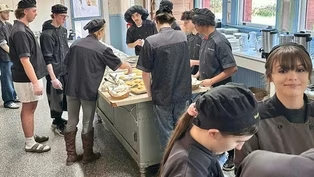
And now, so the kitchen is one of our major projects right now and we have a really great collaboration with Cafe Santa Rosa.
They've helped to develop our Cosecheras Coffee and a portion of every bag sold comes back to the women's club and goes towards our kitchen restoration project.
And our hope with that is that now we will have a commissary kitchen where we can really support maybe women business owners, do some more teaching of some of the skills, some of the kitchen skills, really open it up to be a wonderful resource for our community.
- So it will be a legit, pass health codes kitchen.
- [Anne] Yes.
- All right.
All right.
So that is education there.
- Yeah.
- It's nice to know.
But when the women's club was first established, see, and I thought it was kind of a social gathering place, so that men had their own clubs, but women really didn't have anything.
And then you gave me the real story.
- [Lynette] Yeah.
- I guess, my sister would be so ashamed.
She taught social studies for over 55 years and now I don't know this one.
I'll have to tell her in case she doesn't know.
So tell me why it was originally established.
- So I think when we say the term women's club, it sounds very generic, because today we have lots of options.
The reality is post Civil War, women had been running farms, they had been running businesses, and now after the war is over, just like Rosie the Riveter in World War II, we have a situation where they're looking for more.
They've yet to gain the right to vote across the nation.
And in addition to that, they're wanting to have a secondary education.
You know, this is happening in the same moment of what we call the Chautauqua movement, with the idea of having adult education.
And we have an opportunity with Clara Parsons Bourland, who's not only started a lot of what I call municipal housekeeping here in Peoria, but she had gone to Paris for several years during the Belle Époque and seen such great amazing art and opera and resources in terms of culture.
- [Christine] That were open to women there.
- Open to everyone.
And so she came back and she said, "You know what?
We need to do something."
And so this is all happening kind of in the zeitgeist across the country.
And at one point by the 1930's, the women's club movement that we belong to, which is a part of the general federation of women's clubs, had a million members.
- [Christine] Really?
- It was the largest group of women in the United States focused on things to do with lifelong learning.
- Right.
Well, because they were limited.
How many women had a secondary education, a college education?
I mean, it wasn't happening, but Lydia Moss Bradley, she was way ahead of her time.
She was a real trailblazer.
And to gift the money for the second floor.
- Well, I think it's mind blowing for people in Peoria to understand the Women's Club of Peoria predates Bradley University by four years.
- [Christine] Okay.
- So before she even built Bradley University, she felt there needed to be a place for women to have a voice.
So we have a very unusual theater with a rake theater, which means that each one of the seats that you sit in, you actually can get the same amplification of the human voice from the stage.
And she made that happen.
She provided a third of the cost of the money to make sure that we added that theater on the second floor.
And there were incredible people from all over the world that came and spoke at the Peoria Women's Club for generations.
- Now tell me about the Shakespeare portion.
You mentioned it just briefly.
So what was that?
It was performed on that stage then?
- [Lynette] It was.
- Or was it even before that?
And then-- - Before that and then it grew and the women were in costume.
And in addition to that, you know, we had, the whole point of the Shakespeare clubs kind of simultaneously happening with women's clubs is that it allowed women to talk about politics and in a way that was considered ladylike at the time.
- [Christine] Okay.
- And in addition to that, they practiced their public speaking.
So as our Shakespeare Club grew, and grew, and grew, and there's a great story, we have this amazing bust of Shakespeare in the office, and if women were late to a meeting, they had to pay a nickel.
And if they didn't show up, they paid a dime and that's what paid for the bust.
- Well, and it's still intact.
- [Lynette] It's still intact.
- All right.
Well, William had a way of influencing the ladies, didn't he?
- [Lynette] He did.
- All right.
So you've made some wonderful strides in restoring the building.
I know that you do hold teas there and special events, graduation parties, weddings, showers, baby showers, bridal showers, that sort of thing.
So that kind of keeps you afloat a little bit, but that's not your main thing right now.
- That really covers our operating costs.
So our operating costs just to keep the building up and running, you know, over $50,000 a year.
But we're having the secondary goal to raise funds specifically for the restoration because we have such a wonderful vision for what this club can be and what that music hall on the second floor can be.
It sat dormant for 50 years.
And if you think of what those walls have seen and the amazing things that it has supported and women have accomplished inside those walls, we want to see that back and active again.
And we're making strides.
I mentioned the 10 phase restoration project.
It's about a 5.7 million dollar project.
When we first started it was less, but, you know, the cost has gone up a bit here.
- [Christine] Absolutely.
- Since 2019.
But we've done an amazing job through grants and through generous donations that we've raised, all of it except for about two and a half million.
- [Christine] All right.
- And so we've really been fortunate with some of our donors and we actually have a really pretty exciting announcement about a new donation.
- Yes, and I do want to hear about that because the money from Kim came to repair the roof and redo all the windows, I think, is that correct?
- Yeah, so that was-- - After 50 years of being ignored, they needed some work.
- Yes.
- [Christine] And the roof had a leak, which is right into the theater area, correct?
Or was it?
- No, so we had some, there were some water damage over the years, but it was mostly from just not having heating and air conditioning controlled climate up there.
- [Christine] Okay, all right.
- Was mostly what the damage is from.
His grant wonderfully helped us secure the building.
So before we really started on the inside, we wanted to make sure the outside was solid.
- [Christine] Right.
- So new roof, new soffits, the tuck pointing of the building, all of that's been completed.
The main floor, we have new restrooms.
We've refinished the floors.
The original stenciling, we've recreated the original stenciling on the ceiling.
- So you still had enough that you could preserve-- - [Anne] Pictures.
- That pattern?
We had all of the pictures.
Again, we're great historians and we-- - [Christine] Well, Lynette was mentioning that.
- Keep it.
- That you have pictures from all of the years.
Everything has been documented.
- [Anne] Yes.
- [Lynette] Just about, yeah.
And more importantly, we have like every program they put on and biographies of who the speakers were.
So I mean, it's just an incredible rich treasure of archives.
- All right, so really quickly, before we get to the big announcement, how are you attracting younger folks?
I mean, I'm interested in history.
I was born mid-century of the 1900's.
I consider mid-century 1800's myself just this thing.
And then somebody told me, "Oh no, you're mid-century."
Okay.
But how are you attracting younger people?
They're learning about it through some of these other social events, I would imagine.
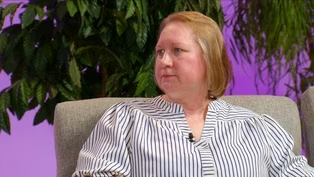
- Well, I think what's interesting is that we're about the only club in the area that you can belong to ages 12 and up.
So it is a club that you can be a granddaughter, and a mother, and a grandmother and all come together at the same time.
Our board has been made up of quite a few people under 30, which has been fantastic.
- [Christine] Right.
- And that variety of ages gives us the opportunity to offer all kinds of programs when it comes to education.
You know, the sky's the limit.
For a long time, actually, Anne used to run our evening department and that was started way back in the 1800's for working women and for mothers with children.
But that has often been a program time for us to allow women under 40, in particular, to participate.
Because the irony of today's women's clubs is that we're a victim of our own success.
- [Christine] Exactly.
- Right?
- Women can go to work, they can own businesses, they can do all the things that those clubs were initially established to fight for.
And so setting up various times throughout the week and throughout the time of the day also makes opportunities for programming that meets the needs of all women of Peoria.
- What's been the most interesting that you've come across of a program that was presented back in the day that it's like, wow.
- We had an incredible thing happen.
We have a group of women called the Archive Detectives.
So our members actually come in and we're always scouring through the old records to find out, you know, what exactly happened?
And in part that started because we wanted to make sure that what we were saying, we had confirmed.
It's kind of like telephone, you know, story gets told over time.
- [Christine] Exactly.
- And it's not always accurate.
And so we started digging through and we had come across the fact that Commodore Vanderbilt IV had been there.
And we're like, "Well, that's interesting.
You know, who is this gentleman?"
It turns out that he was the great grandson of the famous Vanderbilt, but he was a movie maker and he had actually created the first anti-Nazi film.
While-- - [Christine] In the 30s?
- In the 1930s, in 1933.
And when we found out, okay, well this is interesting that this film existed.
He had come a month after Hitler had invaded Poland to the Peoria Women's Club to talk about his concerns with the rise of authoritarianism.
And we though, "Well, that's interesting.
You know, I wonder if we could find this film."
And it turned out that it had disappeared after the 1930's.
MoMA in New York had found it in about 2014 and had it remastered.
And then it disappeared again.
- [Christine] Oh gosh.
- Through a series of phone calls and different people we were able to contact here, not only in the United States, but actually in Belgium, we found it.
And we were able to partner with the Peoria Area World Affairs Council and Bradley University.
- [Christine] To get it there.
- This last fall to be able to show that film.
And we did it as a rich discussion, you know, with Bradley professors coming in and discussing the issues.
- Wow.
How fascinating is that?
- [Lynette] It's pretty crazy.
- Yeah, I know.
I know, Peoria, Illinois.
So tell me about the big announcement.
Now there's some big news that was announced earlier.
- [Anne] Yeah.
- And let's get the whole definition down.
Because a minute 30 second story anywhere else is not going to give us all the information we need.
- Absolutely.
So as I mentioned, we've been doing a great job of raising money and having benefactors for many years now, but we still had about two and a half million to raise.
Well, we've had a very, very generous anonymous donor step forward.
And I'm just going to say she, because it's true.
- [Christine] And it's Peoria Women's Club.
- Because she has pledged a $500,000 donation.
She will match donations up to $500,000, which means in total that could be an extra million dollars towards our club.
- See, and people in the Peoria area are just so generous.
- [Anne] Absolutely.
- What a gift that is.
- It's amazing.
It's through the end of the year.
She's pledged this match.
So we hope to be able to have people reaching out and offering some donations.
We have lots of different ways that people can give.
So they can give individually.
They can go-- We now have a stock account, so they can donate appreciated stock, which I know is something that's a good strategy a lot of people utilize.
They can give qualified charitable distributions from their RMD's.
So there's a lot of different ways that they can give.
And if they're not sure, we would just say reach out to their financial advisor to get the details as to what's the best way to give.
And then they can reach out to our Peoria Women's Club, info@peoriawomensclub.com, is the email.
- [Christine] Right.
- But then we can accept those donations and our wonderful anonymous benefactor will match those donations through the end of the year.
- And they can mail it in too.
- [Anne] Absolutely.
- So the address is Fayette though.
Isn't that, that's where the main door is.
- 301 Northeast Madison - [Christine] Northeast Madison.
Even though the door isn't on Madison.
It's on the side.
It's on Fayette, right?
- The music hall door is on Madison.
- [Christine] Okay, the music hall door, sorry.
Absolutely.
- [Christine] All right.
- Yeah.
- But it's thriving.
And you two and your committee over the years, how long have you been involved, Lynette?
- I've been involved since 2019 actually.
And I think the key thing to understand is it's not just fundraising, it's not just restoration, it's not just programs for people to come to.
It's impact.
And the club was set up to create an impact.
It's still doing that today.
So Anne mentioned the coffee, it's not only impacting the future restoration of the kitchen, but it currently is actually supporting the women who literally pick our beans in Columbia.
- [Christine] Yeah, tell me about that.
- So it's the children, they receive their education through the funds of that.
The women themselves in the village receives their healthcare.
And then we also make sure that there is a, you know, a year round source of income for that group of people.
We're so grateful to them.
We also help support Woodruff's Culinary Arts Program.
So our major fundraiser every year as a membership is really to make sure that the students who are going through the career technical education program at Woodruff have opportunities to go to state and national competition.
So we have that annual event for that.
We also put on the region's only women's art competition called Électricité, very much tied to Clara's time in Paris.
And initially back in the day, we had a women's art club that had a show that had over 1,032 pieces in it and a 64 page catalog.
- [Christine] In there it had?
- [Lynette] It had to be other places.
- [Anne] I think it was spread around town a little bit, yeah.
- [Christine] I guess, yeah.
- We couldn't figure out where they put all the art.
- [Christine] Exactly.
And so, you know, it's, again, we've got the Chautauqua.
So we've got a group of people who are actually going out to New York.
- [Christine] New York, right.
- And we're going to be graduating with 106 people across the nation.
We have done that with Bradley University's OLLI program now since 2022.
And then we also have a financial piece every year called Secure Her Future.
And that is an annual event where we bring in all kinds of, you know, high level speakers to help women navigate the world of finance.
- So tell me about Chautauqua.
Now they're graduating.
You're graduating whom?
- Members of our group, which is our CLSC, the Chautauqua Literary and Scientific Circle.
We are the official Peoria circle, and we have discussions and books that we read every single semester.
Those books tend to be both, you know, fiction and non-fiction, and we cover some pretty heavy subject matter.
That group will be going out to New York, near Buffalo area, and on August 2nd will actually graduate from something that goes back to 1874.
It's the oldest book club in the United States.
- Wow, well, and Chautauqua is known for its arts as well.
I think there's big camps and things for-- - Absolutely.
- Up and coming artistic people, whether it's literature, or dance, or theater, or whatever.
- [Lynette] So here's the crazy Peoria connection.
- Okay, here we go.
- So Lydia actually decides to bring Bradley in her lifetime because of Dr.
Harper.
Dr.
Harper is the first president, not only Bradley University and the University of Chicago, but the first president of Chautauqua.
- Okay, so she brought him here somehow.
- They were friends somehow, but it's interesting how we had talked about the women's club movement and the Chautauqua movement are kind of happening concurrently in history, but certainly influenced each other why we have a theater today.
- Isn't it amazing?
I mean, we can pick up a telephone or send a text and that they were doing that across the miles and how successful that communication was.
And we're sadly lacking in many ways just because it's just too easy.
And then they went through all those steps.
Okay, so the future is in good hands.
- [Anne] Yes.
- And we have a lot of younger people on the board.
How did we do that?
How did we attract 30 and 40 somethings?
- Well, I think there's a misnomer that the younger generations are not as plugged in with history.
I think that they have a craving for, one, connection and two, to learn about history, especially women.
They find it very fascinating, things like we weren't able to sign for our own loan until 1974.
I mean, just things that as they learn and as they're getting exposure to some of these things, I think they're craving and they're wanting more.
- [Christine] All right.
- I also think that they value spending time with people from other generations, the things they can learn.
Sometimes people don't always have that strong generational access in their own families.
And maybe they've moved here from somewhere else and they don't have a really big network here, a really strong family support.
And so they come in, they get involved.
We have amazing content, which I think is a big draw.
But then once they come in, I think it's the relationships that really build it and make them want to stay.
Because in a world that we can be so disconnected because of this technology.
- [Christine] Exactly.
- I think we need a place.
And ours is one of the only ones in town that doesn't have, you have to be a business owner or you have to be this or you have to be that.
You can be anything, anything.
And you can come and you can enjoy and build relationships and meet people, which is really great because you have people from all different backgrounds.
- [Christine] Right.
- You have people from professional backgrounds, you have homemakers.
You have every different background imaginable, all coming together to have really stimulating educational conversations, which I think people really crave.
- Well, I think that's right.
And just to feel a sense of belonging.
- [Anne] Yes.
- So yeah, you manage that.
All right.
So what else do you need to share with us other than this Harper connection and the Chautauqua?
And what else do we need to know about the Peoria Women's Club and how we can keep it strong and going for the next 120 some years?
- I think the thing that differentiates us from everything else, there's so many women's groups today, which is fantastic, but we are so fortunate in Peoria to have this massive building.
It's 11,000 square feet.
- [Christine] I didn't know that.
- The fact that we are a connector in many ways to many different groups.
We see ourselves as an organization and as a physical space that belongs to all of the women of the region.
And I really hope that women start to think more when they're planning their own events, when they're planning their own organizational projects to say, "You know what?
Maybe we should do that at Peoria Women's Club."
We want to help you make that happen, regardless of age, right?
You know, that doesn't matter.
What it matters is that we use the building, you know?
Again, women have so many opportunities today, but we have a stewardship and a responsibility.
When you own the second oldest building in the United States-- - Where's the oldest one?
- Milwaukee, actually.
And a beautiful building.
- Very interesting, yeah.
- But it's not the oldest club, but it's the second oldest club house.
- Okay.
- And again, I think it's incredible that they built such an institution, but we need to hang on to it because it is an opportunity for all people.
- Yeah, that's nice.
And for several generations coming up.
One thing about that location is parking.
We don't have the horses and buggies to drop us off either on Fayette or Madison anymore.
So when you have big events, I think there's a lot right across the street, isn't there?
- Yeah, so on the weekends and after five, there's a lot right across the street at the Northwestern Mutual building.
So as long as it's not during working hours, we have access to that lot, which most of our programming is after hours or on the weekends.
We also have the lot across from Obed & Isaac's is a really large lot that a lot of people park in.
And then we also have some spaces up by the Law Center next door to us.
And then on-street parking.
All of our members, when you become a member, you actually get a windshield card.
And so you can park along the street without having to feed the meters.
- [Christine] All right.
- For club events.
- So you guys have really, you're women.
You thought of everything, right?
- And we have a map.
Every event that's on our website has a map that can show exactly where we're at and help you with some parking.
- So for the fall, what programs do we have?
We're raising some money, but what programs do we have to attract people who are interested in learning more about Peoria Women's Club, PWC?
- Well, the really interesting thing coming up in September and October is, first of all, one of our founders was Dr.
Anna Adams, was a first woman doctor in Peoria.
And so we have started to do more with the U of I Medical College.
And the dean is actually going to come and speak in September.
And there is an awful lot going on at the U of I Medical College right now that I don't think people are aware of, particularly in women's health.
So that'll be September.
And then the other thing that we were first for was we actually made it possible for there to be the first police woman in Peoria.
We funded that position and that today is going to become Moxxy Forensic Investigations, will be here in October.
They're actually an all women forensics group.
They helped solve the last Jane Doe case over in McLean County.
They're actually from way out of state, but because of an Illinois connection, they're going to come in October and they're going to talk about their work.
- [Christine] Make that presentation.
- That's pretty fascinating.
- Pretty powerful.
- I guess.
- Absolutely.
- Yeah, all right.
Well, I'm so glad that you came and shared this.
I'm so glad you taught me a little history here today because I'm never too old to learn.
And again, give us the website.
- Yes, so peoriawomensclub.com.
- All lowercase.
- Yep, peoriawomensclub.com.
All of our events are on there, our ability, anything to donate if you want to learn more about the Restoration Project.
And we also have a really great blog that Lynette is actually the author of, and she goes and tells lots of different stories that are fascinating.
So it's a really great place to spend some time.
But I warn you, if you log on, you might be there for a while.
- Well, you know what?
That's good.
And so that blog is on the website?
- It is on the website, absolutely.
And the ability to donate.
And then you can connect with us.
So again, email us if you've got somebody that is interested in donating, wants to take part in that match through the end of the year, that really exciting match that our generous donor has put forward.
We'd love to talk to people about that.
- Okay, great.
- Well, thank you very much, Anne and Lynette, for being here.
And thank you for being here with us.
And I hope you know a lot more about Peoria Women's Club than you did before.
Until next time, be well.
(soft music) (soft music)
How Peoria Women Built Their Own Clubhouse
Video has Closed Captions
Clip: S7 Ep5 | 48s | The remarkable story of Peoria women building their own clubhouse in the 1890s. (48s)
Restoring the Peoria Women’s Club
Video has Closed Captions
Clip: S7 Ep5 | 1m 4s | A local coffee partnership is helping restore the Peoria Women’s Club kitchen. (1m 4s)
A Women’s Club for a New Generation
Video has Closed Captions
Clip: S7 Ep5 | 1m 12s | The Peoria Women’s Club is finding new ways to connect generations of women. (1m 12s)
Providing Support for PBS.org
Learn Moreabout PBS online sponsorship New Episode
- News and Public Affairs

Top journalists deliver compelling original analysis of the hour's headlines.

- News and Public Affairs

FRONTLINE is investigative journalism that questions, explains and changes our world.
 New Season
 New Episode
 New Episode
 New Episode
 New Episode
 New Episode
 New Episode
 New Episode

 New Episode
 New Episode
Support for PBS provided by:
Consider This with Christine Zak Edmonds is a local public television program presented by WTVP