At Issue with Mark Welp
Joe Chianakas Writes Stories of Authenticity and Belonging
Season 3 Episode 31 | 26m 43sVideo has Closed Captions
Author Joe Chianakas shares how his life and identity shape the stories he writes.
Peoria author and ICC professor Joe Chianakas joins Mark Welp to discuss his journey from educator to published author. He shares the inspiration behind his horror and young adult novels, how his experiences shaped LGBTQ characters in Singlets and Secrets, the importance of authentic representation and how his work led to a national appearance on The Whitney Reynolds Show.
Problems playing video? | Closed Captioning Feedback
Problems playing video? | Closed Captioning Feedback
At Issue with Mark Welp is a local public television program presented by WTVP
At Issue with Mark Welp
Joe Chianakas Writes Stories of Authenticity and Belonging
Season 3 Episode 31 | 26m 43sVideo has Closed Captions
Peoria author and ICC professor Joe Chianakas joins Mark Welp to discuss his journey from educator to published author. He shares the inspiration behind his horror and young adult novels, how his experiences shaped LGBTQ characters in Singlets and Secrets, the importance of authentic representation and how his work led to a national appearance on The Whitney Reynolds Show.
Problems playing video? | Closed Captioning Feedback
Where to Watch At Issue with Mark Welp
At Issue with Mark Welp is available to stream on pbs.org and the PBS app.
Providing Support for PBS.org
Learn Moreabout PBS online sponsorship(inspiring music) (inspiring music continues) - A central Illinois teacher is helping to inspire young people to be authentic and kind.
And he is doing it not just in the classroom, but in the young adult novels that he writes.
Author and professor Joe Chianakas is a longtime Peoria area educator and joins us now to talk about his books and a national TV appearance that you can see very shortly right here on WTVP.
Good to see you.
Thanks for coming in.
- Oh, thank you so much for inviting me, Mark.
This is a real treat.
- Well, I was excited to hear about your appearance on the "Whitney Reynolds Show."
We'll talk more about that in a little bit and let everybody know when that's gonna happen.
But we should talk about your story getting to the "Whitney Reynolds Show."
And I'm assuming she's interviewing you as an author.
- [Joe] Yes.
- So let's talk about, you're a lifelong Peorian, pretty much?
- Yeah, my whole life.
Born and raised and still here.
- Still here.
And you're teaching right now at ICC?
- Yes, I'm a full-time professor at Illinois Central College in the communication program.
- Excellent.
And I'm sure people from the Metamora area remember you as a Metamora High School teacher?
- I hope so.
I had 10 years there, 10 amazing years teaching high school English and an after school martial arts club.
There's a connection there to one of my stories.
- I wanna talk about that too, because I saw some pictures of you on the internet.
Is it karate?
- Yes.
- Okay, man, you do everything.
- Well, not as much anymore.
These knees don't allow me to kick as much as I used to.
But yeah, I got really into martial arts when I was a kid and a teenager and a young adult and yeah, really it's been a big part of my life.
- So how did you go from teaching to deciding, "Hey, I wanna be an author"?
Is that something that you thought about for a long time?
- Forever.
I mean, I like to say I've been a writer from the moment I could hold a pencil in my hand.
When I was in junior high, I remember getting all the good "Goosebumps," R.L.
Stine, Christopher Pike stories.
I would devour those in a weekend.
And then when I ran outta books, I would start writing my own.
I mean, seriously, I was this little seventh, eighth grader nerd who would write his little back of the book blurbs and try to figure out his own spooky story and whatnot.
So I've always wanted to be a writer as well as I've always wanted to be a teacher.
In fact, when I got into teaching, when I decided I wanted to be a teacher, the first question was, I don't know what I'm gonna teach.
I don't know anything.
But that's what you go to school for, of course.
So I went to school, I studied literature, I studied writing, and that's why I started out as a high school English teacher.
- All right.
So your first books, I call it the Rabbit series.
Your first book was "Rabbit in Red," which is an interesting title, but it's a horror novel, right?
- [Joe] Yes, "Rabbit in Red."
There's a shout out to the "Halloween" franchise.
If anyone's a super fan of the "Halloween" franchise, you'll know what that name means.
- Okay.
- Yeah.
So just a little fun.
There's this scene where John Carpenter in "Halloween" zooms in on a matchbook and it just says "Rabbit in Red Lounge."
And when I first started writing "Rabbit in Red"... so I'm a super geek when it comes to scary trivia.
You know, I could tell you everything about Stephen King and eighties and nineties spooky movies, and I thought, what am I gonna do with this knowledge?
I put together a book that was a tribute to what I love.
And so it's packed full of trivia.
And so anyway, when I saw that, I never... you know, titles are kind of a fun thing to play with.
I had a working title, I called it "Rabbit in Red Fright Fest" back in the day until I re-watched "Halloween" for the 10,000th time and saw that and thought that's an Easter egg that other fans are gonna appreciate, I hope.
- Yeah, that's great.
So your first novel is a horror novel.
Now there's different kinds of horror novels, obviously, there's your Stephen Kings.
Geared more towards adults.
You've written other books besides horror ones that are geared towards young adults.
Are the "Rabbit in Red" series, is that geared towards young adults?
- Young adults and adult fans too.
So I think there's a big audience who likes, like me, who enjoys reading stories that remind them of their youth.
And so, although I aim specifically, I create young adult characters, I like playing with young adult characters in my story, especially spooky ones.
'Cause there's something fun.
The way that I look at it is think about a teenager who still has the imagination to believe ghosts are or something, right?
But is old enough to fight back and do something about it.
That to me is the sweet spot: belief in a supernatural, but an adult enough ability and logic to do something about it.
So in most of my stories, that's why I like that kind of character.
'Cause I want them to be able to believe in this stuff, but also be able to fight back.
- So when you're writing a horror novel, how do you decide what's scary enough?
What's too scary, maybe what's too graphic?
How do you make those decisions?
- And everybody is different.
I've had people who've read "Rabbit in Red" with like a bucket of popcorn and just said, "I laughed all the way through.
This was delightful."
I've had other people who looked at me and thought, "Who are you?
And I don't even know who you are.
This is the most disturbing thing I've ever read."
So it kind of depends where you fall in terms of your own experiences with that genre.
To me, I think "Rabbit in Red" in particular is kind of PG, PG-13.
It's not too bad, definitely not in terms of gore or language.
I mean, I really did gear that for a young adult, a teen audience.
But yeah, people go missing, people get killed.
It can be very scary.
If I do that real, then it's very scary.
- Sure.
So tell me how this happens.
You write a book and you think, "Oh my gosh, I just finished a book."
- Yes.
- Where do you go from there?
- Oh, this is such a great question.
It's a big question.
And I love just trying to learn as much as I can about this industry and this business.
So my experiences, "Rabbit in Red" got picked up by an independent publisher, and that first book was published in a very small press, and I learned so much about that experience.
But they closed their doors before I even got the sequel published.
So I learned how to self-publish, and I self-published the second and the third "Rabbit in Red" books.
That is quite a challenge.
And so I got really stubborn and said, "No, I'm not doing that anymore.
I want to find an agent."
Of course, I always wanted an agent.
I mean, who doesn't, but it's really hard to earn that.
So I worked really hard to find an agent.
I worked on my next books, "Darkness Calls," "Singlets and Secrets," and I worked on those for years trying to make them the best thing possible.
So I now have an agent and a new publisher that is amazing.
And that's why these books, I think to some part are doing really well too.
So when I go to new writers and they have a finished manuscript, that's sort of the question: do you wanna self-publish?
Do you wanna find an independent publisher without an agent, or do you wanna find an agent?
And each of those has their own pros and cons.
Self-publishing, you have a lot of control.
You can hit publish tonight, you know?
And get it out online.
But getting an agent or a traditional publisher, I think that helps enhance your credibility.
And for me, I'm just trying to learn a little bit of everything.
There's nothing... I don't want to ever make the statement that one is better than the other.
It's really up to the individual creator and what they want to do with their project.
- So with the first publisher you had for "Rabbit in Red," did they have an editor also?
- Yes.
- That went through and just destroyed your book?
- Yeah, oh my gosh.
They had multiple editors, and I did.
I just had the best.
I love editing.
It is my favorite thing to do.
And you really, when I talk to writers, they kind of look at me like I'm weird because no one likes to be criticized.
Right?
- Right.
- But I have discovered, and this is the thing about maybe teaching and education that maybe that's where I learned this from, but collaboration's where the magic happens.
You have got to take your idea and say, "What do you think about this?
What would make it even better?"
And when you find the right person who knows and understands your vision, they can do that.
So yeah, my "Rabbit in Red" editors, Kathy, Kathy Gloria Teal out there, she was just a fantastic editor and she definitely tore me apart a couple times in that series.
- Yeah, I'm sure you have to kind of get yourself in check at that point, because this is your baby.
And all of a sudden they're saying, "Nope, nope, no.
Cut slash."
That's at first, that's gotta be very difficult.
I would guess.
- It does.
I still remember a scene, the first big scene that she cut, and she said, "Joe, this isn't going anywhere.
I know you love it."
It was a sweet moment between my main character and his father when they were very young, you know, a bonding moment.
But it didn't drive the story forward.
And it makes me think my current "Darkness Calls" editor, George, is so cool that he goes through my book and goes scene by scene and tries to identify the conflict.
And so he'll take a 300-page book.
If there's 300 scenes in there, he'll describe the conflict.
And if there's a scene without conflict, he comes down on me and says there has to be conflict in every moment.
That's been such a great lesson to learn as a writer, that no matter what story I'm trying to tell, that scene needs to have conflict that's driving the story forward.
- So how many pages was your first book?
Do you remember?
- Oh, yeah, I remember the word count more than... It was about 72 to 75,000 words.
which came about to 200 some pages maybe.
- What was it after the editor went through it?
- Oh, that's a good question.
Well, that's what it ended up being.
- Oh, okay.
- Yeah.
But in comparison, I'll tell you, I submitted a hundred and, oh, I don't know, for "Darkness Calls," I actually have like a 200,000-word project, but we aren't publishing, that was too big.
So we're cutting it in half and we made it two books.
So it really, yeah, it's different in every publisher and whatnot too, because of course, the bigger it is, the more cost to print.
- [Mark] So you self-published the second and third book, "Burn the Rabbit" and "Bury the Rabbit."
- [Joe] Yes.
- So as you're writing and you're done, and now you are the editor, are you thinking about the lessons that you learned from the editor on the first book?
- Absolutely.
And I hired her myself.
I really did.
I paid her directly.
The perk of a publisher is that you should never have to pay for a publisher.
You should never have to pay to be published.
They're gonna get a percentage of your sales, right?
So they're investing in you.
So, like right now, for example, with my "Singlets and Secrets" and "Pride and Persistence" series, I have Lindsay Flanagan, who is our author and editor of our young adult imprint, and my current publisher, and she works with me on developmental edits.
And we go back and forth until the story is good.
I don't care if you're self-publishing or traditionally publishing, you need an editor.
So even when I was self-publishing the second and third "Rabbit in Red" books, I went to Kathy, my original editor, and just said, "How much did they pay you?
I'll match it."
And we worked out a really nice deal, and I think it made, even though it was self-published, I still did everything I could to make sure it was the best story possible.
- Three books in the Rabbit series.
And when you come up with this idea, do you know the ending of the series already?
- It changes a lot.
So I do a general outline for my story, and I'm kinda laughing because the original ending of "Rabbit in Red," absolutely not.
It is a complete 180 from how that first outline started.
I mean, the book's been out for 10 years, so I don't mind a couple of spoilers.
But initially my villain in "Rabbit in Red" was, it was just gonna be a slaughterhouse.
I mean, he was going to take care of everybody.
I was gonna have a lot of fun with that.
And as I'm going, I start really liking these characters.
I get an attachment to these characters.
And I also start thinking, you know, the best part of creating and writing in particular is actually doing the work.
'Cause you can have an idea and say, "Okay, I know where I want to be in this chapter, or I know what the first part of my story is, or I know my general conflict and where I want to end."
But the moment you start putting words on paper, I think it just does something magical to your brain.
It stimulates you, you get new ideas, and you have to learn to go with the flow.
I think you have to have the right personality as a writer to not be so stubborn that an idea you originally had couldn't be changed or be better.
And so that's where the magic happens to me.
And yeah.
So my ending wildly different than the original planned ending.
And to be honest, I like it better now.
- That's good.
- That's where the collaboration and the feedback that really plays an important role.
- Yeah, I've talked to some authors who have a basic idea, and then they think of this great ending, so then they work backwards.
- Yeah.
- I don't know if I could do that.
- You can't force something to happen.
That's the thing.
You can't force it.
It's gonna, we're gonna feel that, right, we're gonna see that as a reader and like, "Ah, this didn't quite work out."
And when that happens, I bet you, and I mean no offense to any author of course, but I bet you that author was forcing this idea that they had in their mind.
It's like, "This is how it has to be."
And then that comes off a little awkward sometimes when you're the reader.
- So you do other books besides horror books.
In 2023, "Singlets and Secrets" came out.
Tell us about that one.
- Oh, this is my baby.
This is, I don't know, one of my favorites.
It's hard to pick a favorite.
They're like your children or something, I guess, but I don't have kids, so that's not fair.
But "Singlets and Secrets" is my gay "The Karate Kid" story.
And if you think about even just a few things I started telling you about, I got into the martial arts when I was a kid.
I'm a gay man.
I, you know, like anybody else.
I have my trauma, my stories, my bullies, things like that.
I turned to martial arts to try to get a sense of confidence and strength.
Plus, I always was obsessed with "The Karate Kid" movie, if I'm being honest.
- Who wasn't?
- Yeah, I mean, I warped the VHS tapes of all of those back in the day, and last fall, I'm such a fan.
I paid to go to the Cobra Kai Convention.
So I got pictures and autographs with Ralph Macchio and William Zabka and Peyton List and so many more.
But I'm a huge fan of that series.
And all that to say what I wanted, "Singlets and Secrets" came about because I wanna write the story that I always wanted to read.
Or another way sometimes I look at it is I wanted to write the story that only I could uniquely tell.
For me, teaching and writing, where this really connects, especially with "Singlets and Secrets," is this idea: this isn't an original idea with me, but this is what motivated me.
It is hard to become what you cannot see.
So as a student in the classroom, when I was in high school and college classes, I didn't have any out educators at that time.
Right?
When I was taking karate lessons to try to get tougher, I hate to say it, but I encountered some homophobic instructors who made jokes, and maybe they didn't mean any harm, but you know, there's a difference between intention and impact.
And that's something I talk about in my communication classes.
All of those factors came about.
Plus then you think about how much I love "The Karate Kid" and "Cobra Kai" and all those series and those types of shows.
But I looked at them through the lens of an LGBTQ perspective and I said, "Where are these characters?"
You know, diversity and representation in story, it's not a trend.
I'm a real human being and there are so many others like me and other people who deserve to see themselves on the page or on the screen.
And so this idea came about, it's like, "I'm gonna write my own 'Karate Kid' story from an LGBTQ perspective."
And that's really what it is.
In fact, it even got endorsed, it got a blurb from the creator of "Cobra Kai."
So one of my favorite moments of all time was when Jon Hurwitz wrote me and just said the nicest thing about my book from an LGBTQ perspective.
So it's like I felt part of the conversation.
I think that's what I always wanted to be.
It's not meant to be an egotistical thing, but if I go back to that, it's hard to be what you cannot see.
What's changed in me since this book came out is now I need to be visible for my students, for my readers, for my community.
And the more that we can push that conversation, and the more that we're just a part of the conversation, then that opens the door up for everyone else to follow.
- So this is the story you wanted to read, but since you have a lot in common with the subject of this book, how much of you is interjected into the characters?
- I love this question.
So Aiden's my main character, and yeah, Aiden's got a lot of my flaws.
So what I think, oh gosh, I love to write a flawed character.
And if I have to be really honest, the way you do that is to really hold up a mirror and say, "What are my flaws?"
And so I put that into Aiden.
He's emotional, he's sensitive, he's stubborn.
I can be all of those things, you know, very, very much.
But he is also just a really sweet kid who just wants to be himself and doesn't know where he fits in.
So I used real emotion, that real experience from my own life.
And I created a story that is certainly fictional, but there's a lot of me in Aiden, and there's a lot of me in the other characters.
One of my favorite characters in this story is Aiden's mom.
My mom passed away in 2016, and I keep her alive as this character.
So I put my mom in basically as Aiden's mom, another one of those connections.
And it's just a way like she is, she just kicks butt everywhere she goes, you know?
She doesn't take anything.
She's his biggest champion.
It's just, I love writing a character like that because I hope it inspires other parents to learn how to react to a child who might be a part of the LGBTQ+ community.
- So with "Singlets and Secrets," and then the follow up in 2024, "Pride and Persistence."
Did you self-publish those too?
Or did you have... - No, this was... so the cool story here is that I actually got an agent because of "Darkness Calls," the latest scary novel.
And I got a publisher, a really good publisher, Roan and Weatherford Publishing is my publisher.
And when that deal was set up, we started looking at dates and timelines, and my editor's gonna get to it here, and then we're gonna do this, and then it'll be published in 2025.
So, you know, traditional publishing is slow because you have a lot of people that you're working with.
I'm kind of impatient, I think.
And I said to them at the same time, I was like, "Hey guys, while we're waiting, I've got a whole nother novel for you if you want."
So I sent that to my agent and the publisher right after I signed a contract.
I signed two contracts within the first week.
And that was what's really cool.
So they took "Singlets and Secrets" and also signed me up for a book deal for that.
But that went to their young adult imprint, and it was just a matter of timing that their young adult was ready to go.
And I got the first, I think the first two books in that series out before we got "Darkness Calls" published.
And that's just the fun part of publishing.
But since I already had those titles, I was just ready to go.
And so yeah, we released "Singlets and Secrets" in 2023, "Pride and Persistence" in 2024.
And then "Darkness Calls" in 2025, all through the same publisher.
And thanks to my same agent, Amy Brewer of Metamorphosis Literary Agency for those deals, and they just have different imprints at the same publisher.
- Now, with the subject matter here, having the main character be an LGBTQ+ teen, any difficulty in getting that published?
Any pushback, any weird edits to it?
- Yeah, those are great questions.
No, not in publishing.
And I think this is, you know, again, that's a compliment to my publisher.
I know that there are publishers who may not want to tackle certain content today because they don't want to deal with the public's criticism, but you've got to be brave and willing to have these conversations.
What you're doing right now with me in your show.
To me, this speaks volumes.
Thank you for giving me an opportunity to speak about these.
I mean, that's really all we're asking is no one saying, "You have to believe this and do this."
Let's have a conversation about it.
And the editing, that gets interesting because I write a lot about different queer themes and attitudes and ideas.
And so I have a great editor who makes sure, "Hey, are you, you know, how are you doing this correctly?
Or in the right language and tone?"
Like, so I wanna represent my transgender friends and our transgender community.
I'm not transgender, so I've gotta make sure that I'm doing that as well as I possibly can.
But it's important for me to do those representations.
So, no, the only weird editing questions would be, "I'm not sure about this, are you?"
And so we have these conversations like that about what's appropriate or not appropriate.
Especially in a young adult novel, because, you know, we're dealing with teenagers who have hormones.
How much of that do I put in there?
So sometimes we have some really interesting conversations about that.
And at the end of the day, I appreciate Lindsay, my editor on this, who kind of says, "Sometimes it's better to shut the door and just let your reader guess as to what's happening when it comes to those moments."
And I kind of like that.
- Understood, understood.
Well, and that's the other thing, you know, some people who, you know, "I don't want that kind of subject in my library or don't want my child reading that," you're not writing this to recruit people to the cause.
Obviously, you know, this is supposed to be fun.
This is supposed to be interesting for people.
- Number one, it's entertainment, right?
This is a story of an underdog who gets... so "Singlets and Secrets."
Aiden walks into a high school wrestling room because he's been bullied.
He wants to get tougher.
He's done with this stuff, all right?
But the wrestling team is homophobic.
So with the exception of a couple of fun characters, including our JV captain whose name is Mateo, and yes, Aiden is gonna fall for that JV captain.
And initially it becomes a beautiful story of friendship with the questions of, "Is Mateo like me at all?
Will they, won't they?"
And it becomes kind of the friends to rivals to, well, I'll let you read this story and see what happens.
But that's the entertaining part, right?
That's the romance and the life.
And it's very heartwarming.
At the same time, because I'm this big "The Karate Kid" fan and a martial artist myself, it is full of, I mean, the coolest fight scenes I can think of in my mind, right?
So I wanted this rivalry where ultimately then Aiden drops outta that wrestling program.
He finds a mentor in his high school English teacher who also runs a martial arts club, all right?
So there's a connection there to my experiences too.
But his high school English teacher in the story, the name is Mr.
Samuels, he's kind of my Mr.
Miyagi in the story, all right?
But Mr.
Samuels teaches Aiden and other outsiders who don't fit in with traditional sports self-defense.
The wrestling team gets word, the wrestling team puts on a challenge, all right, let's have a big school exposition, the wrestling team versus these new karate kids.
Winner gets the bragging rights, winner takes all, but for our main event, it's gonna be Mateo, our captain versus Aiden, who fell in love with that captain.
And that's my big ending.
So I have my own crane kick.
It's not a crane kick, but it's my own little martial arts secret at the end.
And a huge ending.
And I always tell people, if you get to the end of "Singlets and Secrets" and you're not crying and cheering, we're just never gonna be good friends.
It is meant to be a book where you are just like, "Yes, I can't," you're gonna get really mad at me for a long time.
There's some bad things, there's some, you know, there's some good conflict in this story.
But you know what, we're gonna face it head on and we're gonna address it.
And so, yes, it is meant to be entertaining.
And then my takeaway is that, of course, all the themes in there are the things that I'm trying to teach about: embracing yourself, being authentic, leaning into truth, finding friendship.
A line I wrote the other day that just pops into my head as I'm talking to you is that authentic friendship is worth coming out for.
That was the theme I was playing with.
When I was a teenager, I didn't have this courage yet.
So I hid who I was.
I lied about who I was.
I pretended, right?
And I developed great friends, don't get me wrong, but I was never friends with them as my authentic self.
That's a theme I'm throwing into this because I'm like, my friendships, my relationships, both personal and professional today are so much better because I get to be who I am and I'm just not going to develop a relationship with someone who doesn't accept that or understand that.
- All right, we gotta talk about your big national TV appearance on the "Whitney Reynolds Show," which of course is here on WTVP, gosh, all over the place.
But it'll be on 10:30, May 4th, on 10:30 PM on WTVP.
She tapes her show in Chicago.
How did you get on the show?
- Oh, this is such a great story.
So I'm someone who wants to take a big swing now and then.
And last summer, summer of 2025 was just a great summer for me.
"Pride and Persistence," the sequel to "Singlets and Secrets," was named a finalist for Best Young Adult Book of the Year through the Imaginarium Convention, which is one of our biggest literary conventions in the US.
So that drew some attention to my series.
The year before I had the Jon Hurwitz quote.
So "Cobra Kai" fans started a little bit here and there, and then thank you to Peoria Proud for everything they do in our community.
But Peoria Proud honored me with the 2025 River City Arts and Entertainment Award for positive contributions to the LGBTQ community.
I'm so grateful for those things.
Put that together, it caught the attention of the producers of Whitney Reynolds in Chicago, and they invited me to come up and share this story.
Not about the books so much, but the same questions you had, like what motivated the books?
What are you wanting readers to take away from this?
Whitney talks about resilience, identity, and choosing joy, even though you face trauma and pain in your life.
Those are the themes in my book.
It was just perfect.
I appreciate what she does so much.
She does big interviews with all sorts of celebrities and then there's me, and she does a lot of great stories with people who've gone through a bunch of stuff.
So I shared a little bit about my youth and my upbringing and my challenges and what I want people to get away from this.
So I got to go up to Chicago.
I spent the night, got to go to their studios, fancy gate, waited outside.
I don't know, it was a blast.
It was a lot of fun to do and see kind of a different way of being able to share my story with others.
- Well, you may be one of those big celebrities after this interview airs.
Again, it's gonna be May 4th, 10:30 PM right here on WTVP.
And you can check it out online and all that good stuff.
Real quick, where can people find out more about your books?
- Well, I want you to pick your favorite local bookseller.
We are so lucky in central Illinois.
I can't think of a bookseller that I don't think is awesome.
So go to your favorite.
If you're in Bloomington, go to Bobzbay.
If you're in Galesburg, go to Wordsmith.
If you're in Pekin, go to Tales, Peoria Book Rack, Book Nook, Barnes & Noble.
And of course you can find 'em online.
But I hope you'll support your favorite local bookseller.
And if I forgot to mention one, you know I love you.
- Well, Joe, we appreciate you coming on.
Very interesting.
And it's gonna be fun to watch your career from here on out.
I assume you're still writing.
- I've got a few more books coming, yep.
"Fearless and Fabulous" is coming next year, I think.
That's the third in my Aiden series, and "Darkness Calls" has a sequel.
- All right, Joe Chianakas, thanks very much.
We appreciate it.
- Mark, you're awesome.
Thanks for having me.
- Thank you.
Thank you for joining us.
We gotta go.
Check us out at wtvp.org.
(inspiring music) (inspiring music continues) (inspiring music continues) (inspiring music continues)
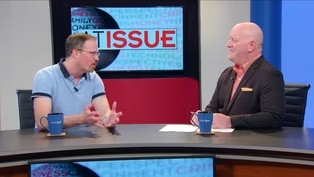
How Horror Movies Inspired Joe Chianakas to Write
Video has Closed Captions
Clip: S3 Ep31 | 2m 13s | Joe Chianakas explains how horror movies inspired his Rabbit in Red books. (2m 13s)
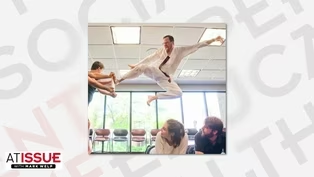
Joe Chianakas Writes the Story He Needed as a Teen
Video has Closed Captions
Clip: S3 Ep31 | 3m 1s | Joe Chianakas explains how his life inspired an LGBTQ young adult take on The Karate Kid. (3m 1s)
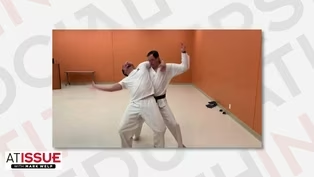
Writing LGBTQ Characters With Honesty and Heart
Video has Closed Captions
Clip: S3 Ep31 | 2m 31s | Joe Chianakas talks representation, romance and the ideas behind Singlets and Secrets. (2m 31s)
Providing Support for PBS.org
Learn Moreabout PBS online sponsorship New Episode
- News and Public Affairs

Top journalists deliver compelling original analysis of the hour's headlines.
 New Episode
- News and Public Affairs

FRONTLINE is investigative journalism that questions, explains and changes our world.
 New Episode
 New Episode
 New Episode
 New Episode
 New Episode
 New Episode
 New Episode
 New Episode
 New Episode
Support for PBS provided by:
At Issue with Mark Welp is a local public television program presented by WTVP