Consider This with Christine Zak Edmonds
John Lynn: A Lifetime of Wanderlust and Illinois Stories
Season 7 Episode 4 | 26m 46sVideo has Closed Captions
John Lynn turns lifelong wanderlust into adventures across Illinois and beyond.
Christine Zak-Edmonds talks with historian and adventurer John Lynn about growing up in Alta, hiking the Appalachian Trail, photographing communities across Illinois and creating his Main Street Illinois presentations. Lynn reflects on small-town history, river and bicycle journeys, walks abroad and the wanderlust that continues to drive his adventures.
Problems playing video? | Closed Captioning Feedback
Problems playing video? | Closed Captioning Feedback
Consider This with Christine Zak Edmonds is a local public television program presented by WTVP
Consider This with Christine Zak Edmonds
John Lynn: A Lifetime of Wanderlust and Illinois Stories
Season 7 Episode 4 | 26m 46sVideo has Closed Captions
Christine Zak-Edmonds talks with historian and adventurer John Lynn about growing up in Alta, hiking the Appalachian Trail, photographing communities across Illinois and creating his Main Street Illinois presentations. Lynn reflects on small-town history, river and bicycle journeys, walks abroad and the wanderlust that continues to drive his adventures.
Problems playing video? | Closed Captioning Feedback
Where to Watch Consider This with Christine Zak Edmonds
Consider This with Christine Zak Edmonds is available to stream on pbs.org and the PBS app.
Providing Support for PBS.org
Learn Moreabout PBS online sponsorship(cheerful music) - Will you consider this?
We all have a bucket list.
Sometimes it just stays a list.
Other times, boy, you take off.
And this guy, my guest, John Lynn, has quite a bucket list and has fulfilled a lot of those dreams.
First though, I want to know about John Lynn.
Who are you?
Where did you come from?
- I came from Alta, which is something that, well, not a lot of people could say that.
Now they can, they've been moved into the area, but, and of course, old time Alta people always say it's Alta, not Allta.
- [Christine] Right.
- That's the way it is.
The way it was.
I went to Dunlap High School back before it was Dunlap High School.
I mean, it was still a basic farm school out in the country, which is great.
- What was the name of the school, was it?
- It was Dunlap High School.
It just hadn't grown up out there yet.
- Okay.
Yeah.
- Then I went to the U of I, got a history degree, and then, I... Well, I was interested in tennis when I got out of college.
That was the age.
So, I worked at the tennis clubs for a few years.
Then I thought I needed a coat and tie job, so I worked for a company called Burrows here in town.
Coat and tie job selling data processing slips and small banks and savings and loans.
Excuse me.
Then I left all that, went and hiked the Appalachian Trail, and that was kind of a change of everything.
- [Christine] Yeah, no coat and tie for that walk.
- No coat and tie for that walk.
And that was a major undertaking and a great experience.
And I think the idea, I sold it to people on the idea that I'd get the wanderlust out of my system, and of course it just reinforced all the wanderlust.
- How long did it take you to do that?
- That was 140 days.
- Wow.
- It would, at the same pace, it'd take probably a couple more days now 'cause the trail is, I think, 80 miles longer than it was when I did it.
Well, then I worked at a local wildlife park.
I don't know if I'm allowed to say the names of things.
- You are, sure.
- Well, Wildlife Prairie Park.
- There you go.
- And I was interpretive naturalist, but we were always looking for speakers on subjects to do with Illinois.
Illinois-themed park there.
And if you went to state government, you could get somebody who could talk about tourism.
If you went to natural resources, you'd get somebody who could talk about parks, or they could talk about wildlife.
Somebody from the governor's office could talk about corruption 'cause they know a lot about it.
- Sure.
Yeah.
- Anyway, they're specialized, and I could never find somebody who could put that all together.
- [Christine] So you decided to take that on.
- Exactly.
- Okay.
- And I, you know, it's, I never imagined that it would be still going on 40 years down the way.
But it involved, I first wanted to put an educational program together to take to schools 'cause they needed materials.
- And was that Illinois or was that the cross country?
- That was Illinois.
- Okay.
- And I had to drive all over the state to get pictures of all the various historic sites and geographical landmarks, and to learn the story of Illinois, put that together, and that became my biggest selling program.
And then I started branching out into, I called it Cities and Towns of Illinois.
That's now the "Main Street, Illinois" program.
I walked the length of the state at one point.
And- - While you were researching, while you were doing your research, or just for fun?
- Just another way of experiencing things.
- Okay.
All right.
- And I had this old map on a corkboard where I'd put pins in it for all the places I'd been.
And when I did that walk, that gave me something like 50 different towns right there, plus all the others that I'd been seeing.
And that gave me the idea to go to every place in the state.
And that took eight years.
And I didn't take many pictures on that, just enough to prove that I'd been to these places.
- [Christine] Okay.
- But I did take pictures of historical markers, interesting buildings, cafes, taverns.
But this is in the film era where you really had to ration film 'cause it got very expensive.
- Exactly, and you didn't have the coat and tie income anymore.
- No, that's exactly right.
So I had to kind of ration the film, and I'd come back with maybe three or four pictures from a lot of these places, which doesn't say much, but it did say that I'd been there.
- Right.
- Proved that.
- Documented.
- Yeah.
And what I found in the course of those travels, getting pictures of the major attractions, and then what I'd see along the way, I was far more interested in the small towns along the way than all these, you know, the big attractions I headed to.
- [Christine] Touristy places.
- So that's when I started to emphasize more on these towns.
And that's sort of my family culture.
We came from small towns and- - Yeah, so tell me about that.
Your parents were from around the Macomb area?
- Yeah, Dad was from Rushville and Mom was from a little town outside, just 20 miles outside of Macomb called Fountain Green.
They met going to Western.
And then it was a happy story from there.
- There you go.
- Yeah.
I have a couple of sisters and myself.
Pretty normal group.
I've just been a little excessive on this Illinois job, and I'm still at it.
I mean, I take a day... Making presentations has paved my way to a lot of these areas.
And then once I'm there, I'll take an extra day and take photos.
And now it's in the digital era, and where I could cover a small town in five minutes, now it's more like 50 minutes, 'cause you can take pictures of everything.
- Exactly, and then go through and edit and figure out what you like, what you don't like, right?
- Right.
Some of it that I'm not even interested in at times, but it keeps a record of what was there.
- [Christine] You really like documenting everything.
- Well, I do.
Yeah, yeah.
Yeah, I guess that's true.
- But that's good, 'cause we need that, 'cause we're losing that in today's world.
We're losing some of our history.
So you make presentations.
- I do.
- You have a couple that you really like, and that's what we're talking about.
Main Street, and then you have "The Rise of Main Street, Illinois."
So what's the difference between those two?
Or one is part one, one's part two?
- Well, the first one is general, just tells a story all the way through.
And I needed another vehicle to use up the 50,000 pictures I have.
- Okay.
- I've got a ton of material.
Yeah, counting the other things, 75 or 80,000 pictures.
But Illinois, in that ballpark, and the new one that I put together, I just got that together, started showing it last year.
A little bit of the same stuff leading in, but then I went to how towns are founded, why they're founded, where they were.
You know, they've had access to resource, transportation, originally that was river travel, and then railroads came through and that was the main thing.
Then when the highways came through, it was really more a matter of connecting the towns that were already there along the rivers and the railroad tracks.
- Right.
But some of 'em were left behind.
- Yes, and that is something that is the sad part of driving through these towns for 40 years and seeing them change, and not many of 'em change for the better.
- Right.
Yeah, you see the boarded up windows and, yeah, exactly.
- Yeah, a few do, they're in the path of the Chicago expansion.
So a little town like Elburn has just blossomed, 'cause it was a struggling, dying, quiet little town until the growth came out that way.
And you could say that at Huntley, and a lot of 'em, a few towns around Peoria have prospered because of Peoria.
And then other places just, they dwindle.
Well, in that "Rise of Main Street," I also like to talk about the people who come from Main Street, Illinois.
And I'm always amazed when I find some name, a known name, not necessarily a celebrity, but somebody everyone's heard of, and then you find that they come from some little town.
- [Christine] Like Burl Ives.
- Like a Burl Ives.
- Right.
- [John] Yale, Illinois.
In fact, I- - Way down there by the Embarras River.
- Right near the Embarras River, that's right.
I've got a picture of his grave site about, I don't know, it must have been a month or so ago.
I was in the area and he's buried near Willow Hill.
But yeah, accomplished fellow, and came from this little town and little area.
So among those that I mention, Ed Mecherle, who was a farmer at Merna, which was just outside Bloomington, and now Bloomington's kind of grown out that way, but Merna's not much, but he farmed in the area and he started looking at his insurance bills and thought, "You know, I don't have, there's no crime in Merna.
Why am I paying these great, exorbitant rates?"
And he theorized that he was paying for the high risk areas elsewhere around the state.
So he investigated the insurance business.
And guess what?
He started his own.
It's called State Farm Insurance.
- How about it?
- And I'm thinking he got a better rate.
(Christine laughing) - He probably did.
So tell me about, so Main Streets, as such, really, really came into being, I mean, farmers had to have a place to come, to go, because obviously they just couldn't get their displies, there were no Amazon trucks coming out to farms back in the day.
- [John] True.
- So they had Main Streets, but how did they come into their heyday?
- Well, a little bit of it was westward movement yet.
Some of it was immigration, but the population was growing.
We'd gotten the Civil War behind us.
And 1830s was a really popular era for Illinois towns getting started.
But if you want to say what was average, that's when I get into that area between the Civil War and World War I, which the heyday.
As I tell people, for immigrants in those days, it was a great thing.
If you were, say, an Italian cobbler back in Italy, there may have been 50 other people who could do that.
- Right.
- Nobody's gonna make a dime.
But if you can get into this new... - New world.
- Territory, yeah, new world, new territory, new state, new towns opening up, you might be the only person within 50 miles with that skill and you're gonna make some money.
- Right.
- Alta, believe it or not, used to have a cheese factory.
And of course the English have great cheeses.
And I don't know if it's an English person who started that cheese factory at Alta, but imagine of all things, Alta had a cheese factory along with a lumberyard and a grain elevator.
- Right.
- And you could say that about a lot of small places out there on the map that, once there was a coal yard, a blacksmith shop, grocery store, you know, all these things, where today it's just a railroad crossing and maybe two houses that still remain, maybe one that's lived in.
So you see where a lot of these things slipped away.
But at that time in the growth era, it was a booming place to be.
And yeah, the majority of people in America came from small towns and rural places.
And I think that was a good thing, for my values.
- So what were the standard shops on Main Street there?
There had to be a bank, had to be a dry goods.
- Yeah, and you need- - A church.
- And maybe at the beginning, it was a general store, and we still have general stores in the forms of Casey's and Huck's and Fast Stops and places like that.
But people needed groceries, things they couldn't make on their own.
So that would've been an important thing.
A shoe store, for that Italian cobbler.
- [Christine] Exactly.
- A tavern.
- A couple of those.
- Oh, yes, a couple of those.
And that's where the Germans really came in handy.
You know, even the great Mexican breweries that there are today, Dos Equis, they hire Bavarian brew masters.
And most of our companies do, too.
But yeah, Mark Twain always questioned whether it was a church or a tavern that would be the first to reach the frontier.
Sometimes the church did, but usually it was more often the tavern.
- The tavern.
Yeah, and I think, wasn't there like one tavern for every 30 people or something like that?
- Oh, that could well be.
I haven't heard that, but that is very likely.
And the tavern would be a place where people could have meals.
They could have drinks, obviously.
Travelers could spend the night, and it became a natural, like a community center where people could gather together.
When there became a second tavern, well, that may have changed things, split that up a little bit, but still the same functions.
And yeah, there are, I think the last full service old inn still operating in Illinois was at Marshall, Illinois.
And it closed, I think in, I'm sorry, 2017.
- [Christine] And where is Marshall, Illinois?
- [John] I believe it's Cumberland County.
- Okay.
- Old Route 40 of the National Road, the Cumberland Road came through there.
And there's still an old bridge from the National Road around there.
And the Archer House, which was for a long time, the longest still-operating.
It turned into a bed and breakfast, and I could see that they struggled.
And the last couple times I've been through there, it has been closed, but maybe someday we'll give that another go.
- Oh, maybe.
- Who knows?
- And then, so you do presentations.
So we have a couple of names of some of your presentations here.
So you hire out so you can make some funds to get to another adventure.
- Exactly.
- So, you have "Main Street," "The Rise of Main Street."
And you do cemeteries.
So "The Dead People of Illinois" and "The Return of the Dead People of Illinois," so.
- [John] That's a natural.
- It is.
- Yeah.
- Tell me about that, because there's some fascinating things.
I mean, you find some that are killed by Indians or... - Well, that does happen, there are some massacre sites.
Was it Indian Creek Massacre site is north of I-80 up towards, I think, Baker, Illinois.
There was a massacre site down by Alton.
Someone named Reagan got killed there, but not any relation to the one up here.
- [Christine] All right.
- But yeah, that did happen during the Blackhawk War, it happened in isolated places here, there and around.
But I got into the cemetery thing as an extension of the Illinois towns thing.
Most of my business has been in the Chicago area.
So I run up and down the road between Peoria and Chicago a lot.
And all those towns I get to frequently, and get updated pictures.
And I decided, "Well, there's this other part of town out there at the cemetery.
Why not start taking pictures there?"
And I didn't spend much time before I realized "This has a lot of potential."
Some are beautiful, some are historic, some... - Need work.
- Every grave, there's a story.
- Exactly.
- And, can't tell all those stories, but learning some of those stories makes it a lot more interesting.
And then of course, me being me, I really took off on funny names.
I love funny names.
- [Christine] All right, so tell me about those.
- And you shouldn't make fun of people's names, I know, but... - They loan themselves to humor sometimes.
- They do.
Well, I just mentioned the town of Elburn that grew up in the Chicago area, outer limits of the Chicago area.
There's a name up there called Outhouse.
Big marker, and said "Outhouse."
(Christine Laughing) And I would show that as a suggestion of maybe one of those names people might consider changing.
- Exactly.
- And there are a lot of old words that didn't mean anything naughty or difficult or awkward, back when those names came around.
- Right.
- Yeah, it's, the usage is changed.
So that would spur some changes.
But an interesting thing, and I learn a lot from my audiences.
A woman came up after the program and said, she grew up in a community, and I've since found a couple others, where they had an Outhouse family, only they pronounce it "Oothoose."
- Oothoose, 'cause it's very German.
Or, I would imagine.
- Or English, I'm not sure.
But you'll remember, the old BBC show with Patricia Routledge.
What was it?
"Maintaining Appearances"?
Her last name was Bucket, and she introduced herself with the last name Bouquet, 'cause it sounded French and more elegant.
- [Christine] Right.
- So I theorized that they'd started calling it "Oothoose" to avoid the, well, if you go back, I learned later from some linguistic videos on YouTube that before the great vowel shift in the English language, and there was a vowel shift in almost every language, English, it was like five or 600 years ago, even before Shakespeare.
And at that time, before the change, that name would've been pronounced "Oothoose."
So they've just stuck with the right pronunciation, even though it looks like- - And the regular spelling.
- Yeah, even though it looks like they're covering up something by saying that.
Yeah, and there was a time when women, almost simultaneously, some were really given these cute, endearing names like Fanny and Minnie and Gracie.
And I got a list of like 50.
And at the same time, they were giving some of these unbelievably weird names that I haven't been able to figure out in most cases whether it came from some classic literature or the Bible or wherever.
But names I hadn't seen ever before, and you're not likely to.
And I'm trying to think of some of these, I don't want to say ugly names, but they were ugly names.
(Christine laughing) Well, there's a gal named Zenobia, and there used to be a Zenobia, Illinois, and that name came from some classic literature or some story.
- So, and they may have been some kind of family names from the old country that were carried over or- - Right.
- Yeah, pet names.
- Yeah, it may have been in the family for 100.
- So how many presentations do you have?
And then, and where do people find you to hire you out so that you can go on some more adventures?
- Well, I have something like 32 different presentations.
- Okay.
- And- - [Christine] Along with these 80,000 slides you have, or, photos, yeah.
- Yeah, and, I guess, when I don't have the money, Illinois is the way to go, 'cause everything is close by.
But I'm known more for those big hikes, the canoe trips, the bicycling trips.
I did walk the length of Great Britain.
- Right, yes, you've been to Europe.
Have you been to every continent?
- [John] No, I haven't.
- Uh-oh, bucket list.
(Christine chuckling) - That's gonna be off limits.
I'm not even gonna attempt to get to every place.
- Okay.
- But Britain was always a specialty.
My mom's side were Scottish, so that's kind of a natural.
But mainly the British Isles and Ireland, they're where I spent my time.
And learned the most about and did programs on those.
Not many people have paddled the three big Midwestern rivers.
The Ohio, the Mississippi, and the Missouri.
I've done those along with the Illinois and the Erie Canal.
I don't consider myself a paddler, I know nothing about it, I don't know anything about boats and equipment.
I know the history, and I just kinda want to soak that kind of thing up, and have a few experiences, too.
But, only 2 1/2 people a year, on average, finish the Missouri River, at least since the year 2000.
A friend that keeps track of these things.
- Well yeah, how long is the Missouri River?
- [John] It's America's longest.
- That's what I thought.
- It's just a little bit longer than the Mississippi at 2321.5 miles.
Mississippi's just a little bit shorter.
But I don't consider myself a bicyclist either, even though I've done thousands of miles of that.
I don't consider myself a photographer, all I do is take pictures.
I don't know anything about it.
- [Christine] They look pretty good to me.
- And, yeah, if you take enough pictures, especially in the digital era, you're, yeah, if you've got a good subject, nice weather, and a good camera, you're gonna walk away with a few nice pictures.
- All right.
- So the thing is to shoot in volume to make sure you get those pictures.
But the same thing with the hiking.
Yeah, I did the AT and I've always considered myself a decent walker.
That's the only thing that seems to come natural to me.
So I'd be willing to call myself a walker.
But backpacking, I really have no interest in anymore.
When you put a 30 or 40 pound pack on your back, that's the definition of turning a nice day's walk into a bad day's walk.
- [Christine] Okay, I got it.
- Yeah.
- And you've done it.
So where do people find you to invite you to make presentations?
And how available are you?
- Oh, I'm very available.
(Christine laughing) I've had a lot busier times than I've had since COVID.
COVID kinda changed things, and the libraries in the Chicago area still haven't gotten their audiences back fully.
It just, it was a disruptor.
Threw everybody out of their habits and routines.
- Absolutely.
- And a lot of people just haven't gotten back to that.
And I'm one.
A lot of restaurants in town I used to like to eat at regularly, I've hardly been.
Or they're gone, yeah.
- Right.
- Well, I can go ahead and give my phone number, and address and all.
All right, name's John Lynn, L-Y-N-N.
The number is 309-682-6025.
And if you're too shy about calling, there's email, but that's, it's too complicated to read that off.
I'd have to spell it for you.
But my mailing address, PO Box 624, Peoria, 61652.
And I'll pick that up right at the post office.
- And we can find you.
So isn't it pleasant that you are using your history degree?
'Cause how many people really get to use their college degrees?
- Not very many, yeah.
And I guess I really didn't have any plans for it.
That's just what I enjoyed.
And it was probably a really stupid thing to become a history major.
But I don't know, I sat down between my sophomore and junior years and went through the whole course catalog and marked courses I'd liked to take.
And then I went with the curriculum that allowed me to take the most of those classes.
So it turned out history, and I'm very happy with that.
American history, mainly.
And it's mainly the Civil War and the Lincoln era that I gravitate to, and always have.
- [Christine] Well, you are from Illinois.
- I am, yeah.
- And that's us, yes.
- Rightfully do that.
- Yeah.
But you run into everything when you go to these Illinois towns and you find out things you didn't know from a historical marker there, something you had no idea took place, but it was a big event.
Or famous person being born there or grown up there.
Those things I find, the surprises along the way.
- Well, thank you.
Thanks for doing all that.
I'm gonna have to find you where you are here one of these days so I can hear each one of those presentations.
- Yeah, well, I encourage people to attend.
That's what makes it go.
- Sounds good.
Well, thank you so much, John.
Nice to meet you, nice to talk to you.
Exciting to learn the stories, especially about the Oothoose family.
And we got a couple other, excuse me, famous people here with funny names, so, we'll talk more.
- Good, Christine, I like that.
- All right.
- Thank you.
- And thanks for joining us.
I hope you learned a little something, and give him a buzz because he's got some fascinating stories here, all across America.
And, you know, pay attention to your bucket list, too.
Until next time, be well.
(cheerful music) (cheerful music continues) (cheerful music continues) (cheerful music continues) (cheerful music continues) (upbeat music)

How Illinois Main Streets Came of Age
Video has Closed Captions
Clip: S7 Ep4 | 1m 18s | John Lynn shows how immigration and growth fueled the heyday of Illinois Main Streets. (1m 18s)
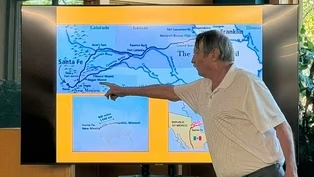
John Lynn's Quest to Visit Every Illinois Town
Video has Closed Captions
Clip: S7 Ep4 | 1m 3s | An Illinois history project leads John Lynn on a quest to visit every place in the state. (1m 3s)
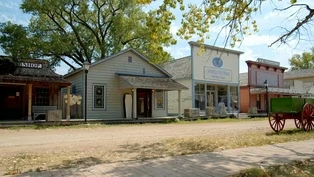
What Happened to Illinois Main Streets?
Video has Closed Captions
Clip: S7 Ep4 | 1m 23s | John Lynn traces how rivers, railroads and highways shaped Illinois Main Streets. (1m 23s)
Providing Support for PBS.org
Learn Moreabout PBS online sponsorship New Episode
- News and Public Affairs

Top journalists deliver compelling original analysis of the hour's headlines.

- News and Public Affairs

FRONTLINE is investigative journalism that questions, explains and changes our world.
 New Season
 New Episode
 New Episode
 New Episode
 New Episode
 New Episode
 New Episode
 New Episode

 New Episode
 New Episode
Support for PBS provided by:
Consider This with Christine Zak Edmonds is a local public television program presented by WTVP