
Jon Batiste’s New Nature Doc Explores the Swamps of the South
Clip: 11/13/2026 | 18m 8sVideo has Closed Captions
Jon Batiste discusses his new nature documentary, "American Amazon"
From the sounds of the American South to its natural beauty, Grammy Award-winning musician Jon Batiste is turning his attention to the landscape of the region he calls home. His new documentary "American Amazon" explores the biodiversity of the South and Batiste's connection to the music and culture that shaped him. Batiste speaks to Walter Isaacson about his Louisiana roots and the film.
Problems playing video? | Closed Captioning Feedback
Problems playing video? | Closed Captioning Feedback
Jon Batiste’s New Nature Doc Explores the Swamps of the South
Clip: 11/13/2026 | 18m 8sVideo has Closed Captions
From the sounds of the American South to its natural beauty, Grammy Award-winning musician Jon Batiste is turning his attention to the landscape of the region he calls home. His new documentary "American Amazon" explores the biodiversity of the South and Batiste's connection to the music and culture that shaped him. Batiste speaks to Walter Isaacson about his Louisiana roots and the film.
Problems playing video? | Closed Captioning Feedback
Where to Watch Amanpour and Company
Amanpour and Company is available to stream on pbs.org and the PBS app.
Watch Amanpour and Company on PBS
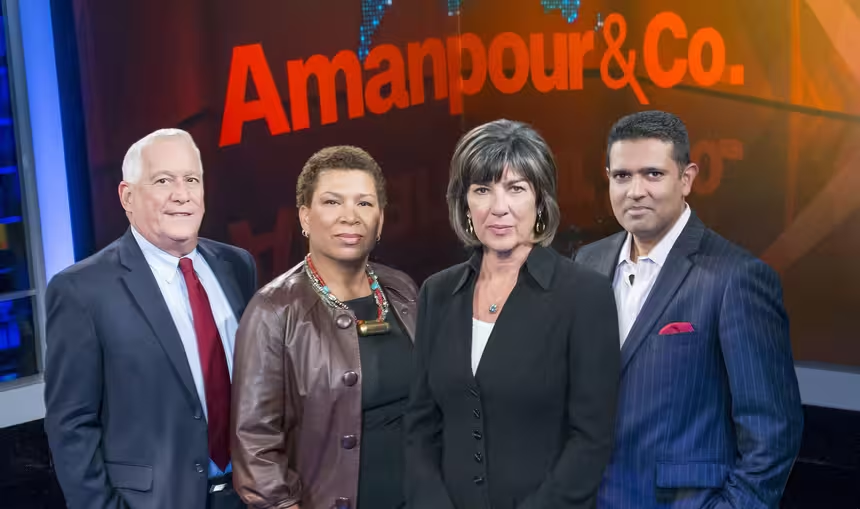
PBS and WNET, in collaboration with CNN, launched Amanpour and Company in September 2018. The series features wide-ranging, in-depth conversations with global thought leaders and cultural influencers on issues impacting the world each day, from politics, business, technology and arts, to science and sports.Providing Support for PBS.org
Learn Moreabout PBS online sponsorshipNow, from the sounds of the American South to his extraordinary natural beauty, Grammy Award-winning musician Jon Batiste is turning his attention to the landscapes and the wildlife of the region he calls home.
His new IMAX documentary, "American Amazon," explores the rich biodiversity of the South and its deep connection to the music and culture that shaped him.
These ancient strongholds are the seeds of the future.
Batiste spoke to Walter Isaacson about the film, his Louisiana roots, and his extraordinarily productive year in music.
Jon Batiste, welcome back to the show.
Hello, how you doing?
Walter, good to see you.
Good to see you.
And I just watched this wonderful documentary you did called "American Amazon."
It's about the flows of all the waters together and the biodiversity of the Deep South.
Why'd you decide to do that?
Well, I'm a son of the South.
I grew up just with the swamp in my backyard, and I didn't know it.
So when I realized that and I started to understand the importance of it and this opportunity came along, I thought it's a great opportunity to share my platform and introduce people to something that's near and dear to me that a lot of people don't know about.
They don't know that we have this incredible stronghold of the ecosystem that's in our country.
And I love the idea of calling it the American Amazon and really changing the perception of it.
Because you know, you think about the swamp, there's a lot of culture that comes from that.
And we kind of take it for granted in the sense of how important it is culturally, but also ecologically.
It's a divine alignment of nature that's keeping us alive and keeping life flowing.
A secret wilderness is hiding right in our own backyard.
A maze of ancient forests and untamed rivers.
[rushing water] Sustaining life... found nowhere else on earth.
You know, there's a line you have in there that I really love, which is, "The water is the source that connects everything."
And one of the things that struck me, it was a little bit like jazz music, in which so many tributaries and so many waters flow into it, and then your music, your social music.
Tell me how, in some ways, it's a metaphor for the music you do.
- I try to make the music feel inevitable.
I make music that feels connected to the past, present, to create the future.
And that's my goal when I'm taking from the past to learn and to grow and to understand so that I can create something that is brand new.
And that's what this is about, really the alignment of all things from the first drum, the first tree, the first river, all of the things that connect humanity over time is very similar to music and how these elements that are foundational in music connect us all over time.
So, we have to know that if we want to move forward and create a better future, a better world, we have to understand all of these things that have been left to us.
We are the stewards of the future.
And the swamp is such an allegory for life and the understanding of lineage and the passing of time.
The filmmakers use an instrumental version of your song "Petriture," right, which is about the aftermath of Hurricane Katrina, it's about the climate crisis.
Why was that used?
My mother, Catherine Batiste, who is one of my biggest inspirations, was an environmentalist.
She decided when we were very young that she was going to change her career path and she was going to understand why everybody who grew up in this area in New Orleans in the 17th Ward called Holly Grove where she grew up and where I would grow up partially with my grandparents and she would talk about how they called it Cancer Alley and how there was all of these people who would get sick and all of these different things that were happening in the environment she wanted to figure out why is this happening on my block in my neighborhood all the time why is it happening in the south I want to understand this so she really started to educate us as she got educated and shifted her career path and became an environmentalist and became somebody who worked for decades understanding and and being an activist in combat and the problems that we see in the south and then you get hurricane katrina that happens and when i put out my album big money hurricane katrina it was the the 25th anniversary i was thinking about petrichor which is the smell that happens in the environment that you you feel that smell it after a long period where there's no rain you need that smell that happens it's a beautiful aroma that's that that aroma I feel like that signals that everything is in order so I decided to call the piece petrichor because that's everything in order you get petrichor when it's all in order and the song in the film is perfect because the swamps and all the things that you see as sea levels rise as temperatures get warmer and warmer as we see all of these different impacts of the swamp of corruption then you get an understanding of why the swamp that we see in the South is so important, why things being in divine alignment and order in the environment is so important.
And it also is just a tribute to my mother and the fact that now, all of these years later from the time I was a little boy to now, this film that I'm producing and doing the voiceover that is speaking to the things that she was the first to teach me about.
And the song was a song that was inspired by those lessons.
You wanna play a few bars?
Oh yeah, I wish I had my banjo.
I played the piece on the banjo.
So uh... [playing piano] You say... ♪ My, my, my, my ♪ That's the refrain.
It's like, my, my, my, my.
Like, it's like we got folks humming.
It's like that old church hum, or like the wise elders, just that feeling of you're looking around and you're observing, and there's beauty, but there's peril.
It's both.
It's all the things like we talk about in life, the balance, and you just, my, my, my, my.
It's all, all you can say is my, my.
So I just wanted to put that into a lyrical context.
And then the words, you know, you talk about the words in the song, "Wonderful Petrichor, no more."
You know, you talk about criminal minerals.
It's too many chemicals.
All of the aspects of things that you would say if you were just having a conversation.
It was like colloquially, you're sitting down in the swamp and you're sitting on your porch and you're sitting there and you're looking out, my, my, my, man, it's too many chemicals.
We losing our minerals to the criminal mineral.
And the power of that sort of spoken, it's almost like a recitative in an opera, something that you kind of can speak a melody through.
And then I put that with some very black, Afro-American blues aesthetics.
And then I put the banjo and the violin, like the early kind of the Appalachian swamp, at the blend of those traditions to create that song.
"Big Money" is an album that was all about that, blending those early tributaries, those Proto-American forms.
You have three new albums out, which I've just been listening to, and they sort of explore the notion of piano playing.
When you were growing up here in New Orleans, you used to train very formally in compositions, but then at night you'd hang out in some of the clubs and learn the improvising.
It seems these albums do that, which is the formal training and the improvising going together.
Tell me about that.
I love the idea of looking at the canon and establishing a new precedent within the canon, understanding what's called classic, and then saying, well, now we can reevaluate what's considered classic, what's considered canon 250 years later.
And some things like the blues and gospel and jazz and soul and R&B music now should be considered classic in the canon.
There's a period when things go into the public domain, and then there's a period when things become the canon of greatness that we all consider and reference when we're trying to create art.
So I think about that often.
When I was growing up, there were things I was growing up with, and I understood in New Orleans, I understood that, okay, if you play this note a certain way, if you play that, that's the blues.
Now, if you apply that to... (playing piano) Play that, apply that to Beethoven, you get a certain expression out of it, that, that's, that approach and that philosophy, to me, is an expression of the new canon.
You know, I think when you were growing up, didn't you sit in with your cousin, Alvin Batiste, who also did some Mozart thing, and he did a song called Mozart that you played when you may have been 16 years old.
Do a little of that on the piano and explain to me how that's one of those tributary waters to this album.
Yeah, so he had a piece, it was a blues actually, funny we talk about the blues, he was one of the first to teach me about the blues and the understanding of it as a form, as an idiom, as something that we express that is taking the pain of life and transmuting it into beauty, right?
So you think about his tune.
(playing piano) He's taking this theme that Mozart did, this vernacular approach to Mozart's melodic theme that he would do.
(playing piano) Mozart has this thing that he does, idiomatic to his music.
Now, Alvin took that and created a blues vernacular piece that was also in tribute to this approach that Mozart had in his melodies.
So I thought that was cool to understand when I was 16.
Oh, you can take something like Mozart and you can apply it to this?
Okay, let me see what else I can mix and match.
And so you did that too with Black Mozart, the most recent album.
Show me how that flows into this album, Black Mozart.
Oh yeah, so you got some... It's the same.
(playing piano) And so do you write that up or do you improvise that, having played Mozart as a kid, and then just knowing how you're going to express it with feeling?
Well, that's an easy one.
For me, that's like a very basic feeling that I have.
I walk around the world all the time with the feeling of the blues in my soul.
So I just walk around with that feeling.
And then when I hear melodies, even if I hear a phone ring or if I hear the sanitation truck come by and it's going, "Beep, beep, beep," if I hear that, I'm going to go, "Yay, yay, yay."
I'm thinking that that's like the tonic of the blues.
I'm constantly expressing the blues in my way of life, and not sadness of blues, but just the feeling of blackness in the black diaspora tradition that I grew up with and understand just from an innate place.
So when I play this music, I always heard it like that.
I didn't think about it like, "Let me change it."
I played the classical music that I learned from my instructors, and then I said, "Oh, what if you... What if I kind of took it to this place of home within myself and just played it a certain way?"
So it wasn't as a project something that I had to think about in that way in terms of writing it out.
It was more I understood the original composition.
I learned it, and then I just took it through the filter of my life and my experiences, and that's what it came out sounding like.
You've spoken a lot about the power of music and your own social music is geared to this, which is bringing different people together, bringing diverse people together.
In this time of real political polarization and poison in our system, what do you think the role of music can be in trying to heal us?
Music is something that connects people across all of the possible divides, all of the division that can be caused when we think about politics or we think about the extreme versions of religious faith and aspects of differences that come when folks are trying to connect and then they just can't get past certain things.
And music is a thing where there's no discussion, there's no sense of paralysis from analysis.
It's heart music, it's soul, it's connected to this deeper part of yourself, this fundamental part of yourself, where at least once we get to the point where we can feel something and feel it together, then maybe we can have a discussion.
Maybe we can find common ground.
Maybe if I understand the feeling that you have is the same as the feeling that I have within me, then at a certain point we can see each other and see more commonality than differences.
So I really believe in showing the radical example of music and the connectivity of music in a way that it shows us the fundamental nature of humanity and injecting music into the conversation and into moments that you wouldn't expect there to be anything that can bring people together, anything that can bring joy.
That's why we do the Love Riot.
That's why we go to places, we go and play in places where people feel forgotten.
We go and play for people who feel that nobody sees them.
We go and create this experience, this moment that it ignites something within people and it's a mass revival of the soul.
Your wife, the writer and artist, like a joie, has been fighting leukemia and I know has gone through another round of bone marrow transplants just out of the hospital.
First of all, how is she?
And secondly, how is this connection between sort of pain and joy, which is very biblical, how does that affect your art?
Well, life is all the extremes wrapped into the experience of one's soul.
And you're walking through life and you're carrying these extremes and your soul is bearing the fruit of the great moments and you're in the peaks and valleys of the dark moments.
You got the valleys of the dark moments where you say, "Even though I walk through the valley of the shadow of death, I will fear no evil for your rod and your staff.
They strengthen me."
See, this is what I carry with me.
This is what I hold on.
This is what we hold on to in these moments.
It's this idea that life and this moment in time in a human body with your soul on this planet, you're going to carry those extremes.
You're going to be in moments where you're dealing with the darkness and the heaviness.
It's all one.
That's what this is made for.
It's everything all at once.
Everybody's going through something.
People who you see celebrating and lifting up their hands in triumph, they're also people who are going through something.
Everybody is going through it.
No one is exempt.
So that's something that we understand and we try to use our platform and our journey when we're celebrating these high moments to also show people, you know, we're dealing with stuff.
Everybody's dealing with things that we're all in this together.
You're not alone in your journey.
This is life and to shine a light on the fact that vulnerability in that way is a superpower and it can empower folks to understand that they're not alone.
Even just that realization can make folks understand that they can make it through to the other side.
And for me, my faith is always carrying me.
You know, as I quote, you know, Psalm 23, think about what that means and how powerful that is.
You anoint my head with oil, my cup runneth over.
Whew, just even in the moment where you're in your lowest point, He's with you.
God is with you.
The universal consciousness, however you wanna call it, what do you wanna call it, however you wanna call it, connect to it today, find it.
It's there in the quiet moments and we can connect to it at all times.
So that's carrying us.
And Sulayka is one of the most profoundly strong and deeply, deeply rooted in purpose of any person that I know.
I admire her and learn from her every day.
And she's surrounded by love and we're doing as well as you would hope for in this period of our lives going through what we're dealing with.
So I'm just grateful that we're able to have all of this love around us to foster us in this time.
- Jon Batiste, thank you so much for joining us.
Appreciate it.
- Absolutely, thank you, Walter.
 New Episode
- News and Public Affairs

Top journalists deliver compelling original analysis of the hour's headlines.
 New Episode
- News and Public Affairs

Today's top journalists discuss Washington's current political events and public affairs.
 New Episode
 New Episode
 New Episode
 New Episode
 New Episode


 New Episode



 New Episode
Support for PBS provided by: