At Issue with Mark Welp
Keeping College Talent in Illinois
Season 4 Episode 7 | 23m 5sVideo has Closed Captions
Bradley and Illinois Wesleyan discuss college affordability and keeping local talent here.
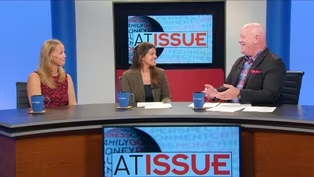
What makes students choose college close to home? Mark Welp talks with Bradley University’s Dr. Angie Cooksy and Illinois Wesleyan University’s Gaelyn Rose about keeping talent in Illinois. They discuss scholarships, local admissions initiatives, campus experiences and the career connections that help students build their futures in Central Illinois.
Problems playing video? | Closed Captioning Feedback
Problems playing video? | Closed Captioning Feedback
At Issue with Mark Welp is a local public television program presented by WTVP
At Issue with Mark Welp
Keeping College Talent in Illinois
Season 4 Episode 7 | 23m 5sVideo has Closed Captions
What makes students choose college close to home? Mark Welp talks with Bradley University’s Dr. Angie Cooksy and Illinois Wesleyan University’s Gaelyn Rose about keeping talent in Illinois. They discuss scholarships, local admissions initiatives, campus experiences and the career connections that help students build their futures in Central Illinois.
Problems playing video? | Closed Captioning Feedback
Where to Watch At Issue with Mark Welp
At Issue with Mark Welp is available to stream on pbs.org and the PBS app.
Providing Support for PBS.org
Learn Moreabout PBS online sponsorship(upbeat music) (upbeat music continues) (uplifting music) (uplifting music continues) - It's only October, but many members of the class of 2027 are already looking at where they'll spend the next few years of their lives.
One of the big questions is, will they stay home in Illinois or will they go out of state for their higher education adventure?
We're gonna talk about what Central Illinois universities are doing to keep kids at home.
Dr.
Angie Cooksy is Bradley University's vice president for enrollment, marketing, and communications.
And Gaelyn Rose is the vice president for enrollment at Illinois Wesleyan University.
Thanks for coming in.
We appreciate it.
- Thank you.
- Thanks for having us.
- I know you've been busy, and it's a busy time of year, but looking at the numbers, enrollment for both Bradley and Wesleyan are up.
So I guess let's start with you, Doctor.
Let's talk about Bradley and the direction enrollment's going.
- Yeah, we're really excited about this class that just came in in 2026 and having the energy on campus.
It's always my favorite time in the fall when the students come back because it's just a palpable energy when you have a whole bunch of 17 to 22-year-olds on campus and figuring out what their next phase of life looks like.
But for me in the enrollment space, we're already thinking about '27 and '28 and what that means to make sure we're offering a really valuable experience for students who are starting to think about college right now.
So it's exciting, and we're moving forward.
It's just kind of the name of our game.
- And Gaelyn, what about Wesleyan?
Tell us about how your fall's going.
- Yeah, wonderful so far.
There's a lot of momentum at the university, which same, just a high energy, I think, in the fall.
And everything always feels back-to-back when you bring in a new class, and then you have homecoming, and then you have family weekend.
It's amazing to see.
We're really thrilled.
We had our largest incoming class, I think, in recent history in 2025.
And then in 2026, now we have sort of our largest overall enrollment at the university in this past 10 years.
So it is same, just a really vibrant space on campus.
So many students and families that are excited, and a lot of those right here from Central Illinois and from the state of Illinois at large.
So we've enjoyed getting to celebrate those big wins and continuing to look toward the future.
- Yeah, I want to talk a little bit about the pool of students that you have to choose from.
When I do research for these stories, sometimes things really just knock me over.
And when I saw a statistic that roughly half of high school graduates in Illinois head out of state for college, that blew my mind.
And Governor Pritzker recently said, of those 50%, about 75% don't come back.
Whoa.
- Yeah.
- That's an interesting statistic.
I want to know first of all, and that's statewide, every university has seen that.
What is Wesleyan doing about trying to keep some of our brightest minds, especially in McLean County, local, and staying at home and going to school there?
- Yeah, absolutely.
So Illinois as a state has one of the largest net migration out of any of the states here in the US.
So it's something that we pay a lot of attention to- - I think we're top three, which is not a top three that I want to be a part of.
- It is not.
We are losing the most high school graduates and losing the most students who are leaving the state overall.
And so we know we have, right, demographics are going to be tough, and we know that this next decade will be tough from a college enrollment perspective.
However, these types of initiatives that we've continued to look at for both of our universities are incredibly important to keep local talent here in the state.
And so for us, that was the launching of our McLean County Direct Admit Program.
We piloted this about three years ago with Bloomington High School.
Then we expanded to five high schools for the next couple of years.
And now we've expanded to include every high school in McLean County.
So that means they will be able to receive offers directly based on qualifying academic criteria that their high schools are all coordinating with us.
So it's an incredible community effort for the entire county, and it's guaranteeing them a minimum $40,000 scholarship.
Sometimes it can be incredibly daunting, right, to look at that sticker price and understand whether or not that's even a possibility for your family.
And this has been a huge investment and commitment by the university to make sure that students know a nationally recognized, strong private liberal arts institution is well within their reach, right in their own backyard.
- What are some of those qualifications that need to be met according to be eligible?
- Yeah, that's a great question.
So we've been working really closely with the principals and with the college counseling offices at each high school to ensure that we are not looking at students who will not thrive there, right?
We want to ensure that students are having a great ability.
So they will have certain GPA metrics or certain kind of course requirements that they'll be fulfilling.
And our college counseling partners have been absolutely wonderful about ensuring those offers go to students who they know will be very successful at IWU.
- And Bradley, I know, has been looking at this issue too for years.
Tell us about some of the programs that Bradley has to try and keep some of our students here.
- Yeah.
So on the college side, we actually launched a new partnership with ICC this past year, really designed to build off of the Peoria Promise, where students, local students, are going to ICC, and then those ICC students have an opportunity to come to Bradley, and we've cleared up pathways and making sure that that really is a two-plus-two experience so students know that they've got that investment from the community to be able to stay here and choose that.
We also have really great relationships with our high schools, and I can't speak enough, and Gaelyn mentioned it, the high school partners that we have inside these high schools are really doing tremendous amounts of work.
And often we think about this as a one-to-one relationship.
We're working with one student.
When you get to work with these high school counselors, they're working with hundreds of students every year.
And so being able to go into these high schools, we had really great relationships, for example, with Richwoods High School this year.
It's a great IB program at Richwoods.
And so in partnership with them, we've reevaluated how we evaluate the credit for those students that are coming in with IB curriculum and making sure that we're giving the students the recognition for all of the things that they've done in high school or in their time at ICC to be able to then graduate from Bradley as quickly as they want to but maximize that experience.
In addition, we launched our Bradley Commitment in the last few years, which is a commitment from Bradley that for families making less than $65,000, they have the ability to go to Bradley tuition-free.
And again, recognizing that families come from all sorts of different economic backgrounds for 16 and 17-year-olds, this can be a really daunting experience to think about the investment of college.
So we wanna make sure, either through our academic scholarships or partnerships or grant opportunities, that these students, that any student has the opportunity to come to Bradley.
- And these programs that you both mentioned, are these something that other universities are doing too to try and entice people, whether it's in Indiana or Missouri or anywhere bordering Illinois, to try and stay in their own states?
Is this pretty common?
- Yeah.
I don't know how you feel.
I think there's been more innovation, maybe in the last five years in our industry than maybe in the previous 20.
Everybody's trying to figure out how to do more with less, how to meet the needs of students where they are today, and in really fast-changing technology demographics where things are changing, I feel like almost every day.
Things are changing on the financial aid side of things.
And so every college, if they're not asking these questions, I don't know where they work because it's really trying to figure out how are we serving our institution and making sure we're providing the experience that students are looking for today.
And also, how are we connecting with those students to show them that we have the opportunities?
And, you know, I always joke, people talk about, like, "Oh, this college is, you know, the hidden gem or the hidden secret."
I don't want to be anybody's hidden gem or hidden secret.
Like, I want people to know about all of the amazing things that we have at Bradley, but also in Central Illinois.
And I think that's the cool thing about higher ed is while we're recruiting the same students, we're also recruiting students differently.
And so we get to work in collaboration a lot, which is a different thing than many industries.
- And I would add, I think that's an incredible opportunity for students, right?
For colleges to take a step back and say, "Why are we doing this and who are we serving?"
And so there are 2,000 four-year colleges, right, throughout the United States?
And students will have more opportunities than ever.
And some of that is the simplicity of they can look up schools on the internet now as opposed to going to their local paper and going to the library and seeing what six schools are around them.
So there's a lot more mobility, but there's all of this innovation and this collaboration in this work that we're doing to ensure that college is accessible.
That means that our low-income students, our first-generation students, students who are just like me coming out of high school, they have more opportunities than ever before because there are more colleges who are investing in that education supported by, of course, our cities, our counties, our states.
But I think it is just a really, really special time to get to be part of college enrollment because of the rapid space and because of how much we've expanded access to students.
- The technology that you mentioned is interesting because I know when I got out of high school, I think the internet existed, but it wasn't what it is today.
And I actually came up, I grew up in the St.
Louis area.
I came up and I visited Bradley because otherwise all you had was a pamphlet, brochure, whatever, and that's all.
You knew you had to go really visit the schools.
And now you can take your virtual visits if you want and all that other stuff.
And recruiting students, I think when people talk about college and university recruitment, they automatically think of athletes.
But trying to recruit and get the best and brightest students, I mean, that's something too.
What kind of proactive things is Wesleyan doing to try and go out there and get the best?
- Yeah, absolutely.
So just like everything else, right, it's a tremendous collaboration.
So we have our coaches, who are, of course, working with their recruited athletes, but to the same token for our non-athletes, our faculty are an incredible representative of our university just as our students are.
And so in addition to our own enrollment office who's going out and meeting with the college counseling office, that's meeting with students in their high school, that's meeting with students and families in their hometowns, we also have faculty who are teaching lessons in high school.
We have student ambassadors who are hosting events at coffee shops and pizza parlors and getting to meet them in that way.
And I would say all of us do an incredible amount of marketing.
Enrollment simply doesn't exist without marketing.
So in every single available channel, we're going to be finding that space.
We're really excited about kind of some of the expansion into social media and digital spaces simply because we can reach more students who might be that unique, great fit for the type of education that we have here that we otherwise wouldn't always be able to see when they're many states away or in a market that may not have a ton of students for us to be visiting in person.
But overall, I think the greatest importance is that we're building a relationship.
Every single space we're doing, most of the students we're recruiting, it's not just in their senior year of high school.
We got to meet them as sophomores and as juniors, and we've gotten to know them over time.
I often joke it's not just the student's name we know coming in, it's their dog's name and their favorite treat, right?
We wanna make sure that we are getting to build that relationship with them because they're going to spend their next four years with us at an incredibly transformative time in their lives too.
- When you talk about looking for students or recruiting, you know, Bradley, I would say, has a leg up over some of the other places in Central Illinois because, you know, you've got Bradley basketball, which has done well in the last decade or so.
And you're in a bigger city, Peoria.
You guys, as much as you market, you're salespeople too.
So what's your pitch to a kid who's looking like, "Hmm, I could go to University of Miami and be on the beach, or I could go to Loyola in Chicago and be in the big city."
How do you market not only Bradley, but Central Illinois?
- So a couple things.
One, if you want to be on the beach in Miami, I'm not that, and I'm okay for that.
I'm not gonna apologize for not being on the beach in Miami.
There's a great university that's on the beach in Miami.
If that's where student want to go, we have to give them the space to go do that, right?
For me, it's really thinking about what are the great things that are here?
And as we talk about recruiting our local students, some of it is just exposing them to what is in Peoria or what is in Bloomington-Normal.
They often think, "Oh, I grew up here.
I know Wesleyan.
I know Bradley."
But they've never been on our campuses.
They've never necessarily, maybe they've gone to a basketball game or they went to a sporting event, but they've never thought about seeing themselves on campus.
And so as we recruit locally, it's just as much about helping them see the value in staying in Peoria as it is of them learning about our campuses.
And so we do a lot to get our students in the Peoria community onto campus.
A lot of our faculty are working on events.
We have a business and engineering club that's partnered with a number of the local high schools, and we have high school and middle school students on campus almost every Wednesday in our labs, meeting with our faculty, getting to do experiments in the quad, just so that they can see this place is right here in their hometown.
And often they're like, "I had just no idea."
We had a visit day yesterday, and I was speaking to one of our local families, and he was like, "Well, I just didn't think about Bradley 'cause it's just always been here."
And so it's different, to your question, how do you recruit these students?
You have to meet the students where you are or where they are.
The questions and conversations we may have with a local student may look different than a student that's coming from the city of Chicago or coming from Milwaukee or coming from St.
Louis 'cause they have different needs and concerns, right?
Like, if I'm coming from Milwaukee, where can I park my car?
You know, what does that look like as I'm traveling?
Can I stay on breaks?
Whereas a student locally might be like, "If I go home every day, am I gonna have the same social experience on campus?"
And so making sure that we have those personal conversations and really learning what are their concerns, but also what are they excited about and who can we connect them with so they can learn more about what they dream for their future is something that we take a lot of pride in.
- And Gaelyn, for those kids who don't care about going to the big city or the beach, and maybe they live in a small town now, Wesleyan probably has an advantage in terms of being able to say, "We're not too different from where you are now, and you like where you are now, so come check us out."
- Yeah, it's an interesting space, right?
We both are in areas that are a little bit of a middle.
And so I am from Miami, Florida, originally.
My husband grew up on a soybean farm in Southern Illinois.
So we often joke, right, like, if there's a nice middle place that can fit both of us.
I think we do see students from all over, but especially for some of our rural students, but really for students from anywhere, the campus itself is incredibly diverse.
And so you're going to meet students from many different states, many different countries, and you're going to get a globalized education no matter what you do.
And I think to Angie's point as well, right, you are special at what you are special in.
We are not going to apologize for the things we don't necessarily have on campus, but we also know that, right, we're number seven in the country for students getting jobs, and we have 98% of our students who are placed after graduation.
So I'd say so many of these colleges that maybe are some of those hidden gems or are breaking out of that hidden gem status, they have incredible amounts of success in terms of their graduates going on to do incredible world-changing work.
- [Angie] Yeah.
- And I know civic leaders, you know, when they see a Bradley or an IWU graduate, they want those folks to stay here too.
How important is it?
And I don't know if anecdotally or if you know any statistics about people to graduate from your schools, how many of them would stay in the area?
How important is that?
- I think it's tremendously important for our students to stay locally if they want to.
And we have such great partnerships with the community and the business leaders and the innovation that's happening.
Peoria is the healthcare hub for Central and Southern Illinois, and so there's really great things happening medically here, but also we have big industry here with CAT and Komatsu.
And so there's so many opportunities for our students to get lots of experiences.
And then for us in Peoria being, I just saw an article before I came on today, we're ranked as one of the top 10 farmer's markets in the country.
Like, there's so many things that are happening in the city that are attractive for our young graduates to stay and build their families in a place that's really largely very economical compared to some of the other places in the country.
And so they can start here and have some really impactful experiences right away after graduation.
- Absolutely.
I mean, I think business, agribusiness, healthcare, all of those, I think Central Illinois is such an incredible hub for it that our students get so excited and many of those similar businesses and partnerships.
I mean, I think 70% of our students, I imagine, are similar, will do an internship during their time in college, and it's because of those incredible partnerships that have been built over time.
But we even see it, you know, a little north in the state and heading up toward that Chicago area, some of those more burgeoning markets in quantum, right?
And some of those types of spaces that we've seen a lot of growth for us that students are still choosing to stay in state in places where they previously had to go to Silicon Valley or to do more of that finance to go to New York.
There are still some major hubs here in the state of Illinois where we see students be incredibly successful.
- So when students are looking at all these different options and seeing, you know, pros and con lists and all that stuff, the one thing they can't do a whole lot about is the tuition, and I'm sure their parents are really looking at those numbers.
So how do you stay competitive with, you know, you're both private universities, how do you stay competitive with the public universities that we've got a ton here in Illinois and tell us a little bit about that fight.
- Yeah, sure.
Yeah, we use an incredible amount of data, which sounds like a really boring answer, right?
But we are always keeping an eye on a variety of different sort of peer sets to ask to ensure that we know what a student would be paying at any of these institutions.
But most importantly, we need to focus on what is the cost of this type of education cost, because that is going to be different than at other large state institutions, right?
We know that we are not running the most efficient model by having, you know, a 17-to-one student faculty ratio.
However, it is something that's really important to how we do education where we are.
And every school has to decide, right, where we're going to invest at.
For us, it's in people.
And so I think that's incredibly important.
But overall, we spend a lot of time focusing with families on understanding that over 95% of students receive financial aid at Illinois Wesleyan.
Almost no one is paying that overall sticker cost.
However, it takes a lot of work on one-on-one with families to understand exactly what that family will pay because we want to ensure that we are as accessible as possible to as many families as possible.
So being able to launch our new $200 million campaign, where a huge portion of that is going to focus on scholarships and financial aid for students who need that, will only propel that even further into the future.
But we're really proud of the work that we are doing and that we'll continue to see over the next few years.
- Yeah, I can't agree more about the education piece.
I was working with a family yesterday, and the student told me, "Oh, I'm waiting till November 1st to apply."
And I said, "Why?"
And there's so much information that these students are getting on a day-to-day basis.
I think somebody told us, we were at a conference last week, and somebody told me that the average number of emails that our students are getting a day from colleges and universities is something like 30 to 50 emails a day.
And so you have to think about how are we breaking through that noise and how are we making sure that they see us in all of the information that we're getting.
For us, a lot of it is about timing, making sure that we are responsive as quickly as possible.
We automatically award students their academic scholarship at the time of admission.
There's not a separate application.
They don't have to jump through any additional hoops.
We are recognizing the work that they've done either in high school or in the community college space and saying, "We see you.
Here's what we're putting towards our investment in you to be at Bradley next year."
And then the FAFSA is open in October.
I can't say that every year 'cause it's been a little bit of a jumping ship the last couple years, but it's currently open now that we're in October for this year.
And we will work really hard to have financial aid out typically by Thanksgiving.
And that's usually earlier than a lot of our other peers in the space.
But for us, it's about making sure that families have as much time as possible to figure out, is this price work for our family?
Is the value that we're getting what we're looking for in the experience, and working with us to figure out how that can work.
That's why we do a lot of our admitted student events in the spring.
And one of the biggest changes I've seen in the last couple years is students used to visit colleges to decide where they were gonna apply.
And as our economy's changed and as the industry has changed, I'm seeing more and more students that are choosing to visit to decide where they're going to go after they've already been admitted.
And so making sure that our experiences are aligned with where the students are now all ties into what is the value proposition that we're promising and are we delivering it?
- 100%.
- Very interesting stuff.
Well, I'm glad that both of our local universities are thriving.
We have more than one, obviously.
So you guys keep up the good work.
Dr.
Angie Cooksy with Bradley University and Gaelyn Rose with Illinois Wesleyan University.
Thanks for coming in.
We appreciate it.
- Thank you.
- And boy, big investment money-wise, investment in your future, and a lot to think about with that.
- Yeah.
- Thank you very much.
- Thank you very much.
And we appreciate you watching tonight.
You can watch this segment again.
Just go to wtvp.org, and you can share it on social media, and we will see you next week.
Have a good night.
(uplifting music) (uplifting music continues) (uplifting music continues)
 New
NewPreview: Keeping College Talent in Illinois
Preview: S4 Ep7 | 30s | Preview: Keeping College Talent in Illinois (30s)
Providing Support for PBS.org
Learn Moreabout PBS online sponsorship New Episode
- News and Public Affairs

Top journalists deliver compelling original analysis of the hour's headlines.
 New Episode
- News and Public Affairs

FRONTLINE is investigative journalism that questions, explains and changes our world.
 New Episode
 New Episode
 New Episode
 New Episode
 New Episode
 New Episode
 New Episode
 New Episode
 New Episode
Support for PBS provided by:
At Issue with Mark Welp is a local public television program presented by WTVP