In the Arena
Beautiful Chaos: Pierre Paul’s Path to Accessibility Innovation
Episode 1 | 26m 46sVideo has Closed Captions
Pierre Paul turns lived experience and bold ideas into technology built for accessibility.
Entrepreneur Pierre Paul shares how immigrating to the U.S., finding his voice through speech and debate, and studying at Bradley University shaped his path as a founder. He tells Doug Cruitt how We Hear You grew from a dream of a sign-language translator into the Hero door opener, and why resilience, trust and a willingness to hear “no” keep him moving forward.
Problems playing video? | Closed Captioning Feedback
Problems playing video? | Closed Captioning Feedback
In the Arena is a local public television program presented by WTVP
In the Arena
Beautiful Chaos: Pierre Paul’s Path to Accessibility Innovation
Episode 1 | 26m 46sVideo has Closed Captions
Entrepreneur Pierre Paul shares how immigrating to the U.S., finding his voice through speech and debate, and studying at Bradley University shaped his path as a founder. He tells Doug Cruitt how We Hear You grew from a dream of a sign-language translator into the Hero door opener, and why resilience, trust and a willingness to hear “no” keep him moving forward.
Problems playing video? | Closed Captioning Feedback
Where to Watch In the Arena
In the Arena is available to stream on pbs.org and the PBS app.
Providing Support for PBS.org
Learn Moreabout PBS online sponsorship(low-key chilled rock music) (low-key chilled rock music continues) - Welcome to "In the Arena."
I'm your host, Doug Cruitt.
Now, this is not a show about pitch decks, vanity metrics, or overnight success stories, because quite frankly, those really don't exist.
This is a show about the story behind the startup, the human behind the headline.
It was Theodore Roosevelt who once said, "It's not the critic who counts, not the one who points out how the strong man stumbles, but the one who is actually in the arena, whose face is marred by dust and sweat and blood."
Every founder who sits in this chair right here, they know full-well it wouldn't be clean, comfortable, or even predictable.
Now, today's guest is someone who didn't just build a company, but he built it out of lived experience, frustration, probably a lot of conviction, and definitely a refusal to look away.
This is the story behind the startup.
This is "In the Arena."
And I'm pleased to welcome Pierre Paul with We Hear You.
Welcome, Pierre.
- Thanks for having me.
- Have a seat.
- Absolutely.
- Now, before we start talking about any sort of product or company- - Yeah.
- I need you to answer this question.
-Okay.
- Who was Pierre before he was a startup founder?
- Ooh.
Okay, you're sending me way back here.
Pierre before he was a startup founder, you know, he was born in Minas Gerais, Brazil, and he grew up in Guyana, a small third-world country on the top coast of South America.
And as a child, he knew that his parents were working really hard to provide.
So, his dad went to the United States to pursue a PhD in plant pathology and work in agriculture.
And he needed to raise enough money to bring myself, my mother, my siblings from South America to the United States.
And so, throughout this story, Pierre is a child who is trying to understand the world, and, you know, having phone calls overseas to his father, learning to sing from his mother, watching his brothers grow up and fight, and then my father does what he needs to do, and he brings us up kind of one at a time to the United States.
And then, that begins the journey of Pierre as a youth.
I'm young, I'm in the United States, and it's difficult.
It is difficult because we came to the US a little bit after 9/11.
So, the perception about foreigners, just in general, wasn't very positive.
And so, you know, my parents had a strong accent, but they spoke English beautifully.
I only spoke Portuguese.
And I also had an accent when I was a child.
And so, the ways that we were different, it was seen by the people around us.
And it led to a lot of negativity, a lot of xenophobia, a lot of hate.
And throughout all of that, I was asking my parents, like, "Why did you bring us here?
Why would you make this choice?"
And, you know, it really was something where they wanted me to trust the process, have faith in good humanity, even though I wasn't seeing it at the time.
So, Pierre before he was a startup founder, he was just a kid trying to figure out how to be a kid growing up.
Yeah.
- So, how old were you whenever you moved to the United States?
- So I was about, you know, five; five, six.
I remember my first time seeing snow, I was terrified, because growing up with the equator running through where I'm from, we don't see snow.
But I was a kid.
I was young enough to understand that things were changing and things were moving.
But, you know, not old enough to fully process what the world would look like.
- Right.
Now, how do you think those experiences at that age kind of laid a foundation or a bedrock that made you who you are today?
- You know, I think, if I hadn't experienced them, I wouldn't have so many core memories from that move from Guyana to the United States.
But they were foundational to the way that I maneuver now, right?
I faced so much shifting and changing at a young age that it put me in a place to say, "Okay, if I need to pivot, how am I able to pivot based on the example that I saw from my mother, from my father, from my siblings?"
So, I think being so young with so many changes, it gave me a mindset of being able to pivot and swivel on a moment's notice.
- Now, since you weren't born in this country, you came here, you didn't even speak the language.
- Yeah.
- How was, you know, the fitting-in piece of trying to make friends while, and maybe not so much when you're five or six years old, but as you got a little bit older.
- Bad.
It was rough.
You know, when I get to elementary and middle school, I was trying to fit in, but I stuck out like a sore thumb.
We're in the middle of Ohio, all right?
Not a lot of people look like me, they didn't sound like me, and they weren't necessarily kind because I was an outsider.
And it was at a young age when I realized that we treat people poorly who are different from us because we don't fully know how to understand them, how to engage with them.
And so, those difficulties led to, you know, some core memories; people spray-painting terrible stuff on on our door because there was so much hate and fear.
And it took a lot for me not to blame those individuals, and that was kind of the guidance from my parents.
And actually, my sixth-grade teacher.
My sixth grade teacher, Mrs.
Boyle, she was really the first person who didn't look like me, who believed in me, and it helped shift my perspective on what it means to be a person, right?
What it means to be a human being in a world with other human beings who are just trying to figure it out.
- Thank you, Ms.
Boyle.
- Absolutely.
- And that's, I think, one thing to point out is sometimes it just takes one person- - One person.
- To believe, to then, especially in someone that's young to gain that little bit of confidence, and you just never know where that's going to take that person.
- Not at all.
- So, as you're going through school and you're starting to fit in now, clearly right now I think all the viewers would probably agree you're very eloquent with your words.
- I appreciate it.
- And was that an intentional, like, a practice that you focused on it so, so much?
- Yeah, so I actually view it as kind of an obsession.
When we came to the US and the school system was like, "If he doesn't learn English, we're gonna hold him back."
My parents were like, "No more telenovelas.
No more Portuguese Power Rangers, English."
Because English was spoken beautifully by all of my siblings, by my parents, but I, as the youngest one, Portuguese was what I picked up.
And I was learning that.
And so, I became obsessed with English because I knew that I was losing a part of myself when I had to lose Portuguese.
And so, I said, "If I was going to miss this section of myself, I was going to master English in a way that had never been seen before."
So, I was in fifth grade, sixth grade, seventh grade, through really eighth grade, learning Socrates, Aristotle, Plato, understanding how they used rhetoric and the devices inside of those, like, rhetorical devices, pathos, logos, ego, ethos, and then the systems that they broke down into.
Sophistry, as an art form, as a debate style, I was obsessing over it because I wanted to eloquently articulate what I felt when I came to America, what it feels like to be here, and how it might feel for others who haven't found that voice, who don't have that skill of rhetoric.
So, it became an obsession that led me into high school.
I knew.
A lot of kids going into high school, they're like, "You know, I wanna be the jock.
I wanna be, like, the captain of the whatever team."
I wanted to be the speech and debate guy.
I wanted to be the guy who was doing speech and debate and was dominating the circuit.
That's what I knew I wanted to do, so.
- And?
- I did it.
- You did it.
- So, you know, I jumped into high school, and I started out with speech and debate freshman year, had a good year.
Went into sophomore year, and it was a little bit unknown.
It was unknown because I started in a debate category where I had a partner.
Partner and I had a falling out, so I needed a new category.
There was a category that we had never had somebody from our school do, and it's called impromptu.
Impromptu speaking is where they give you a random prompt, and you have two minutes to create a seven minute speech about that prompt.
And so, I remember my speech coaches Mr.
Frank and Mrs.
Custer, they're like, "Okay, try it out.
You'll be our first impromptu speaker."
And I'm like, "All right.
Yeah, sure."
And I go out, and it turns out I had it in me.
It took some time.
It took some practice, it took some growth.
But I went out sophomore year, only person in this category from our team, but I'm showing up and I'm showing out.
Get to junior year, doing a different category, get to senior year, and I graduate senior year as the number-one public speaker in Ohio, number seven in the US.
And, you know, it just solidified the work that I was doing.
It was grueling.
A lot of people talk about how they hate hearing their own voice on camera.
I had to.
I was re-listening to myself give speeches and give moments of different things that I experienced.
I was listening to Winston Churchill, to Barack Obama, to Malala Yousafzai.
I was listening to people speak and taking it and thinking about their style and the emotions that they invoked.
So, it worked out well, because then I got a speech scholarship to attend Bradley University, which was the number one speech school at the time.
- Wow.
- Yeah.
- That is amazing.
- Thank you.
- So, other kids are, are sports, music, band.
- Yeah.
- And you're practicing your speech.
- I'm practicing speech.
- So, when you're going to gym you're listening to Churchill.
- Oh yeah.
Absolutely.
- And you're putting in the reps of speaking, learning.
- Yeah.
- Now, I think this is probably a good place to transition over to more of the present.
- Yeah.
- How did that, that upbringing, that early stage of your journey break something in your mind to decide that you wanted to step into the arena and become a startup founder and build something from nothing?
What was the fuel?
- Yeah.
- Was there a single moment where you're like, "I want to create, I want to build, I want to do something new?"
- You know, to step into the arena, like, to step into the arena that we're in, I think it's a conglomerate.
Multiple things have built up to this moment.
When we think about what I just spoke about from my early childhood, my parents took a chance.
They took a risk.
They were entrepreneurs in the sense that they stepped into a different arena that was a different nation to make an opportunity.
I go into, to middle school, I step out of my shell to figure out how do I get people to accept me for who I am?
I go into high school, and I had this vision of being a speaker, a debater.
And then, I had to step into the arena to become a debater, a speaker.
And so, then when I get to college and I'm, you know, studying political science and thinking about going to law school, and everything is all set up.
And one night, I had a dream to invent a sign-language translator, something that I had no connections to.
There was a choice.
Do I follow the path that I decided for myself that I thought was right, the path of going to law school?
Or do I take a chance and trust divine intervention, divine timing and step into this unknown arena?
And here we are now in the present, knowing that that arena is what leads us here.
- Right.
- But I'd say all of those things, brick by brick, built the foundation.
- That's amazing.
Now, you mentioned We Hear You and the ASL translator.
Let's talk about that a little bit.
- Yeah.
Had a dream.
I wish it was like this profound dream where, like, I and shook hands with Jesus, but that's not what this was.
I was walking into a McDonald's, and I was ordering my regular, when I used to eat McDonald's regularly in college.
I ordered a McChicken, a McDouble, and an Oreo McFlurry.
But in the dream, I was deaf.
So, I signed my order into a system that was on the counter, just a tablet.
And when I signed my order, it verbalized it for the hearing associate behind the counter.
And then, when they spoke into it, it signed back to me.
And I woke up the next morning, and I'm like, "Well, that was odd.
That was interesting."
- And now I'm hungry.
- Right, so now I'm hungry.
And I call Bethany, who's now my co-founder and the chief operating officer at the company.
I'm like, "B, I have this crazy idea."
And luckily, when you have, like, the mind of an entrepreneur, you surround yourself with people who entertain your crazy ideas.
- [Doug] Yeah.
- And so, from there, like, Bethany's engaged, and she's asking questions.
"Well, how this, and why this and da, da, da, da."
And somehow, we got to the point where it was the reason that we need to do this is because we hear the struggles of the people around us.
We know that there is a communication gap, and we might be able to solve it if we try.
- Right.
- And that's what gave us the mindset and the fortitude to move in that direction.
- Now, what year was this?
- Ooh.
Oh my gosh.
You're taking me back.
I was between my bachelor's and my master's.
So, I'm going to say it was 2019, right before COVID hit.
Right before COVID hit and took out the world was when this idea was kind of coming into fruition.
So, let's say 2018, it was building up, and then the incorporation stuff happened in 2019, and then we launched right before COVID took over the world, that December.
- [Doug] Wow.
- Yeah.
- Now, where does that product lie today?
Tell me about that, that specific part of your business.
- Yeah, so that section of the business, you know, we had such a phenomenal run.
We did a pilot with Air Emirates in Dubai, and we were taking it to different parts of the US and just testing it out, and learning with the deaf community.
Building, understanding the plight and why it wasn't right when we first built it.
And so, right now that one is pending an exit.
That's as much as I can say as of right now.
But that one is pending an exit to a deaf-owned team, and we're very excited about that opportunity.
- Congratulations on that.
- Thank you so much.
Thank you.
- Exiting the arena on one.
- Yep.
- But that buzzword of a pivot, or this may be an evolution.
- Absolutely.
- A continuation of a dream.
But tell us what you're working on now.
- Yeah, so it really is a continuation in a different lens.
While the sign language translator was being developed, we were recognizing how inaccessible Bradley's campus was.
Love Bradley University.
They've taken so many steps to grow and be better.
But, you know, we're working on campus, we have friends on campus, we're carrying books on campus.
And doors suck everywhere, right?
And we just happen to narrow in on the doors on campus.
And so, you know, we were talking as a team, and I had this idea for, like, a James Bond kind of, like, device that you can, like, talk into or, like, you press your chin on it, and it opens doors for you.
Don't know where to place it, right?
I'm on a podcast with Carden Wykoff, who is a cherished member of our team.
And we're talking, we just met.
We met taking a class at Cornell online.
And I was like, "Hey, your last name is the building that I'm a hall director in.
Is there any relation?"
And she was like, "Oh yeah, my great, great, great somebody actually is the one who put the funding in."
And I'm like, "Whatever."
Like, that's so wild.
And so, we're on the podcast, and I'm telling Carden about this idea that I have.
And she kind of stops the podcast, and she's like, "Pierre, I'm challenged with doors every single day because I have muscular dystrophy, and human kindness doesn't come as frequently as you would think."
And when she said that, it blew my mind.
- [Doug] Wow.
- Because we live in a world where you see people hold the door, right?
You want people to escort grandmothers across the street.
But she said that, and then we got building a system that could open doors.
And so, now we're working on the Hero Door Opener, a device that can make virtually any door automatic in less than 15 minutes.
- That's amazing.
So, we're gonna dive into the Hero door opener a little bit.
So, one question.
- [Pierre] Yeah.
- TAM, SAM, SOM.
How many doors are there in the world?
- Oh man, you know?
I'll have to send you the clip.
I just did a little interview where I said TAM, SAM, SOM is probably the most overrated.
- (laughs) Yes, it is.
- But fair question.
You know, about 42 billion doors around the world.
- [Doug] Okay.
- Right?
And so, you might have seen the question where it's like, are there more doors than windows?
I'm saying doors.
I'm saying there are more doors, but there are a lot of doors, right?
There are a lot of doors around the world because every single building has an exterior door.
Then you walk in, and there are multiple interior doors.
So, we're saying 42 billion roughly around the world.
- Hopefully that comes up in a trivia night sometime soon.
- [Pierre] Oh yeah, you got it.
- Get it.
I appreciate that.
So, this is taking doors that exist that currently are not accessible to turn them into an automated door that will open.
- [Pierre] Absolutely.
- [Doug] Pressing a button or an app.
- Absolutely.
You can use voice activation on the app.
We just got an Alexa compatible.
You can use a regular wall button.
You can use a fob that you put on your key chain.
And so, I want you to imagine all the doors that you walk through every single day.
I want everyone to.
- Yeah.
- And you think about the hotel.
You walk into a hotel, you have all your luggage with you.
You're trying to, like, kick the door after you hit it with your elbow and try to push through.
We want a world where you tap the key card, the door automatically opens.
Right?
We want a world where if you want your bedroom door to be automatic, you can.
If you break your leg and you need your garage door now to be automatic, we can make that happen without having to break the bank.
- Wow.
So, how do we turn a normal door- - Yeah.
- Say, a bedroom door in somebody's house or a door on college campus.
How do you turn that into an automatic door without installing a bunch of wires and what I imagine would be a pretty expensive time-consuming thing?
- Absolutely.
Right?
So, if you're trying to make a door automatic, it's gonna cost anywhere from five to 10 to $30,000 depending on the type of door.
Whether it's sliding, telescoping, revolving, et cetera.
And then, the hard wiring.
If you want to do it in a way that is more robust, you use the Hero door opener, right?
Which, you know, we have it right here on the door.
And what sets it apart is that it's portable.
It's lightweight.
Currently, to our knowledge, the lightest in the world at 5.8 pounds.
- Okay.
- And we created an over-the-door hang.
So, if you imagine, like, the shoe racks that you might have had at home where you kind of, like, hang it there and, like, you put your shoes inside of the little pouches.
We did that, but with the Hero door opener.
So, you just tighten the screws around it.
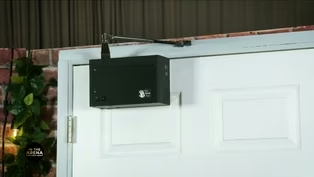
It creates a seal to the door, and then you slide the Hero onto it, attach the arm to the top of the door, and then it works as a free-swinging door when you don't need it to be automatic, and then it's automatic if you need it, right?
Doors not being automatic impact individuals with disabilities; largest marginalized group in the world, and the only group where majority of us become a part of, whether it's because of temporary injury or old age.
- Right.
- Right?
Parents with a stroller.
Your hands are full.
You're a dad, your hands are full with all these things, and you have doors to maneuver through.
Everyone benefits.
So, a college campus, a hotel room can make their door automatic with the Hero because we made it so you don't have to hard wire it into the building.
You plug and play.
- [Doug] That is impressive.
- Thank you so much.
- So, another very important world that those of us in the arena you got to talk about is traction.
So, where are you seeing the most interest not just of, "That's a great idea," but putting action towards that of, "We want to place an order, we want you to install it in our buildings, in our homes."
Where are you seeing that traction?
- So, we're seeing the most traction in assisted living facilities and hotels.
And so, you know, just to kind of speak to it a little bit, we've had a blockbuster year.
- That's fantastic.
- We started this year.
Thank you.
We just signed a a 240,000 Euro contract with the EU.
And so, that's for hotels across France.
And then, the Netherlands just reached out and said, "Hey, we heard what you were doing in this section.
We want to see if this can actually spread across our region."
So, hotels are really exploding.
We're working with Morgan's Hotel in San Antonio, and these hotels are seeing that accessible travel is important, that ease of mobility is important.
- Right.
- So, that's a huge arena for us.
Assisted living, as well, right?
If you have an assisted-living facility that is really caring for the individuals that are present, you know that falls and trying to grab a door and trying to maneuver and being hit by a door, you can't have it happen.
- [Doug] Right.
- So, those are areas where we're really seeing it explode.
And then people are using our website for B2C, right?
They're going and buying a Hero for their dog.
They want their dog to be able to go out the back door when they're not home, so they set up a little, like, button- - Oh, wow.
- For the dog to press to go out.
And I'm like, "You know what?
That's the beauty of innovation."
- It truly is.
- Yeah.
- So, this journey, I mean, it's what I love about this show and what it's meant to be is to find the story behind the startup, so going back in time and seeing who Pierre was before the startup, and now you've stepped into the arena and we talk about the dust and the blood and the sweat.
What are, like, one or two quick things that really maybe you didn't expect that really maybe knocked you down to your knees, and from that, what have you learned?
- That's a great question.
That is a great question.
So, I think first, when we launched the first product, the sign language translator, we had spent so much time building and working on this product.
And I'm a researcher.
So, I remember I compiled a brief, and I dropped it on the desk of the data scientists, and I'm like, "Hey, this is what people have done.
This is where they dropped the ball.
This is where we're not going to drop the ball."
And when we started reaching out to Schools for the Deaf within about a 300 mile radius of Peoria, most of the schools for the deaf said, "Nope, we don't want it.
We don't care.
We don't want this product."
- [Doug] Wow.
- And it was jarring, because I'm 19, I'm 20.
I got to go to my team and tell them something.
And I remember I went to my team, and what I said was, "Hey, we have to do this in a way that has never been done before.
We have to build trust within the community so that we can establish ourselves as different from the other people around us."
And so, that was, that was one major moment that comes to mind.
And then, a second moment is how easily that shift from "No" to "Yes" can happen, simply by putting in the hard work.
- Yes.
Now, behind us here, a tradition that you're starting here on "In the Arena" is we ask our guests to come on because a stereotypical whiteboard - That's a lot of us founders.
- Yeah, yeah, yeah.
Of course.
- You got to just kind of just throw everything you can against the wall.
- Yeah.
- Tell us about that quote up there, because I love it.
- Yes, absolutely.
A good "Yes" is protected by a million "No"s. The resiliency that it takes to step into the arena, you're going to get told "No" a lot.
People aren't going to like your idea.
They're gonna tell you that it's not going to make it.
They're going to explain to you all of the reasons why it isn't for them, why it might not work.
But those "No"s lead to just one "Yes" that can change your mindset, that can change the company, that can change the team.
That "Yes" doesn't always mean an exit, doesn't always mean, like, a big sale.
That "Yes" can just mean somebody believed in you today, tomorrow.
When you got seven "No"s yesterday, but the next day somebody says "Yes."
"Yes, I love that idea.
Yes, I believe that you can do it.
Yeah, I'll let you do a demo here."
And so, that quotation drives our team in so many different ways.
- I love that.
If you were to say in one to two words.
I'm going to limit you, one to two words.
- [Pierre] Yeah, yeah.
- How would you sum up your journey thus far?
- Beautiful chaos.
- [Doug] (laughs) I love that.
- Beautiful chaos.
- [Pierre] Beautiful chaos.
- Yeah.
- Fantastic.
Well, I appreciate you coming on, stepping into the arena, telling us your story behind the startup.
We hope that other founders out there will learn, learn from what you've done and been able to accomplish, and best of luck moving forward.
- Thank you so much.
- Now, what I love about Pierre's story isn't just what he's building, it's why he stayed in the arena when it would've been easier to walk away.
The person in the arena isn't perfect.
He or she doubts.
He or she bleeds.
They get it wrong sometimes, but they show up anyway, again and again, and service as something bigger than him or herself.
Now, if you see a founder out in the wild, and it feels appropriate, go give them a hug.
Seriously, there's a chance that they need it more than they'll ever admit.
Join us next month as we step back into the arena with another founder daring greatly and choosing effort over comfort so that their place shall never be with those cold and timid souls who know neither victory nor defeat.
I'm Doug Cruitt.
This is "In the Arena."
(soft music) (soft music continues) (bright relaxing music)
How Immigration Shaped Pierre’s Resilience
Video has Closed Captions
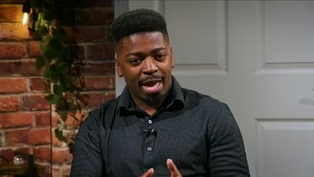
Clip: Ep1 | 1m 55s | Pierre reflects on immigrating from Guyana and learning to adapt through change. (1m 55s)
The Inspiration Behind the Hero Door Opener
Video has Closed Captions
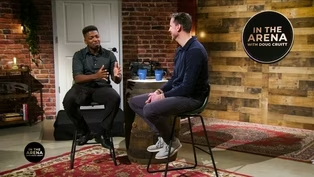
Clip: Ep1 | 42s | A candid conversation inspires Pierre to create a faster, affordable automatic door. (42s)
Making Everyday Doors More Accessible
Video has Closed Captions
Clip: Ep1 | 49s | Pierre explains how the Hero Door Opener can automate nearly any door in minutes. (49s)
Providing Support for PBS.org
Learn Moreabout PBS online sponsorship New Episode
 New Episode
- Science and Nature

Explore scientific discoveries on television's most acclaimed science documentary series.









Support for PBS provided by:
In the Arena is a local public television program presented by WTVP