WTVP EcoWatch
What Is Inside a Solar Panel?
Clip: Season 3 Episode 1 | 6m 16sVideo has Closed Captions
A solar expert explains what panels contain, how they endure weather and affect farmland.
University of Illinois professor Philip Krein explains what solar panels are made of, addresses concerns about hazardous materials and describes how panels withstand Central Illinois weather. He also discusses construction on farmland, restoring land after a solar lease and why rooftops, parking lots and other developed spaces should be prioritized for future solar growth.
Problems playing video? | Closed Captioning Feedback
Problems playing video? | Closed Captioning Feedback
WTVP EcoWatch is a local public television program presented by WTVP
Support for Ecowatch is provided by the Backlund Charitable Trust
WTVP EcoWatch
What Is Inside a Solar Panel?
Clip: Season 3 Episode 1 | 6m 16sVideo has Closed Captions
University of Illinois professor Philip Krein explains what solar panels are made of, addresses concerns about hazardous materials and describes how panels withstand Central Illinois weather. He also discusses construction on farmland, restoring land after a solar lease and why rooftops, parking lots and other developed spaces should be prioritized for future solar growth.
Problems playing video? | Closed Captioning Feedback
Where to Watch WTVP EcoWatch
WTVP EcoWatch is available to stream on pbs.org and the PBS app.
Providing Support for PBS.org
Learn Moreabout PBS online sponsorshipProfessor Krein, some people are worried about the contents of solar panels.
Can you tell us what the solar panels are made up of?
- Sure.
A solar panel that you would put on your home or typical one that's used in a commercial setting will have an actual silicon solar cell ultimately made of sand, refined, pure silicon.
And then the metalization, the conductors on top of it that'll be mounted on a plastic backing, and then there's a glass front piece and some aluminum framing to wrap the whole thing up.
I actually have a little mock-up we did over here.
So there's a typical silicon cell and you can see the metal contacts, the vertical ones there, and a piece of glass in the front and a piece of plastic behind to hold it together.
- And some people are worried that there's hazardous chemicals in there.
I've heard people say things like, "oh, there's heavy metals in there.
Like lead and, and cadmium."
Are those things in there and?
and if they are in there, are they in large amounts?
- Al almost all of the commercial solar panels are made of silicon.
Now, there are some other technologies that, that use a, a different materials, but they're actually pretty unusual these days and almost everybody has gone to lead free solder heavy on the tin and the silver.
So, minimal hazardous material, less than you would have in a laptop computer or or anything like that.
- Let's talk a little bit about how these companies protect their investment.
They obviously don't want the solar panels to break, but we have seen them break.
I mean, how easily can they break, and is it a big deal if they do break?
- Sure.
Well, the glass in the front is there for protection.
It has to be as clear as possible, and all the manufacturers use what's called a low iron glass that's as transparent as they can make it.
And it's not completely impervious.
I mean, it's not thin stuff.
Here in central Illinois, it's gotta be able to take a certain amount of hail damage without breaking.
I did see a panel on a friend of mine's house with a hole just about the size of a golf ball.
He lives next to a driving range.
So they're not completely impervious to being broken, but they stand up to most of the weather we can hit them with here in the region.
- Sure, and when these solar farms are built, sometimes they're built on farmland, and people have concerns that maybe once that is built on the farmland, that it, quote unquote, ruins the farmland.
Can you tell us a little bit about the building process and what that does to the soil?
- Sure, virtually, all the construction in our area, certainly involving solar, but also any significant structures, anything like that, the first step with the contractor is to come in and actually remove the top soil, take it off and either use it in another place where it can be productive or store it actually for use elsewhere.
I know when we do construction on campus, the top soil is always put into a pile in the south campus for reuse later.
So the top soil would come off.
The concrete structure that holds the panels, which... it's not like a parking lot, Relatively limited use of that would go in and then the panels are mounted in that way.
So it's relatively easy to sort of deconstruct that at the end of life, take that back out, and then of course bring the topsoil back in and restore the property to its original use.
- Yeah.
I was gonna ask you.
After, let's say a farmer has a 20, 30-year lease, and that comes up, and they decide they wanna go back to farming, they can take out the solar farm and the soil's not ruined per se, is it?
- No, certainly not.
Again, the top soil would've to be brought back in, but that's a typical process in our region.
And no question that anybody who wants to do that.
You want the deconstruction terms in that contract up front so that there's no surprises at the end when you wanna go back to farming about who's responsible and who's paying to come in and actually take those things out and get 'em recycled properly.
- So you've been studying solar a lot in your long career there at the U of I. Where do you see the future of solar going, whether it's residential or the so-called solar farms that we're seeing in central Illinois?
- Well, I think a couple things.
Number one, we are at the point where solar energy and wind energy are actually the lowest cost resources.
And indeed right now in Illinois, they're the highest-growing capacity element as we build up, try to build up more energy supply and remove some of the older, more expensive plants.
And I don't see that going anywhere.
There's continuing advancements that are continuing to bring prices down so it will be the low-cost energy resource.
Now, personally, I'm not a fan of converting farmland over to solar panels.
When we're at the point where the economics say that the land is better to produce energy than it is to produce food, there's an issue there.
We have seen some, so solar foldable tech combine kinds of things where people can do vegetable farming and other things under the panels, and that's an interesting concept.
Personally, I'd like to see parking lots and rooftops being kind of the first point as we try to add more and more panels while not taking away our very valuable farmland.
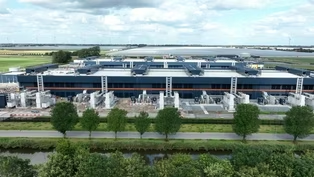
Data Centers Move Into Central Illinois
Video has Closed Captions
Clip: S3 Ep1 | 3m 17s | Data center proposals promise jobs and tax revenue while raising environmental concerns. (3m 17s)
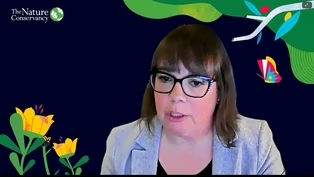
Mining the Sun: Solar on Degraded Land
Video has Closed Captions
Clip: S3 Ep1 | 7m 13s | The Nature Conservancy explores turning degraded land into productive solar sites. (7m 13s)
Providing Support for PBS.org
Learn Moreabout PBS online sponsorship New Episode
- Science and Nature

Explore scientific discoveries on television's most acclaimed science documentary series.








 Recently Added

Support for PBS provided by:
WTVP EcoWatch is a local public television program presented by WTVP
Support for Ecowatch is provided by the Backlund Charitable Trust