At Issue with Mark Welp
When Mothers Are Incarcerated: The Impact on Children and Families
Season 4 Episode 4 | 26m 40sVideo has Closed Captions
Nia Frazier shares her story as advocates examine pregnancy, parenting and prison.
Mark Welp talks with Illinois Prison Project Assistant Director of Education Kaitlyn Foust and formerly incarcerated mother and activist Nia Frazier. They examine pregnancy behind bars, separation from children, the lasting effects of parental incarceration, reentry and arguments for rethinking punishment while maintaining accountability.
Problems playing video? | Closed Captioning Feedback
Problems playing video? | Closed Captioning Feedback
At Issue with Mark Welp is a local public television program presented by WTVP
At Issue with Mark Welp
When Mothers Are Incarcerated: The Impact on Children and Families
Season 4 Episode 4 | 26m 40sVideo has Closed Captions
Mark Welp talks with Illinois Prison Project Assistant Director of Education Kaitlyn Foust and formerly incarcerated mother and activist Nia Frazier. They examine pregnancy behind bars, separation from children, the lasting effects of parental incarceration, reentry and arguments for rethinking punishment while maintaining accountability.
Problems playing video? | Closed Captioning Feedback
Where to Watch At Issue with Mark Welp
At Issue with Mark Welp is available to stream on pbs.org and the PBS app.
Providing Support for PBS.org
Learn Moreabout PBS online sponsorship(hopeful music) (hopeful music continues) - The percentage of women in prisons and jails in the US is small compared to men, but the number of incarcerated women has been on the rise.
And there's another statistic you may not think about.
More than 58% of women in prison and nearly 80% of women in local jails have children who are minors.
We are joined today by Kaitlyn Foust with the Illinois Prison Project.
She's the assistant director of Education.
And Nia Frazier, a formerly incarcerated mother and activist.
And they're here to talk about what happens to incarcerated mothers and their children, and what pregnant women go through when they are behind bars.
Ladies, thanks for coming in.
We appreciate it.
- [Kaitlyn and Nia] Thanks for having us.
- First of all, we should tell people about the Illinois Prison Project.
And Kaitlyn, tell us all about your organization.
- Absolutely.
The Illinois Prison Project, or IPP, is a legal nonprofit that was founded in 2019 with the mission of providing legal support to the thousands of people that have excessive sentences here in Illinois.
There's a lot of ways for people to get trapped up in our prison system, but not a lot of ways for people to have their cases reviewed for the transformation that they experienced while incarcerated.
And so IPP really tries to bridge this gap by advocating for not only where people have come from and their past, but also who they have become now.
Our executive director, Jennifer Soble, started the nonprofit when she was looking at the Illinois Department of Corrections population data.
And as you're going through this spreadsheet that has thousands upon thousands of names, you start to recognize that there's some patterns about who we're truly incarcerating in our system.
There's thousands of people who were incarcerated before their 18th birthday or before their 20th birthday, you know, when their brains were not developed enough to really understand the consequences of their actions.
There's a lot of veterans and elderly folk that are incarcerated.
About 25% of our population right now is elderly.
And then we also have, when you look at the women that we incarcerate, a lot of their cases, when you really look into them, could be told by a much more nuanced story if you consider domestic violence and gender-based violence.
And then, like you mentioned, women that are mothers and caregivers as well.
So when our executive director started to look into this population data, she found that there's some truths about who we're incarcerating in Illinois that she didn't really think a lot of people understood, or recognized that that is really what we're doing here in Illinois.
So the nonprofit was able to, through legal work and policy work and education, try to change the way that we discuss mass incarceration in Illinois.
- So it sounds like every sentence has a story behind it.
- Absolutely.
Absolutely.
And every sentence has a human behind it and a family behind it too.
So it's not just the story of an individual, it's a story of a community, and what we're allowing to be done on behalf of our communities.
- Sure.
Now, you mentioned excessive sentences.
What do you define as an excessive sentence?
- Absolutely.
So excessive sentences, the definition really ranges, but it's typically sentences of around 40 years or more.
So our sentencing structure here in Illinois is really complicated, and I won't go into it.
But basically, when you get these large sentences, they usually come with a mandatory amount of time that you have to serve.
So no matter the education you get, no matter the programming that you go through, no matter how much you transform from that original person that went into prison, there's no mechanism for you to be able to go and advocate for your release.
You have to serve that full sentence.
So you have people who are ministers, and getting master's degrees, and basically lawyers from all the paralegal work they've done throughout the years, but they have no ability to come out and have their transformation evaluated.
And so that's what IPP tries to do.
There's not many mechanisms to get these cases reviewed on that sort of basis, but there's a few.
And so our legal work really focuses on using those mechanisms to not only litigate or argue that specific part of the law, but also use those as times to tell this full story.
So not just tell the story of this person and the crime that sent them to prison, but also telling that full dynamic story of who they've become, who's in their lives that's impacted by their incarceration, and really trying to change the way that people discuss incarceration in Illinois.
- And Nia, you know what she's talking about firsthand.
Can you tell us a little bit about your story and how you got involved with this group?
- I got involved with IPP because I heard about the Ambassador Program.
And I was already really passionate and interested in advocacy work.
Actually, while I was incarcerated, I sort of made a declaration that when I got home, I would do everything in my power to fight for the women that were still behind bars.
And there's no looking back.
I'm so grateful.
- So when you were incarcerated, you were pregnant before- - I was.
- You served your time.
- Yeah.
- What was that like?
- Awful.
Typically, when you're pregnant, you have support of your family and your friends.
And I did have a sort of newfound family there because, you know, you do form relationships, but I was in labor, and I didn't have my mom, I didn't have my grandmother, I didn't have anyone who really knew me.
And when I did give birth, my daughter went straight to the NICU.
And so I wasn't able to be with her.
And then after about a day, I had to ask permission to go see her.
So I did.
And then the day after that, they finally let her stay in the room with me.
So I had a couple days with her, but then when it was time to give her to my family, which was the most horrible experience in itself, but the woman who was kind of facilitating this whole thing wouldn't give her to my uncle, who was the person there that I wanted my daughter to go with.
And so she said, "No, absolutely not.
There has to be a woman here."
Right.
And, you know, of course, they did that because I was labeled and looked at as a felon or whatever.
And so thank goodness my mom and my grandmother were there to come upstairs, so that they could all leave with my daughter.
- So you gave birth at a hospital?
- I did.
I was still detained in the county jail.
- Okay.
- Yeah.
And I gave birth to her in the hospital.
So they did transfer me to the hospital.
- Okay, so if you're in a county jail, what is healthcare like for you?
Because obviously, you need to be looked after before you even have the child.
So what was that like?
- I would say healthcare was minimal because... So while I was detained, I was still in the county jail, and they had their own little healthcare system there, but it, of course, is nothing in comparison to a hospital.
So I would go, I don't remember, this was 14 years ago, but I would go every once in a while to see the doctor, and then I would go out to the hospital, also every once in a while.
I knew for sure that I wasn't getting the nutrition that I needed.
I wasn't getting all of the healthcare that I needed.
- Right.
I mean, we talk about prenatal (chuckles) vitamins and eating right.
And of course, I mean, you've got plenty of stress, so forget being stress-free before your pregnancy.
That's amazing.
And these statistics were mind-blowing when I was doing research on this, the amount of women who are pregnant before they go to jail or are in prison.
Can you tell us a little bit about that?
- Absolutely.
I think it's a great point of that, you know, Nia's story is incredibly harrowing to hear, and what she's gone through is so traumatic.
But I think the point that the statistics show is, it's a very common experience that women go through.
And really, when you look at the people that we're incarcerating, most of the women have kids.
And so when we think about incarcerating a woman, you know, in the sentence that you might wanna give her, you also have to factor in that their child will also have to face that sentence.
There's a woman currently named Destine Phillips, who was just convicted and is facing several years in prison.
And unfortunately, she has a one-and-a-half-year-old daughter.
So any time that she gets, you can just factor that into that child's life to understand that it has these compounding effects on our communities, on our families.
And I think, really, when you put it into those human terms of being able to be with your child, or having to ask permission to see your child, or any of those barriers that just really separate the fact that, sure, the woman giving birth committed a crime, but she's also a mother and also a person that's about to give birth and go through something that you need support, and you need community.
So I just don't think our system has the capacity to factor in any of those nuanced conversations when we just look at, you know, crime and punishment in that traditional sense.
- And Nia, how long was your sentence?
- 10 years.
- 10 years.
So tell me about the process of getting to see your child, how often that happened, where that happened, and how long you had.
- So while I was still in the county jail, they had some sort of program where I was able to see her face to face with no bars, no windows, anything like that for about an hour at a time.
So I remember feeding her her bottle and changing her diaper, things like that.
But that I think I was only, I was limited to maybe five of those visits, and I was in the county jail for two years.
And then when I was sentenced, I went on to one facility, Logan Correctional Center.
I was there for another three years.
I was finally able to get more one-on-one visits because I actually skipped the visits that I had to have through the glass after those five visits.
And then I went on to Decatur, where I was able to have visits at a Mom and Babies, it was like a program, it was called Mom and Babies.
And she was able to come on the unit with me, and I was able to have those visits.
- And we should tell people too that you're from the Chicago area.
- I am.
- So it's not like you're from Peoria, and you can make the hour drive to Decatur.
- Right.
- That's a long way for your relatives to bring your baby to see you.
- Right.
- As your child gets older, how do you deal with trying to help raise a child that you're far away from?
And how does your child adjust to having your mother in prison?
- A lot of phone calls while you're still in.
I don't think children do adjust.
I think it's one of those traumas that sits with you and you begin to identify with as you get older, much like losing a parent to death, you know?
My daughter is still dealing with it now.
- How old is she now?
- And she's 14 years old.
- Okay, tough age.
- Right.
So think of that.
And she's dealing with the hormones and all of that, and she's also dealing with those traumas of not having her mom for the first nine years of her life.
- Yeah, that is tough.
Wow.
Kaitlyn, what have you seen, and what do we see typically from kids who don't have that parent in their lives every day, parents who are facing a prison sentence?
- It's a tough situation.
Like Nia said, you know, your parent plays such an important role in your life.
And with the placement of all Illinois prisons, you know, if you're from Chicago, you're not gonna be able to go out and visit your parent that often unless you're in some of these programs.
And even if you're in these programs, like you said, the facilities are just sort of inaccessible.
I don't know if you've ever heard of ACEs, adverse childhood experiences.
It's a psychology term for the type of compounding trauma a child can go through.
And I believe one of those is to have a parent that's incarcerated, like that is how impactful it is, that it is factored into these psychological tests.
Because I think it's, you know, your parent is somebody that you can sort of feel safe with in expressing all sorts of emotions.
And, you know, there's a limited ability to have that safe place with a parent while they're inside.
But then also, you know, a lot of times when mothers return home, it's not just going through the experience of reentry and dealing with all that is tough with coming back into society, but now, you have to be somebody's mom, somebody's mom out of nowhere.
And there's not a lot of supports for women generally coming out of prison, but especially when you factor in all of the responsibilities that come with coming out and automatically being thrust into motherhood when you're not used to that, and maybe even the child is not used to you playing that role yet.
And so I think that's a thing that people really need to discuss more, right?
It's not just that initial separation.
It is just this sort of compounding tear at that root wound.
- So how do we balance having someone who's been found guilty of a crime and serving their time, especially someone who is pregnant or is a parent?
I mean, there are plenty of people who go to jail and prison who have kids who are five, six, teenage, whatever.
How do we balance having them serve a sentence and still letting them be a parent to their kids?
- Do you have a thought on that, Nia?
- That's tough.
I could go if you, but I wanna give you the chance first.
- I think that we need to revisit what punishment looks like.
I think that rather than holding parents in prison, they can have them on house arrest if possible or just some sort of alternative, because in those formative years, personally, I feel like all childhood, even up to late teenage years, those are all formative years.
Like these kids need their parents.
And there has to be some other way that we can still punish these people and allow them to be with their kids, especially if they made a mistake, or in some cases, these people are incarcerated by the theory of accountability, which means that they didn't even commit the crime, or they were found not guilty after they had their case overturned years and years later.
You can't get that time back.
So why not another route?
- That's a tough question to answer.
What are your thoughts?
- Absolutely.
I think, kind of to Nia's point, we're kind of very far away from having a future that can balance both of those things, but I think it really starts from looking at the reality of who we're incarcerating.
And our systems are really not designed to accommodate these nuanced situations that a lot of women face.
One of our projects at the Illinois Prison Project is called the Women and Survivors Project, because when you look at the women that are incarcerated, if you just look at their cases on paper, it seems very black and white.
But when you start to actually listen to their story, a lot of it comes down to self-defense in gender-based violence scenarios or domestic violence scenarios that, because the way that people experience those, you know, abuse or traumatic situations doesn't perfectly align with what our criminal legal system needs to incarcerate somebody, you're already walking in with two different stories being told.
And I think that also goes into like understanding how we can accommodate for both people that are incarcerated and for their motherhood.
It starts by looking back at the original way that the system incarcerates people, right?
Like we don't really have a system that can judge people on both lines.
You're judged as the criminal, not as this full person that you are.
I'm forgetting the woman's name, but right now, there is a woman who is incarcerated, or she took a plea for involuntary manslaughter for something that was her acting in self-defense.
And so there's a lot that we need to really do, but I think it comes from listening to people like Nia and asking these questions and these types of conversations, so that when we're having these conversations, it's not about some evil group of people that we need to be protected from.
It is mothers, it is wives, it is survivors of abuse, like that is who we're incarcerating.
- And there are people out there who say, "Oh, well, that's unfortunate, but you did the crime, so now, you gotta do the time."
They have that attitude.
But when you think of a child who is without their mother, the effects it could have on that child could be far worse than, you know, feeling like you're getting vengeance or something against a person who's committed a crime.
- Especially when we have so many other options.
Like I think that a lot of times people think that incarceration is the only solution in these situations, but there's a lot of ways you can have someone have accountability for what they've done without compounding that trauma.
And I just think even to the people that say, "You did the crime, you should do the time," I think there's ways that we, as a rational, reasonable, intelligent community, can find better ways that isn't perpetuating the harm.
- Yeah.
One of the statistics says, "Right now, there's five million children in the US who have experienced the incarceration of a parent."
And you have to wonder, obviously, you know, you know the effects that it's had on your daughter, but everyone's different.
And there may be kids out there who may be more prone to commit a crime because their parent has been in jail for whatever reason.
So what can we do?
Do you do any advocacy in terms of, you know, changing laws, things like that?
Can you tell us about that?
- Absolutely.
So we have our legal branch, which does direct representation.
We have our education branch, which is what we're here as a part of, to go out and educate the community.
And then we have a department at IPP that, specifically, their whole job is to go down and advocate for policy change in Springfield.
So we can kind of triangulate the information that we get both from our legal team and from our education team, and then go and fight for policy change that is actually gonna be effective.
We also work a lot to not only change the way that the laws are written, but also change the way that things are applied, right?
Like pushing to include broader definitions, or to get the decision-makers in Illinois to really consider what's the purpose of why we're trying to do, and bring in concepts like family reunification and community safety into these discussions outside of just punishment and, you know, revenge, or those types of things.
So it is sort of a holistic process.
It's both going and trying to change the laws as written, but then also change the way that we in the community here discuss incarceration, and then also go and change the ways that, you know, people in the governor's office or people at the Prisoner Review Board are discussing these things, so that even if we don't win a case, or we don't win a policy, things like domestic violence or gender-based violence or mothers in incarceration are being discussed at many different levels.
And it's not just that same old narrative of, you know, "Lock them up and throw away the key."
- Have you had any big policy wins that have really made a difference in the lives of people who are behind bars?
- Yeah, yeah, absolutely.
Thanks for asking.
We were a big part of passing the Joe Coleman Medical Release bill.
Prior to 2022, Illinois was one of only two states that had no mechanism for compassionate or medical release.
So if you were dying in prison, there was really no official mechanism for your case to be reviewed under those compassionate circumstances.
And unfortunately, a gentleman named Mr.
Joe Coleman, who was a veteran, and he was an elder in the community, he was incarcerated, and he passed away without any abilities for his family to move him into a space where he could die with dignity.
And so the Illinois Prison Project and some others, but the Illinois Prison Project was definitely a part of it, went and wrote this policy, so that there would be a mechanism for people to petition for medical release.
And because of that policy, hundreds of people that are sick and dying have been able to come home and return to their communities, and get the treatment that they really need.
And kind of because of that, we're able to then go and represent people, which, just a couple months ago, we had our 200th client released from prison.
And so these were people that were serving extremely long sentences that, because of these interventions or the ways that we're sort of pushing the envelope, would have otherwise stayed in prison for a very long time.
And so that has a real human number, but in terms of we've also saved the Illinois taxpayer over $273 million just from those almost over 2,000 years of needless incarceration time that's been saved.
So that's how the policy translates into the actual day-to-day impact that we can have on the Illinois taxpayer.
- Sure.
And Nia, recently, the two of you were part of a panel at Heartland Community College called When We Incarcerate Mothers, We Sentence Children.
And just that title says a lot right there.
What do you tell the people in that class, the kids, what do you hope they learn from what you've been through?
- I just really hope that they understand, kind of much like we've been saying here, that these are mothers, these are grandmothers, these are aunts, they're humans, they have lives.
You know, sometimes when I tell people my experience, they look at me, and they're so shocked, "What?
You've been incarcerated?"
It can happen to anyone.
And I think even I was ignorant to who could be incarcerated and what that looks like.
When I was first arrested and taken in, I was pregnant, and I felt like I was the only one who was pregnant.
You know, there is no education about incarceration as a kid.
You know, I thought I was the only one.
And then I found out that no, there are women that will never see their children.
They were pregnant when they went in, and they will never see their children grow up.
Or there are also some women that go in, and they won't see their children until they're adults.
And, you know, how heartbreaking is that?
So it could happen to anyone.
And I think that we just really need to educate our communities much like Kaitlyn said.
It really starts in the community.
So I just really hope that we can get to these children before they get into things that they shouldn't be getting into, you know, like educate them, support them.
Rather than seeing that their parents are incarcerated and saying, "Oh, that's unfortunate," let's have communities get together and form programs, so that they're on the right path.
- Yeah.
Well, it's a good thing that you're doing.
And I'm glad that you survived all this.
- Thank you.
- Kaitlyn, tell us a little bit about how people can find out more about your organization.
- Absolutely.
Easiest way, visit the illinoisprisonproject.org, Illinois all spelled out.
There, you can find more about our organization.
You can find our legal resources.
You can also find a link if you wanna invite me and Nia to come and speak in a church or a school or really any community space you think that needs to hear this lesson.
We also have a legal clinic in case you have specific questions on behalf of yourself or loved ones.
So illinoisprisonproject.org, and follow us on social media.
- All right, Kaitlyn Foust with the Illinois Prison Project and Nia Frazier.
We appreciate your stories.
And thanks for sharing those with us.
- Thank you.
- Thanks for having us.
- All right.
And thank you for joining us.
You can check this show out again.
Just go to wtvp.org, click on "At Issue," and boom, there it will be.
You can share it with your family and friends.
Thanks for joining us.
Have a good night.
(hopeful music) (hopeful music continues) (hopeful music continues) (hopeful music continues)
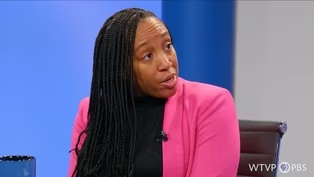
Video has Closed Captions
Clip: S4 Ep4 | 2m 44s | Nia Frazier recalls giving birth while jailed and the painful separation from her newborn. (2m 44s)
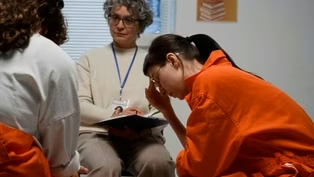
Preview: When Mothers Are Incarcerated
Preview: S4 Ep4 | 35s | Preview: When Mothers Are Incarcerated (35s)
Rethinking Punishment for Incarcerated Parents
Video has Closed Captions
Clip: S4 Ep4 | 4m 37s | Nia Frazier and Kaitlyn Foust discuss alternatives that could keep parents with children. (4m 37s)
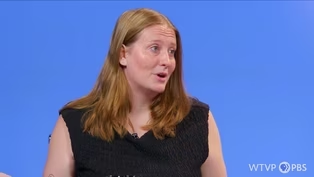
Video has Closed Captions
Clip: S4 Ep4 | 2m 56s | Nia Frazier explains how incarceration continues to affect her daughter years later. (2m 56s)
Providing Support for PBS.org
Learn Moreabout PBS online sponsorship New Episode
- News and Public Affairs

Top journalists deliver compelling original analysis of the hour's headlines.
 New Episode
- News and Public Affairs

FRONTLINE is investigative journalism that questions, explains and changes our world.
 New Episode
 New Episode
 New Episode
 New Episode
 New Episode
 New Episode
 New Episode
 New Episode
Support for PBS provided by:
At Issue with Mark Welp is a local public television program presented by WTVP