Consider This with Christine Zak Edmonds
Weather, Broadcasting and Bond: Chuck Collins
Season 7 Episode 2 | 26m 46sVideo has Closed Captions
Chuck Collins looks back on five decades in weather and his lifelong love of James Bond.
Chuck Collins looks back on five decades in broadcasting and meteorology, from his start in radio to a career forecasting Central Illinois weather. In retirement, he reflects on how weather technology changed over the years and shares the story behind another lifelong passion: James Bond.
Problems playing video? | Closed Captioning Feedback
Problems playing video? | Closed Captioning Feedback
Consider This with Christine Zak Edmonds is a local public television program presented by WTVP
Consider This with Christine Zak Edmonds
Weather, Broadcasting and Bond: Chuck Collins
Season 7 Episode 2 | 26m 46sVideo has Closed Captions
Chuck Collins looks back on five decades in broadcasting and meteorology, from his start in radio to a career forecasting Central Illinois weather. In retirement, he reflects on how weather technology changed over the years and shares the story behind another lifelong passion: James Bond.
Problems playing video? | Closed Captioning Feedback
Where to Watch Consider This with Christine Zak Edmonds
Consider This with Christine Zak Edmonds is available to stream on pbs.org and the PBS app.
Providing Support for PBS.org
Learn Moreabout PBS online sponsorship(light music) - Will you consider this?
We have our very own James Bond, but on the side he made a name for himself as Chuck Collins, Mr.
Weather Guru, Central Illinois.
Man, I mean, you lived and breathed weather for how many years?
- Yeah, well, in the business, 50 total, radio and TV, and 40 in weather.
So last 40 years up until October when I retired, all weather all the time.
- And exactly.
I mean, anytime, if we'd get up in the middle of the night and hear something, you know, look, oh yeah, Chuck's doing something.
But let's go back to, in case anybody missed the whole big retirement thing, you grew up in Central Illinois.
- Yeah, I grew up in Marquette Heights.
And just as I started peaking high school, my father got transferred to Southern Illinois, and then he got transferred back right after high school.
So I wasn't really born here, moved here when I was three, wasn't born here and didn't go to high school here, but I lived all my life here.
- Raised the rest of the time.
- So I consider myself central Illinois-grown.
- Okay, well, that's good.
That's good.
And then, you know, you did some radio and kind of news business or disc jockeying.
What made you get involved in, excited about weather?
- I mean, excited about weather.
Yeah.
It was when I was at WMBD; at that time it was AM, FM, and TV all in the same building.
- Right on University.
- Right.
Yeah.
So I was doing news for the AM side of things.
Really never thought about TV although we were all in the same newsroom together.
It was television, radio, and newsroom.
And I'd always loved weather, but I never really had thought that much about getting into TV because I was a long-haired bearded radio guy, you know?
And then Duane Wallace, the news director at the time, said, "I know you like weather, love weather.
We have an opening on Sunday nights on the TV side, you know, one weather cast a week.
We need somebody to do that.
You want to give it a try?"
So I got myself in front of the green screen, did it and practiced.
Got bitten by the bug, and I've been doing weather ever since.
- But you weren't a meteorologist to start with.
You were just the weather guy.
- Right.
- And then when did you go and where did you go for meteorology school?
Yeah, early '90s then I decided, well, if I'm going to be on TV doing weather, I want to know what I'm talking about.
I want to be a meteorologist.
So in the early '90s, I went to the distance learning program at Mississippi State, and it took four years to do that.
But it was rewarding to do that because I wanted to really know what I was talking about.
I didn't want to be a weathercaster; I wanted to be a meteorologist.
So it was all home study.
I was working, had a baby, you know, my wife was working, I'm trying to sleep, and then I'm trying to go to school, distance learning for four years.
But that was a great time.
So that's why I did that.
- Yeah.
Well, good for you.
And it really did grab you.
So what was the most interesting thing that you learned in meteorology school?
- Oh, you know, growing up watching Hooley, Rolly, John Day, watching those, I was fascinated by that.
That's what got me into radio and TV.
But just the progression in all of our lives, technology.
I mean, when I first started doing weather- - Right.
Then in the '90s.
- Yeah.
Yeah.
Actually, late '80s, '88.
I'd have to drive out to the weather service, which at the time was at the airport, Beyerle Aviation.
If I wanted to look at a computer model, if I was lucky enough for it to be in on time, I'd have to go out there and look at it; drive all the way to the airport, drive all the way back if I wanted to look at models.
And now they're right at our fingertips on the web.
And of course the technology and the storm tracking has just exploded measurably over the, you know, past 40 years.
And then we got Doppler radar in Lincoln in '95, and that was a game-changer for severe weather because we had our own local radar before we didn't have radar here.
It was in (indistinct).
So technology- - That's far east.
And when weather's coming From the west, usually.
- Right, so that's the big thing, like in all of our lives, the technology, just, you know, has made it so much more available, information more available.
- Right.
Well, we've had a couple of big ones here lately.
We are recording this the end of June, and Father's Day just kept coming down, coming down.
And then even the week before that, it just seemed like this rumbling thunder that went on for about 20 minutes.
It never gave up.
What's the deal with all that?
- It's been active, and what we're doing, people I think are, know, maybe not know what they are, but have heard the terms El Nino and La Nina.
They're major weather pattern changes.
Well, we're going from a La Nina, which gave us a colder and snowy winter, to El Nino, we're in a transition area.
And so El Nino was basically changing the weather patterns in the United States.
- And that's coming from California.
- Right.
Yeah, exactly.
So all the all the moisture-laden systems in the storm track are coming right here.
Now, eventually it'll go north, and that'll usually mean, in El Nino a mild or warm fall and a mild winter.
And because the storm tracks are going to split around us eventually, but right now they're right on top of us.
- Oh, aren't we lucky?
- Yeah.
- Well, a lot of people say, weathercasters, meteorologists get very excited when they see these models.
And you never know what Mother Nature is gonna throw at us.
But it's like, "How did they get it so wrong and they still have their jobs?"
Okay, do you hear that a lot?
- Yeah, If I had a dollar for every time I heard of that, I would have an island in the South Pacific all by myself and tropical drinks all day long because I'd have more money than I would imagine having.
But believe it or not though, it's improved so much dramatically with technology.
A three-day forecast is about 99% accurate.
Five-day, about 90%.
The farther you go out, it's more of a trend than a forecast.
So we're doing a lot better than we did because there's more than one forecast and more people forecasting.
Used to, as you know, Weather Service was the only forecast in town.
They put out the public weather service, the public forecast.
All of us had the same forecast.
If it was wrong, we were all wrong.
So I did my own forecasting, and most everybody else does their own forecasting.
So we, you know, disagree sometimes, but that's the challenge of it.
- So you've moved from the West Bluff over to East Peoria.
Do you still have all your stuff?
I mean, how are you doing with some of these weather events?
You're still on your computer?
- I'm on my iPad or my laptop.
And I'm tracking.
But it's fun to track it from my recliner, not having to be in front of a green screen for three or four hours.
And there was a time where I couldn't live without severe weather.
Well, I can live without it now.
- And how long did it take you to do that?
How long did it take it, that adjustment?
- Oh, about two months.
It didn't take long.
Now, maybe I will miss it.
And, you know, you can't take the weather out of the boy.
You can take the boy out of the weather without the weather out of the boy.
But I still do.
I miss it to a certain extent, but not the stress.
Sometimes it's stressful when you're doing that and on the air for three or four hours.
- Well, a lot of people are depending on you too.
- Yeah, exactly.
Sure.
So I don't miss that aspect of it.
And right now I'm just enjoying watching it.
And all my neighbors text me: "Should I get in the basement?"
So I'm still answering to somebody.
- Okay.
Well, that's good.
But it was, I mean, when people say, "Oh, you know, Chuck Collins, gosh, he's just, you know, on the air all the time."
And I said, "He lives weather."
And you really did.
I mean, you were devoted to it.
You were one with Mother Nature, except she was calling the shots.
- Yeah, exactly.
And I think you have to be.
You have to get right into it.
It's like breaking news or election night.
I mean, severe weather is election night.
And the newsroom is, election night is a big thing for the newsroom; severe weather is a big thing for the weather department.
So yeah, you have to be invested in it.
And, you know, you have to enjoy the sunny 80-degree days while you can, because, you know, we live in the most volatile weather belt in the world, basically, in our latitudes.
- Tornado Alley.
- Tornado, snow, you know, hard freezes that could affect crops.
I mean, flooding, drought.
I mean, we've had it all.
So it's challenging because it's not like Florida weather or Phoenix weather or Hawaii weather.
Those meteorologists get maybe two minutes on the air if they're lucky, maybe a minute because there's nothing to talk about.
- Same old, same old.
Yeah, exactly.
Okay, but now the Washington tornado.
You were on air live, and that tornado was going right over you.
You heard the sirens and everything.
And I think you and Sandy ducked under the desk, right?
- Because the tornado, the Washington tornado started out in East Peoria on Springfield Road at the entrance to the TV station.
And it did take out some trees on the property.
So it was on the property about a hundred yards away.
And we were on the air.
There were tornado warnings already out upstream for Washington.
And then the tornado touched down there on Springfield Road, and we heard it.
So that's when we took cover.
We were probably on the air.
We wanted to stay on there as long as we could.
We knew there was a warning out for us, the station, East Peoria, Morton, Washington upstream.
We wanted to stay on the air as long as we could.
Well, when we heard the tornado touched down, that was it.
We all basically dove for cover live on the air and came out 10 minutes later, realized the tornado was still on the ground.
It was at Farmdale by that time, intensifying.
And it was a big wedge, 190-mile-an-hour monster headed right into Washington.
- Yeah.
Wow.
That was a crazy day, a really crazy day.
So now that's a little bit behind you.
But you have this thing with James Bond going on.
So let's talk about that a little bit.
- That's my hobby.
I've been a James Bond fan all my life.
I saw my first James Bond movies at the Beverly Theater on Knoxville.
- All right.
And I had been a collector, just, you know, collected stuff as a kid and as an adult.
And then I was invited to join a organization called the Ian Fleming Foundation.
And basically it's a nonprofit, and we are preserving all things having to do with Ian Fleming, not only literary, but his creation, James Bond.
So basically we buy, sell, and trade vehicles used in James Bond movies and lease them out to museums, auto shows, auto clubs, whoever wants to pay the money to have one on display.
And that's how we make our money.
So we have about 65 vehicles, a helicopter, submarine, cars, motorcycles, models.
And where are those all stored?
- Different places?
- I can't tell you the location, otherwise I'd have to kill you.
- Okay (laughs), we don't want that.
I've go seven grandkids- - But suburban Chicago we'll say is our warehouse.
And we take those all over the country and some get shipped overseas.
And so it's just a bunch of guys, Bond nerds getting together a couple of times a year, working on things, getting them ready, and then if they have to be shipped out, we're there for shipping, for liability.
- Do you get to go with them?
- I get to go to the locations when they're done.
For instance, a couple of months ago, I was at the International Spy Museum in Washington, DC, because we had four or five vehicles there.
Somebody has to be there to supervise the transport, loading them on the transports for liability purpose.
So I got to go out there and supervise that, then come back home and they went on to the next location.
- Well, so who maintains them?
So you guys actually maintain them?
Yeah, we have a climate-controlled- - Are you a good auto mechanic person?
- Oh, enough to be dangerous.
But if anything, we have we have a whole bunch of guys who are body shop guys, who are mechanics, who are electronics, who are computer.
And keep in mind, half the vehicles don't actually have engines or run.
They're shells, some of them are shells.
They look like full cars, because they would use, let's say, five or six of the same cars- - In one movie.
- Right, in one movie.
And they do different things.
So we have one car that has fake missiles on it that runs five miles an hour.
And it's a Jaguar.
But that's how it was used in the movie.
It wasn't one that went 150 miles an hour.
So stuff like that.
But we do have, and we have Ford has agreed, they're refurbishing one of our Mustangs from "Diamonds Are Forever," 1971, red Mustang Connery drove.
We found it in terrible shape.
They agreed to refurbish it, restore it for us if they can share, you know, the promotional value with it and all that stuff.
So we have partnerships with car companies and boat companies to help.
- So how did this society find you, or did you find the society or how did that work?
- Yeah, it was formed in '92, and that was the first year of the auto show, Central Illinois Auto Show at the Civic Center.
So the foundation came to town.
At that time, only had three vehicles, a two-man submarine and a Lotus car and one of the Ski-Doos you have on water.
So they came to town, and of course I was excited about that.
Met one of the co-founders, and he said, "Well, yeah, you need to be a part of the organization."
- So there you are.
- Why don't you join?
And I've been doing it ever since.
- So the cars themselves, they don't put a whole lot of mileage on them then now?
- No.
No.
There are a few that actually run, but like I said, most of them are, like I said, they have different functions.
We even have the Caterpillar excavator from "Sky Fall."
And, you know, an excavator sitting there, it runs, but we don't have any, you know, we don't have any jobs for it.
It does run, but it was all modified by Caterpillar engineers for the movie and has bullet holes in it and everything else.
And then we have models.
Some movies have didn't have real vehicles; they had models that were on the green screen, and like a jet and stuff like that.
So most of them are on wheels.
We got to pull them around with the dollies and stuff because they weren't made to run, so to speak.
- That's crazy.
So you're finding out about the film industry as well?
- Yeah, it's quite amazing.
And, you know, the co-founders are big in the Bond connections.
And yeah, they have all sorts of stories.
- What's the most interesting one you've heard that you can share without killing me?
(chuckles) - Oh gosh.
I'm trying to think.
I didn't go.
They have golf outings in London and places like that and stuff comes up.
People just don't realize, I guess, in movies, what goes on with those vehicles.
Like I said, there were five Jaguars in one movie, "Die Another Day."
And we've got the one with little machine guns, fake machine guns and air rockets that come out; and it has a little five-gallon gas tank in the back.
People don't realize that.
And there's gears and levers and hydraulics because some engineer is laying in the bottom of that thing steering and stuff.
So I think, overall, just people may not realize what goes in to- - Making it look real.
- Yeah.
And now it's more, you know, special effects than anything.
But I can't think of anything right off my... I will pretty soon, but I think, overall, it's just... And I didn't realize what went into all that, you know?
We got these little rockets that fire out of the fender.
Well, they're plastic rockets and they're hydraulic air, so air just shoots them out.
But it looks like they're shooting out- - Like the real deal, right?
And look at all this.
This is something new.
- Well, I guess I could have, in my later years, but, you know, and early on.
And you probably know, you know, guys in the newsroom, we weren't allowed to have facial hair.
Or it was contractual, you had to have approval.
So most of the time, well, I couldn't grow a good beard anyway.
- That doesn't look bad.
- Yeah?
Well, thanks.
I went to No Shave November after I retired, And haven't looked back.
- And there you are.
- I always went No Shave November.
But yeah, I didn't grow it because wasn't allowed to, but I couldn't grow much.
- Well, to some people it's offensive, you know?
Some people, they think it's a block of who you really are.
And you're such an Ian Fleming fan that you named your son Ian.
- Yeah, my son is named Ian.
I didn't name his middle, Ian Fleming's middle name was Lancaster.
We didn't go there, although that's distinctive.
But his middle name is after my dad, William.
But yeah, we named him after Ian Fleming.
- [Christine] And Linda was okay with that?
Linda was okay with that?
Is she into James Bond?
- No, I don't think she sat through an entire James Bond movie.
We're just polar opposites as far as our hobbies are concerned.
But no, she's always liked Ian, so that's why we did that.
- [Christine] And you got it.
And you're gonna be a grandpa?
- Yep.
In November.
And that's one of the reasons I wanted to retire at this time back in October because I knew we would eventually have grandchildren.
I want to spend time.
That was one of the reasons.
But that was a plan all along to retire when I did because I wanted to, you know, do other things and get... You know, gardening is my passion.
It's kind of like my golf.
I don't golf.
- You're not a golfer?
It's like people's golf, gardening and working around the house.
And doing a project was my golf.
That's my therapy.
- Well, you used to do a lot of work 'cause you lived in an old neighborhood.
And how old was that house?
- 1905.
- Okay.
- So we had a old house.
- The fact that it was still standing.
- Yeah.
- Mine was built in 1890.
So the fact that it's still standing.
You know, it needed some work on the inside and the outside.
If I'm still standing at that age, I'm gonna need a little extra work inside and out.
- Yeah.
Amen.
I would break break nails and drill bits trying to drill into the walls and to the studs and the rafters because they were just built differently.
- But they're still standing.
- It's a tank.
- Absolutely.
- Exactly.
So what do you like to grow?
Are you a vegetable gardener or a flower- - Actually, I'm a landscaper.
I'm not really a gardener, vegetable gardener too much.
But I'm a landscaper.
- [Christine] So do you do your own design?
- Do my own design because I took a semester or two in college of horticulture.
Thought I might want to go into it.
So yeah, that's what I do.
So yeah, no, I go to the garden center.
They haul a couple of tons of rock over.
- Rock and mulch.
- Yeah, rock and mulch and haul it to the back with a wheelbarrow or whatever.
So that's my gardening.
It's landscaping more or less.
- Well, how many hours a day do you do that?
I mean, what's your day like?
When you first wake up, I mean, you used to live and breathe weather.
First thing you did when you woke up was, unless something woke you up, like some kind of event, what's your day like now?
- Well, it varies because one thing I love about retirement is I have the option of waking up and doing something or nothing, you know?
- How about it?
- Yeah.
But I might work just a couple of hours and I might not work at all.
And, you know, I get to do things like, you know, I work like 2:00 to 11:00, 1:30 to 10:30, 2:00 to 11:00.
Second-shifter like you did.
And I would... Just lost my train of though.
2:00 to 11:00.
No, no... - Now you can do everything or nothing.
- Yeah.
Yeah, everything or nothing.
And I enjoy... So I was at work at 3:00 or 4:00 in the afternoon.
Well, I can go to Walmart at 3:00 or 4:00 in the a afternoon.
- When there's nobody there.
- Right.
I can go to the RiverPlex.
Instead of going in the morning when everybody's there, I can go there at 3:00 or 4:00 in the afternoon when nobody's there.
- Right.
- You know?
So it's a flexibility.
So sometimes I really don't plan out too much.
I just see what the day brings.
- There you go.
I like that.
I like that a lot.
Well, so what do you see, future?
So your son Ian lives in the area as well?
- Yeah, Bloomington-Normal.
- Okay.
And he is in education.
- He is a principal at, he's a principal of the Alternative middle and high school which is located in Flanagan.
It serves Livingston and McLean County.
So he's the principal of that complex.
Then my daughter-in-law, Bree, is a second-grade teacher.
Of course, they're going to have the baby.
So I anticipate you know, doing a lot with the grandbaby.
- [Christine] You'll be over there a lot.
- Yeah, 'cause we have two granddogs right now, and I treat them like grandkids.
- Okay (laughs) Oh, well, this baby is in for a lot of loving.
And that's what babies need.
- Yeah, exactly.
So I'm looking forward to that.
But planning eventually to travel once I get the house the way we want it.
Do a little traveling.
And a couple of bucket-list items.
I've never been to London, which is the mecca of James Bond.
- Oh, absolutely.
- So I want to go to London in the next couple of years and spend a few weeks there.
- Oh, you should probably be here when the baby's born 'cause they'll need you right there.
- Oh yeah, yeah.
Ill do that.
- And then when the baby is just doing his... I think it's a he, isn't it?
- Yeah, it's a he.
- When he's doing his thing for the first couple of months, then you have time to go 'cause he won't miss you at that point.
So yeah, check out London.
And there's so much to do in London.
- Oh, yeah.
- All right, then what?
Then after that, you're gonna go to Dubai?
- I don't know.
Yeah (laughs).
Only if somebody pays for it.
- Okay, there you go.
- But no, just enjoy life.
Like I said, enjoy things I never got to do because I worked.
- Those are your hours.
- You know, people think we're in the TV business so we get to watch a lot of TV when we're working.
No, I didn't get to watch TV when I was working.
So I'm catching up on things that I couldn't, you know, couldn't get around to watching because we were working and not watching TV.
So I'm getting caught up on some shows I like.
- You know, and I'm the same.
It's like, well, I've never ever seen "Survivor."
and it's been on the air for how many years?
And I wasn't interested then when I had the time.
Forget it, you know?
It's really who wants to eat bugs or whatever (laughs).
Okay.
So that's your bucket list.
- Yeah, so not set in stone, but just whatever comes along.
My sister lives in Los Angeles area, so we go out there and, you know, have fun out there.
- Yeah, so what's the next big thing for any of these cars?
Or are they ready to bring some more James Bond memorabilia in?
- Yeah, well, we have cars out in South Bend.
There's car museums, auto museums all over the nation.
There's smaller ones and there's bigger ones.
So we have cars right now in in South Bend, Milwaukee, Green Bay.
And then we had an exhibit a couple of years ago at the big Petersen Automotive Museum in LA.
So we had several vehicles there.
So it depends on who wants them.
And although we're a nonprofit, we're aggressively seeking people to join the organization and donate monetarily so we can- - [Christine] So where do they find it?
Online?
It's online.
We have a website.
Just Ian Fleming Foundation, IFF, and they'll find it.
- Okay, and then you did a fun video when you were retiring from WEEK, and you really looked the part.
- Tim Campbell, the creative services director and station manager, him and the whole crew did a great thing.
I mean, it was... I had the easy part of, you know, jumping off trains.
- Starring in it.
Yeah.
- Yeah.
Jumping off trains, and actually, I was jumping off a footstool, you know, onto the ground.
But they did such a great job, and that was really a fun time.
You know, it took about three or four weeks to do that, right up until retirement.
I was exhausted, you know, going out on shoots at 9:00 in the morning, 10 o'clock in the morning, and we're doing shoots all day.
It was exhausting, but it was great 'cause there's Aston Martin guys around the area that'll loan us their cars- - A lot of fun.
Yeah.
- They had the castle on Grandview Drive.
- Well, thanks for being here.
You know, people asked if I went to your retirement party.
I said, "We never even really worked together except for St.
Jude Telethon."
- Exactly.
Yeah.
- That was it.
But we still know each other.
- Absolutely.
- And retirement's good.
- Yeah, I'm not giving away our age, but we've been in the business- - For a while.
Yeah.
- Quite a while.
- [Christine] Okay, all right.
Well, thanks for being here- - Thanks, Chris.
- and sharing all your stories and adventures.
And thank you for joining us, because, you know, he's a fun guy.
Yeah.
And he can not live and breathe weather anymore.
He can just live through it.
- Yeah.
- Thank you for joining us.
Until next time, be well.
(light music) (light music continues) (light music continues) (light music fades) (relaxed ambient music)
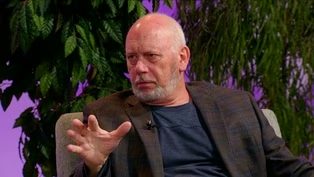
How Chuck Collins Found His Calling in Weather
Video has Closed Captions
Clip: S7 Ep2 | 54s | Chuck Collins recalls how a radio career unexpectedly led him to television weather. (54s)
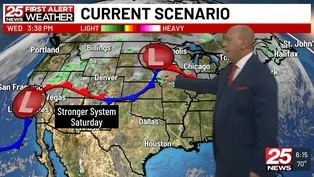
Why Severe Weather Demands a Meteorologist’s Full Attention
Video has Closed Captions
Clip: S7 Ep2 | 1m 10s | Chuck Collins explains the intensity of covering severe weather in Central Illinois. (1m 10s)
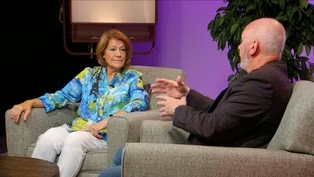
Why Weather Forecasts Are More Accurate Than Ever
Video has Closed Captions
Clip: S7 Ep2 | 1m 9s | Chuck Collins explains how technology has dramatically improved weather forecasting. (1m 9s)
Providing Support for PBS.org
Learn Moreabout PBS online sponsorship New Episode
- News and Public Affairs

Top journalists deliver compelling original analysis of the hour's headlines.
 New Episode
- News and Public Affairs

Today's top journalists discuss Washington's current political events and public affairs.


 New Episode
 New Episode
 New Episode
 New Episode
 New Episode
 New Episode
 New Episode
 New Episode
Support for PBS provided by:
Consider This with Christine Zak Edmonds is a local public television program presented by WTVP