WTVP EcoWatch
Can Data Centers and Clean Energy Grow Responsibly?
Season 3 Episode 3 | 25m 29sVideo has Closed Captions
Illinois weighs data center rules while solar grazing puts farmland to work in a new way.
Mark Welp reviews environmental wins and losses from the Illinois legislative session and updates local responses to proposed data centers. Advocates and industry voices debate water and energy safeguards, while a Dunlap solar farm shows how sheep can manage vegetation and keep agricultural production working alongside renewable energy.
Problems playing video? | Closed Captioning Feedback
Problems playing video? | Closed Captioning Feedback
WTVP EcoWatch is a local public television program presented by WTVP
Support for Ecowatch is provided by the Backlund Charitable Trust
WTVP EcoWatch
Can Data Centers and Clean Energy Grow Responsibly?
Season 3 Episode 3 | 25m 29sVideo has Closed Captions
Mark Welp reviews environmental wins and losses from the Illinois legislative session and updates local responses to proposed data centers. Advocates and industry voices debate water and energy safeguards, while a Dunlap solar farm shows how sheep can manage vegetation and keep agricultural production working alongside renewable energy.
Problems playing video? | Closed Captioning Feedback
Where to Watch WTVP EcoWatch
WTVP EcoWatch is available to stream on pbs.org and the PBS app.
Providing Support for PBS.org
Learn Moreabout PBS online sponsorship- [Announcer] This program is made possible in part by the Backlund Charitable Trust, established to educate and create awareness of environmental issues.
(gentle music) - Welcome to our latest edition of "EcoWatch" on WTVP.
I'm Mark Welp.
This program is dedicated to bringing you the latest environmental stories impacting our area and the state of Illinois.
- We had a couple of solar sites come up near us, and we got looking at it that, man, there was a lot of grass there.
I'm using their grass to fatten my sheep, and it works out great because if I have to use a piece of equipment that cuts that grass, it also throws debris, and it throws dust, which then can lead to cracked panels, can lead to just dust on the panels, which inhibits the life of that panel.
- Data centers have sort of emerged as the big new threat.
We're just proposing that they tell us what they're doing and set out a baseline of responsibility for water use so that we know, okay, you are using technology that responsibly uses our water.
We have a sense of how much that's gonna be.
We have an understanding from the state water survey of how that might impact our water resources.
- We're going to introduce you to people finding unique ways to make the land of Lincoln a better place for mankind and animals by protecting plants, water, soil, and crops.
Let's get started.
This episode, we look at what our lawmakers did and did not do this session in regard to environmental laws.
We'll update you on how local governments are responding to the data center debate.
Plus we'll show you how renewable energy and agriculture are working together in Central Illinois.
But first, the 2026 Illinois legislative session ends with some minor wins and big losses for the state according to environmental groups.
The POWER Act, which would regulate data centers, did not advance in the General Assembly.
The POWER Act would hold data centers accountable for their own energy needs and ensure that during peak demand, the centers can only use the amount of power proportional to the amount of new clean energy they bring to the grid.
Prohibitions on cost-shifting so utilities can't pass their energy costs onto rate payers.
Data centers would also be required to show how they power their operations with new clean energy.
Water safeguards include the transparent reporting of water use, water efficiency standards, fair cost requirements, and drinking water protections.
Backup diesel generators would have limited use to avoid pollution, and there would be binding community benefits agreements, and non-disclosure agreements with local governments would be prohibited.
The Prairie Rivers Network, Natural Resources Defense Council, and Illinois Environmental Council are just some of the organizations working this summer to make sure the POWER Act is brought up again during the fall veto session.
While negotiations for regulating data centers continues, as of July 1st, there is a two-year pause on new state tax incentives.
Governor Pritzker says data centers are asking too much for too little in return.
- Working families shouldn't get stuck paying the bill when data centers aren't stepping up.
That means paying for their water, electricity, and other resources they use, all the while having safeguards on the impact they're having on our environment.
And most importantly, Illinoisans deserve to know when data centers are being developed in their neighborhoods.
Community members need to have the opportunity to voice their opinions, and these developments must be open about their plans.
- One person who isn't concerned about data centers is Elk Grove Mayor Craig Johnson.
The village near O'Hare Airport is called the data center capital of the Midwest.
There are 20 centers operating there and five under construction.
- We work with data centers.
We've had them for 26 years.
So they're not new to us.
We know how to work with them on environmental issues.
We know how to work with them being good neighbors.
We know how to work with them to give generation, or to give money back to the community.
So we know what we're doing with them, and we can keep doing that.
- We'll have an update on the data centers controversy in just a minute.
In other legislative news, the Wetlands Protection Act also stalled in Springfield.
The Audubon Society says the act would create a state permitting program that would require permission prior to modifying or filling wetlands.
Normal farming activities would be exempt from this.
This legislation is important to environmental advocates because 72% of Illinois' wetlands are no longer protected by the Federal Clean Water Act.
According to the Audubon Society, restoring and protecting wetlands would reduce flood risk, protect water quality, and conserve essential wildlife habitat.
A bill that could help address plastic pollutants in Illinois did pass and is awaiting the governor's signature.
House Bill 4418 grants the Illinois Environmental Protection Agency rulemaking powers to create a stormwater pollution prevention plan that addresses plastic pellet spills.
The pellets are tiny raw material used to manufacture everyday plastic goods.
The rice-sized pellets can pollute waterways and be eaten by birds and fish.
According to the group Environment Illinois, there are at least seven facilities in Illinois that produce these pellets, and four of them are near a river, including locations in Peru, Ottawa, and Henry.
Now for an update on the data centers controversy, since our last program, many city councils and county boards in Illinois have approved moratoriums until they can learn more about the facilities and shape future rules.
The city of Bloomington and town of Normal both approved six-month moratoriums in May.
The Bloomington ruling only applies to centers that exceed five megawatts.
The McLean County Board amended zoning rules concerning data centers.
Developers now have strict rules regarding landscaping, lighting, roadway improvements, water use, and more.
The Tazewell County Board approved a temporary resolution, not a moratorium, until an ordinance can be drafted.
Champaign County passed a 12-month moratorium in April.
And in Logan County, the county board enacted a 12-month moratorium in May, but the state's attorney determined it was invalid.
The proposed $5 billion data center near Latham is up in the air for now.
As we rely more and more on cloud computing, corporate IT operations, and artificial intelligence, we need data centers to house the storage and processing systems that support all those services that make our lives easier.
However, with that convenience comes a lot of issues.
Now we're going to focus on the environmental concerns and hear from both sides of the issue.
We start with Andrew Rehn, the climate policy director with the Champaign-based Prairie Rivers Network.
- As we've been working on the energy sector, data centers have sort of emerged as the big new threat, both on energy and water, because of their genuinely unprecedented energy demand.
And with that comes a massive amount of water demand as well.
And so these could have pretty major impacts on our resources.
And to be clear, the big data centers, the ones we're talking about aren't the ones hosting the internet.
They're not the ones providing the services that we use every day.
It's really the workhorses for training AI data sets are what the biggest of the big AI data centers are and the ones that are really driving this concern.
- What are some of the concerns about all of this water usage?
- Yeah, so the water use is one of those areas where nationally there has not been a ton of transparency.
And so we don't really know as much as we'd like to know.
We do know that a data center using evaporative cooling is gonna use a ton of water.
And some of these larger data centers, if they were using evaporative cooling, which means that the water comes through the plant, it absorbs the heat, and then a bunch of it evaporates away because it's absorbed that heat, I mean, it can use, half of the water it pulls through can go away.
And that can be... That means that the data center looks like a small town or larger depending on how big the data center is.
And I think for these hyperscalers, like the one in Joliet, which is a 1,800-megawatt data center, which is an insane amount of energy usage, that energy creates heat, heat needs to be cooled, you use water as part of your cooling process, but if you were using evaporative cooling, that would consume an insane amount of water.
So they switched to technologies like closed-loop cooling, which do better on water use, but then they actually increase the energy use.
And we don't really know how often they're gonna be flushing that system and replacing it.
And when they flush the system, we don't know where that fluid that's in the closed-loop system is going.
And I say fluid because if it's a closed-loop system, it's probably gonna be things like glycerol, or, like, it's not just water in there.
It's stuff that takes heat away from their chips more effectively.
And then on the other end... So you've got your chips generating heat.
On the other end, you've gotta get rid of that heat.
It's still gotta go somewhere.
And so if you've got a chiller tower on the other end of that loop, that closed loop that's using evaporative cooling, you're still using water at your chiller towers, unless it's an air-chilled tower.
And so there's just a lot of questions.
And this is why we're proposing at the state level, and we'll be working on this in Champaign County, we're just proposing that they tell us what they're doing and set out a baseline of responsibility for water use so that we know, okay, you are using technology that responsibly uses our water.
We have a sense of how much that's gonna be.
We have an understanding from the state water survey of how that might impact our water resources.
- So with all the concerns about water and electricity, is there anything positive that can come out of building data centers?
- Illinois has set climate targets to attempt to decarbonize our electric sector, and data centers pose a real challenge to that, but they can also be an opportunity.
If data centers are bringing renewable energy with them, if they build enough renewable energy to meet their demand, not only do they not increase our electricity costs, because they're meeting their own demand, they also build out renewables on our grid.
And that has economic impacts.
That builds up a sector.
that means we can have more trained workers, more trained companies able to build that reduces the cost of build for everyone.
So we have a path here where data centers can help us meet climate targets if we have them bring their own new clean energy, which is the key policy in the POWER Act.
- Data center and AI infrastructure expert Kirk Offel is the CEO of OVERWATCH Mission Critical and host of the "Data Center Revolution Podcast."
He's worked in the data center industry for more than 20 years.
He talks about the benefits of data centers, but also says governments and communities should insist on transparency from developers and know what they're getting into.
- So the concerns that people have, the "not in my backyard" argument, the NIMBY argument, those are valid, but it's not to stop.
And that's not what America does.
This is what's called transformational infrastructure.
The very first transformational infrastructure program was the railways, and there was a lot of resistance and pushback on the impact on the environment and what we were gonna do for energy.
The second was gas, I mean, was the way that we electrified the US grid.
Think about the pushback that people would've had when we were rolling electricity across the grid, connecting what is now the NFL cities of the United States.
And that is now the backbone of the US internet.
So if you think about it, there are cities in Illinois today that we've never heard of, because they were swept off the face of the state because they opposed the interstate highways, which came as a byproduct of the automobile revolution.
We're living in a cloud revolution and an AI revolution.
And this infrastructure, we don't want it to stop.
We want it to be done with governance and oversight and ethics.
But we don't want these to stop, because Illinois competes against 49 other states, and you don't want those programs to go to either another state or another country, where not only will that technology go there, but the jobs will follow.
The beauty about data centers in your market is you, if you're living in any town, and they wanna put a data center in your market, the best thing you could do is demand that all the costs for the infrastructure gets pushed onto the developer.
I'm telling you the developer's building a utility, and it's like every other utility; we will pay for it as consumers.
There's a reason why your Netflix went from 6.99 a month to 11.99 a month to 14.99 a month to 19.99 a month.
It's because they're investing in that infrastructure, and we are paying for it as a service.
So if we want data centers to bring jobs and a tax basis of revenue to our communities, we need to force certain things upon them, and that should be one.
Build behind the meter first, but build it in a way that you could do a closed transition into my utility, which means not only are you adding more reliability to the utility, but eventually, you could put more power capacity on the utility and bring the price of energy to the left.
You can move the needle to the left.
And on water, it's very simple.
Force the data centers that are coming into your markets to go to closed loop.
Closed loop means zero water design.
It means we use a fluid like a glycol fluid or a mineral oil in our system, because it absorbs the heat and rejects it better than water can.
The only water that we would ever need at this point is called gray water.
That's the water that hits your drains and you don't wanna touch ever again.
Without data centers, you have no cloud.
We are the sky for the cloud, and now we're also the home for AI.
So this digital infrastructure has always been out there.
It's prevalent, and it's been around since we've been using technology.
It's just now arriving onto the mainstream because the volume and velocity in which we build at now requires us to engage with these local communities specifically around the way we embrace other utilities, most specifically energy.
And the second would be the environmental impact or the way that we use water.
So because the demand of data centers and the size for them continues to grow, we are now in a collision course with a whole nother utility, which is energy.
And now people are paying a lot more attention to what it is that we're doing.
As a byproduct of that, we didn't do a very good job.
In fact, I testified in Capitol Hill in January, where I even spoke to the committee and said we've failed as an industry to communicate to these communities what it is that we're building.
'Cause today they only see it as consumers.
They see us as consumers of the utilities, and they need to see us not only as a utility ourselves, but we're a partner to the other utilities.
- The Illinois Environmental Protection Agency is getting more than $316 million in federal grant funding to clean up our drinking water.
$295 million will help get the lead out of the state's drinking water by replacing lead pipes.
Illinois leads the nation in known lead service lines.
$21 million in PFAS funding will support local drinking water systems and private well owners to help with testing, planning, and infrastructure projects, addressing PFAS and other contaminants.
PFAS, or forever chemicals, are man-made chemicals used to make consumer products water, stain, and grease resistant.
PFAS are extremely durable and have been linked with increased risks of cancer, reproductive issues, and developmental delays in children.
This funding comes on the heels of the Trump administration's announcement that it would roll back key regulations against PFAS contamination in water that were established under the Biden administration, and Trump's proposal to zero out all federal funding for the drinking water and clean water financing funds to the states.
Time to clean out your garages and basements.
Peoria County is hosting three household hazardous waste collection events in the coming months.
The one-day events will be held in Pottstown, Chillicothe, and Bartonville over the next three months.
No registration or appointment are required.
These collection events are open to Peoria County residents only.
Some of the accepted items include used motor oil, old gas, lawn chemicals, and fluorescent light bulbs.
For a complete list of accepted items and items not accepted, plus more information on recycling, you can go to peoriacounty.gov.
Last year on "EcoWatch," we told you how researchers at the University of Illinois are studying agrovoltaics, or the practice of growing crops under and around solar panels.
Today we wanna show you another form of agrovoltaics called solar grazing.
I recently went to a 30-acre community solar farm in Dunlap to see the process in action.
(sheep baaing) - Those sheep are our living lawn mowers, otherwise known as lambscapers, and they will be providing vegetation management services on site via targeted rotational grazing.
So they keep all of this greenery down to a lower height so that we avoid shading the panels.
And at the same time, they're benefiting by getting really good nutrition from that vegetation.
This community solar farm is five megawatts in size.
That means behind me, there are 7,200 solar panels.
But day to day, that is equivalent to about 1,200 homes and the electricity required to power those homes.
So this is a community solar project, also known as a distributed generation solar facility.
So that means that this electricity is going directly onto the electric grid here.
And then, ultimately, it's powering homes and businesses in the area.
But the way that community solar works means that any resident or business within that overall electric utility grid can benefit.
So at Pivot Energy, we're committed to 100% dual use.
So every single qualified solar site that will allow for sheep and has, you know, the right circumstances, we either deploy sheep or cropping or a pollinator habitat and soil enhancement type of work.
So across the country we have 72 projects that will have dual-use solar and agriculture on them.
And across Illinois, we have 25 projects by the end of this year that'll have dual use.
And it's working out really well.
I think that these sheep especially are really effective at keeping that vegetation down, and it's a great way for us to not just kind of deal with these grasses out on these properties.
I would just say that a lot of different stakeholders benefit from community solar projects like this.
So the landowner is compensated via a contracted lease to host the solar site.
Farm partners and other vendors in the area are compensated for their kind of construction services and ongoing services on site.
And then, again, back to those residents and businesses that can be subscribers, they're getting those energy savings on their bill every month.
So it really is something that's a win-win-win across a lot of different population types.
- We are a commercial sheep producer.
So we have about 100, 125 producing ewes.
We raise meat and lambs, we produce, and then we are ASGA-Certified Solar Graziers.
- [Mark] How did you get involved with solar grazing?
- So solar grazing came along probably four or five years ago.
We had a couple of solar sites come up near us, and we got looking at it that, man, there was a lot of grass there that really needed something to do with it, and we watched some guys mow it.
And so I started doing a Google search, and I found ASGA, the American Solar Grazing Association.
Reached out to them, and they were just a wealth of knowledge and a great network of people.
They got talking to us, and then we got us in connection.
And actually, one of the first people we talked to was Angie Burke from Pivot.
And she put us in contact with a farm partner group called United Agrivoltaics.
And they work with farmers locally that then take it, and then they can take direct contact with these solar developers and solar companies that maintain vegetation on all solar sites within a certain region.
So that becomes our responsibility.
My sheep will come on site here.
They'll maintain vegetation throughout the year.
We'll pull them off if the grass gets too short.
We'll bring more on if it gets too tall.
And then from there, we will continue to produce our lamb crop using their grass as we do it.
It's a great partnership to do it.
I'm using their grass to fatten my sheep, and it works out great because they then benefit from it that right now this is ground that is no longer in row crop, but it's still in production agriculture.
So I can still produce an agricultural commodity using this ground just like it did 10 years ago.
And in another 25 or 30 years when this project comes out of production agriculture, because if it's properly maintained and properly grazed, organic material, all the biomass that we're going to produce on here is going to actually make this a better ground than what it actually is today.
(sheep baaing) We are currently under contract for about 120 acres, several with Pivot and a few other partners, and we're looking to expand the portfolio.
We have a few more in the works.
Central Illinois is kind of a good site because we are so close to the grid that we have to pump that energy into it to get it spread out.
And we have a strong agricultural heritage here in Central Illinois, and this is a way for us to keep that.
(sheep baaing) A sheep is a good fit 'cause due, one, to the height of the panels, they can walk under and maintain that vegetation right up on it.
They like the cover to it.
Goats tend to be a little more top-down when they're eating, whereas sheep tend to keep their heads down as they move.
Cattle tend to be a little too big and are a little rough on the infrastructure.
And anything, and we compared to, our biggest competitor would be a mechanical machine, right?
But if I have to use a piece of equipment that cuts that grass, it also throws debris, and it throws dust, which then can lead to cracked panels, can lead to just dust on the panels, which inhibits the life of that panel.
We put sheep on here so they can increase that biomass, like I said, which helps with water infiltration, keeps that water not just running off, which then helps with erosion control.
It helps build up for the organic material.
And then we're not burning the fossil fuels as much when we're burning the grass.
We don't have to use as much chemicals for spray and herbicide use.
And that sheep then will come back through here, and then the manure and urine on there helps build up all that microbials and biomass.
(sheep baaing) - Those 75 sheep that were recently released will return back to Tin Can Farms in Glasford this fall and take a break until next spring.
The Emiquon National Wildlife Refuge near Havana is growing thanks to a federal commission.
The Migratory Bird Conservation Commission approved $815,000 for acquiring additional land to expand the refuge by 76 acres in Fulton County.
The land acquisition will provide land-based access to an additional 98 acres of existing refuge lands that are currently reachable only by water via the Spoon River.
The Emiquon National Wildlife Refuge, located within the Mississippi Flyway along the Illinois River, was established in 1993 to conserve wetlands of national importance.
The refuge is home to a number of migratory waterfowl, including the mallard, the northern pintail, the green-winged teal, the gadwall, and the American wigeon.
Emiquon National Wildlife Refuge encompasses more than 2,600 acres of wetland habitats at the confluence of the Illinois and Spoon Rivers.
The Nature Conservancy's Emiquon Preserve is adjacent to the refuge.
Finally, Illinois has a state bee, and it's all thanks to some eighth graders.
Three kids from Naperville started a research project that eventually made the black and gold bumblebee a state emblem.
The black and gold bumblebee is one of more than 400 species of native bees in Illinois.
The Bombus auricomus plays a vital role by pollinating a wide variety of crops and wildflowers.
State Representative Janet Rohr of Naperville, who helped with the legislation in the House, said, quote, "These students are bringing awareness to a key environmental issue, raising awareness of and ultimately protecting our pollinators like the gold and black bumblebee.
When we protect our pollinators, we're protecting our entire environment."
(gentle music) Thanks for joining us for "EcoWatch."
If you'd like to watch again, share with a friend, or watch past episodes, just look for us at wtvp.org.
I'm Mark Welp.
See you again soon.
(gentle music swells) - [Announcer] This program is made possible in part by the Backlund Charitable Trust, established to educate and create awareness of environmental issues.
(bright music)
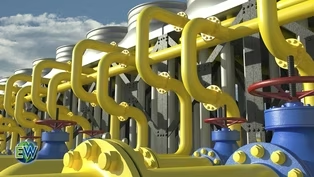
Balancing the Costs and Benefits of Data Centers
Video has Closed Captions
Clip: S3 Ep3 | 8m 22s | Experts examine how data centers affect energy, water, jobs and Illinois communities. (8m 22s)
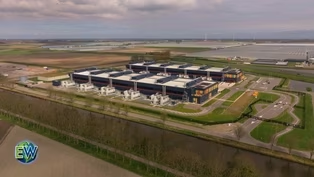
Data Centers and Solar Grazing | EcoWatch Preview
Preview: S3 Ep3 | 55s | Explore data center concerns, Illinois environmental policy and solar grazing. (55s)
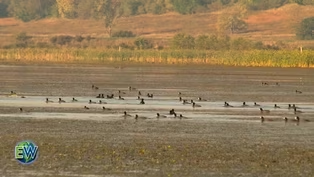
Expanding Emiquon National Wildlife Refuge
Video has Closed Captions
Clip: S3 Ep3 | 1m 3s | A federal investment will expand Emiquon National Wildlife Refuge in Fulton County. (1m 3s)
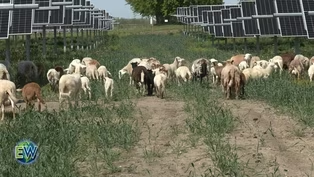
Sheep at Work on a Central Illinois Solar Farm
Video has Closed Captions
Clip: S3 Ep3 | 5m 51s | Sheep help manage a Central Illinois solar farm while keeping the land productive. (5m 51s)
Providing Support for PBS.org
Learn Moreabout PBS online sponsorship New Episode
- Science and Nature

Explore scientific discoveries on television's most acclaimed science documentary series.
 New Episode
- Science and Nature

Capturing the splendor of the natural world, from the African plains to the Antarctic ice.
 New Episode
 New Episode







Support for PBS provided by:
WTVP EcoWatch is a local public television program presented by WTVP
Support for Ecowatch is provided by the Backlund Charitable Trust