You Gotta See This!
Route 66: 100 Years on the Mother Road
Season 6 Episode 1 | 42m 36sVideo has Closed Captions
Celebrate 100 years of Route 66 through the people and places of Central Illinois.
Celebrate the centennial of Route 66 with a journey through Central Illinois. Explore museums, landmarks and roadside attractions in Pontiac, Lexington, Bloomington and Springfield while hearing personal memories from those who lived, worked and traveled along the Mother Road. Their stories reveal how a highway became an enduring symbol of freedom, connection and Americana.
Problems playing video? | Closed Captioning Feedback
Problems playing video? | Closed Captioning Feedback
You Gotta See This! is a local public television program presented by WTVP
You Gotta See This!
Route 66: 100 Years on the Mother Road
Season 6 Episode 1 | 42m 36sVideo has Closed Captions
Celebrate the centennial of Route 66 with a journey through Central Illinois. Explore museums, landmarks and roadside attractions in Pontiac, Lexington, Bloomington and Springfield while hearing personal memories from those who lived, worked and traveled along the Mother Road. Their stories reveal how a highway became an enduring symbol of freedom, connection and Americana.
Problems playing video? | Closed Captioning Feedback
Where to Watch You Gotta See This!
You Gotta See This! is available to stream on pbs.org and the PBS app.
Providing Support for PBS.org
Learn Moreabout PBS online sponsorship(upbeat music) (bright music) (engines revving) (exciting jazzy music) - It was fastest, best, and most scenic way to get from LA to Chicago.
- These were roads and paths that had previously been traveled.
- There was a growing desire, almost a demand for better roads.
- [Micaela] It kind of just took these little pieces and united them into this one roadway that took you through the heart of small towns across Illinois.
- [Melissa] There's over 90 communities in Illinois that 66 traverses.
(exciting jazzy music) - This is Bob Waldmire's van.
He traveled in it all over the Route 66 for many years.
- In Lexington, you can go see Memory Lane.
- My parents, Bill and Helen Posegate, built the A. Lincoln Motel on Route 66.
- Springfield has certainly always been a stop for Route 66.
Matter of fact, we tagged ourselves the heart of Illinois Route 66.
(exciting jazzy music) - Let the road take you where it's going to take you.
- I think people should get in their car and go get their kicks on Route 66.
(exciting jazzy music) (gentle music) - Really, you got to go back to the turn of the century.
The automobiles were just coming out and there was also a big fad for bicycles.
And with that, there was a growing desire, almost a demand for better roads because most of them were gravel or dirt.
- Route 66 started in 1926, and it stretched from Chicago to Los Angeles, technically Santa Monica.
- And it was part of the federal government's attempt to create order out of chaos, you know, to impose a logical system on what was before a system of like county roads, municipal roads, farm roads, you name it.
So Route 66 was part of a United States interstate system, and in the beginning it was the fastest, best, and most scenic way to get from LA to Chicago or vice versa.
- [Amanda] Route 66 in Illinois, we were first actually to have the road paved end to end.
We were the first of the eight Route 66 states to have our 300 miles that we have in Illinois.
All of our miles were paved first.
- Illinois really got the early start.
They appropriated money around 1814, 1815.
They'd created a gravel road between Chicago and St.
Louis, Pontiac Trail.
They paved Pontiac Trail and it became Route 4.
In 1924, an organization was put together by the government to do something about making some sense of the roads.
And one of those on the commission was Cyrus Avery, the father of Route 66.
Frank Sheets from Illinois was in it.
And they sat down and created a system of maintenance and a numbering system.
And it's pretty much used today.
You've got the east-west roads going even, north and south roads are odd.
And so one of the roads they plotted out was Route 66.
- The federal government, they originally decided on the number 60, but apparently there was some opposition to this route being named Route 60.
So they didn't like the number 62, which was available, so they chose Route 66.
And in hindsight, it was miraculous because the 66 in song and in all history has just been a great choice.
- [John] By November 11th, all the highways, including 66, were commissioned.
And then during the Depression, John Steinbeck, "Grapes of Wrath," established that term the motherroad.
- [Amanda] It just started as a road in some boring legislation that no one thought much about that created what we now know as Route 66, which has kind of become this mythological legend, this beloved like Americana pop culture icon.
- [Erika] This living road that's constantly being reinvented for every single generation and every single traveler that experiences it.
And so that's all part of its big, beautiful story.
(upbeat music) (idyllic music) - Hi there, welcome to Pontiac.
This is the Route 66 Museum Hall of Fame for the state of Illinois.
We have an exhibit starting in Chicago, and as you're moving around the room it's like you're traveling towards St.
Louis.
(idyllic music continues) - Hi, I'm Rose, the boss lady, but they call me a docent.
(laughs) Here's your passport.
I've already stamped it.
You are at the Route 66 Museum in Pontiac, Illinois.
The Route 66 Museum is a history of Route 66, and ours is just in Illinois, and it goes from Chicago to St.
Louis.
- It's a place for travelers, people to come and reflect and remember Route 66.
And particularly they're remembering that era from post-World War II to the decommissioning.
(idyllic music continues) We have memorabilia from the Rialto, which is in our Hall of Fame, Rialto Theater in Joliet.
And when we come in, there's a display.
We've got a lot of things from the movie "Cars."
It's there for a purpose.
If you bring young kids in, they look around, it's not going to grab their interest right away.
But if they see the things from "Cars" and they remember the movie "Cars," they're attracted to that.
Then you tell them this van was the concept for Fillmore and you got them.
Then they start looking around for other cool stuff.
This is Bob Waldmire's van.
He traveled in it all over Route 66 for many years.
People come from all over to see this.
It's an interesting, interesting place to look at.
You can't imagine anyone actually want to live in there, but he did.
Bob Waldmire was from Springfield.
His folks ran the Cozy Dog.
He decided early on that he wanted to do artwork, and he didn't want to be confined to one place.
He wanted to be on the road.
So he started out going really to college towns selling all sorts of artwork, but he was really good at drawing bird's eye view of towns like Normal and Macomb and Charleston.
And people bought them.
Businesses bought them to promote their business, and eventually he decided he was going to do more than that.
He went west, and he was there for a while, but he found that he didn't have time to do his artwork.
So he packed up and moved to the southeast corner of Arizona in the Chiricahua Mountains.
First vehicle was a Squareback Volkswagen.
It got too small to carry all this stuff.
So he bought this and drove that around everywhere.
He saw the bus in Grants, New Mexico and had an idea that he would convert it into his home.
So he did.
He bought it in Grants, took it back to Springfield towing the van, and they converted it into a bus with a whole second floor on it, and then he took it back.
And when he'd go back and forth between Illinois and Arizona, he would take that.
- It's probably one of the biggest museums in Illinois.
I've had as many as 19 different countries in one day, and I've had as many as 777 people in one day.
We're just so lucky to have it here, you know, but to bring all these people here and it's just amazing.
- You got to have some connection to the past, some appreciation of the past to understand the present and look forward to the future.
Come out and see it.
Great experience.
(gentle music) - I'm Mary Alice Davis and my parents, Bill and Helen Posegate, built the A. Lincoln Motel on Route 66 right after World War II ended because dad thought that people would start traveling again.
And, fortunately, he was correct.
Dad was an industrial arts teacher with a master's in architecture, and he decided after the end of World War II that people would start traveling again.
He loved to travel himself, so he had the idea of building a motel.
So he quit his paying job with a wife and two small children.
First, he looked for a nice lot outside the city limits on Route 66 and found a large lot with a big house in the middle of it and bought that and started building and moved the four of us out to the house so we would be there on site so they could work the motel.
It was in 1946, so I was 10.
I'm 90, going to be in a couple weeks.
My brother's six years younger, so he was only four.
He did a lot of research and wanted to name it exactly how Lincoln signed his name.
So he discovered that Lincoln always signed his name A. Lincoln.
The original sign is not the one that was on the Rose Bowl float or on the cover of the Department of Transportation map.
It was a wooden sign with planks, and on the second to the bottom plank, there were two small hooks, and there was a no sign made out of the wooden material that was the rest of the sign.
And my brother and I used to argue when the motel was filled who would run out there and hang the "No" on the little hooks?
That was called the A. Lincoln Tourist Court because in the '40s, they weren't motels, they were tourist courts.
So he decided to change it to the A. Lincoln Motel.
It was the first neon sign that a sign company made was the neon sign when we changed it to A. Lincoln Motel.
Well, he did it in stages, and he built six units and then six units, and he was big on conserving space.
So the first 12 units were six around three carports, but then later he discovered that he could put two motel rooms into the carports and have eight units in a section instead of six.
Also in the house, he closed out the dining room and put a outside entrance in.
And when the motel was full, he rented out the old dining room, which was now a motel room with a private bathroom.
The upstairs, the second floor of the house were four bedrooms.
My parents had one, my brother had one, I had one.
Of course, one bathroom.
It was a clawfoot tub, no shower.
And we rented out the fourth bedroom when the motel and the old dining room were full.
We rented that out.
And in fair time at the beginning, to make a little money, my brother and I would sleep on cots in my parents' bedroom and we rented out our bedrooms.
I was always afraid somebody was going to go through my dresser in my closet, so up to 10 people would use this bathroom.
Conservating space was his motto, so.
Well, dad took care of the construction and the maintenance and mother rented the rooms.
And bear in mind the office was open 24/7, especially if there was a vacancy.
So the doorbell would ring sometimes in the middle of the night, middle of when we were having a meal.
It didn't matter.
But mother would answer the door.
Occasionally, performers at the Lake Club, which was a club out toward where the motel was located south of town, but we would have the opening acts and one was a blind whistler called Fred Lowery, and he actually made records, which I have some of them.
Whenever he'd make a new record, he'd send it to mother.
He and his wife came there for years.
Just been a great adventure.
I'm glad that I can remember so much of it.
When you start out, you don't start at the top.
You have to make your own way, and you're not entitled to anything.
So I enjoy telling all these stories to my two daughters and my four grandsons because I want them to know what it is like to start a business with no experience.
So, yes, I am grateful.
(gentle music) - Hi, I'm Mayor Johansen in the city of Lexington.
We're proud to be a part of Route 66 and its history.
Well, I grew up in Lexington and lived here all my life.
When my mom and dad first came to town, we owned a restaurant up on Main Street and it was called the CNL Cafe, and we lived in an apartment up above it.
I remember as a kid looking out the window, and Main Street was packed then.
That's before the malls.
There was more mom-and-pop shops.
There used to be some older guys.
My dad was one of them.
On Friday and Saturday nights, they would just sit in their cars and watch the traffic go by.
And that intersection down there was the hub of town.
I've been full circle with it because I remember when it was in its heyday and I remember when it closed and the impact it had, not only that intersection, but the downtown area, and it was a sad time.
But about that timeframe, that's when the malls started popping up.
So these mom-and-pop stores, there wasn't a good survival rate for them, so they were closing up and everybody was going to the malls.
Now we've come full circle and more and more traffic's coming down 66.
The malls are gone or almost gone, and then you see the mom-and-pop stores popping back up on main streets.
So it's been good.
It's been interesting.
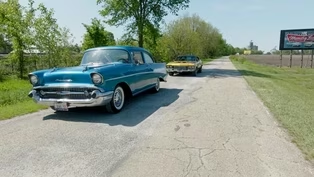
(exciting music) One of the things we'd like them to see is our memory lane.
I think that's one of the biggest things.
It's one of the oldest stretches of Route 66, the original Route 66, which was Route 4 before it became Route 66.
It's the original concrete, which I'm told is, you know, 24 inches thick in places.
And we have no intentions to repaint it.
I'm going to leave it as original as I can.
That was the road that came mainly through Lexington until they put the first bypass in, which took us to the edge of town.
But on that memory lane as you drive through there, there was houses that had a gas pump out in the front yard, and they had a restaurant.
You could stop and get a sandwich there and stuff.
So that's the oldest part of the road for us in this area.
They drive down memory lane.
We've recreated some old billboard looks, so it looks like they're actually driving down back in time.
One of the originals was out there and somebody stole it, so I recreated it kind of by memory and we put it back out there.
Living here all my life and seeing it all my life, there for several years it was neglected.
And I think the interest in bringing that back and letting the people enjoy it and see it, that is a part of Lexington.
That's the part people come to see.
That's what I tell people.
We celebrate it all the time.
I mean, somebody comes in with a bus, we'll meet them, I'll greet them and talk to them and do whatever, you know?
It's been good.
It's been interesting.
And to live long enough to see that, I'm glad I have.
I mean, it's been fun.
It's fun when I'm out there working, I'll see a carpool taking a picture of one particular sign, and I've often wanted to go ask them, say, "Why that sign?"
What memory did that trigger that you want a picture of it?"
So I think just that it walks you back in time.
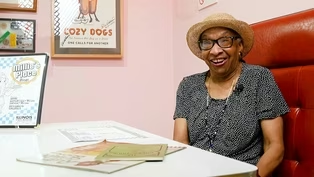
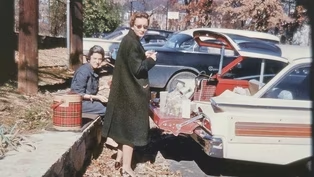
(upbeat country music) (light rock music) - My experience on Route 66, it goes back a long way because I was much younger then.
We had to go to California to my mom's brother's funeral.
And so we had a, I think it might have been a Chevrolet station wagon, one of those woodies, because it had the wooden panels on it.
We were going to go to the funeral.
My mom was pregnant with my youngest brother.
My youngest brother would now be like over 60 years old.
(light rock music) This would have been in the early '60s, probably.
So it'd be my mom, my dad, my paternal grandmother, her name was Lillian Hayes, and then me, Kathryn.
Would have been everybody from Georgie, Georgie Richie, Ovella, Neddy, Bill and me, nine.
And we had a woodie car.
Yes, we all drove in that car.
We were very close, but you could sit three people across in a seat, even in the front, and there were no seat belts either.
That's another thing in hindsight.
There were no such thing as seat belts at that time.
The funnest part was going on a road trip because this would have been the longest road trip we had ever done.
I remember the Petrified Forest, seeing it.
I remember seeing the Grand Canyon, and we have a family picture somewhere of all of us standing by the sign that says, "Welcome to the Grand Canyon."
That was really cool.
(light rock music) My favorite part was laying at night in the park or wherever we stayed and looking up at the stars.
So we always tried to stay like in a park of some kind.
I remember sleeping under the stars.
Now, we though this was really fun because we didn't have a mattress, but we had blankets and we made pallets and we slept on the ground.
Or we may have slept on top of the picnic table, for example, and maybe have a couple of blankets.
And since it was in the summer, you didn't need a cover, and we just got ate up by mosquitoes, but that was part of it.
The destination was truly fun, but getting there was fun too because you were with your brothers and sisters and were going on a new experience, but getting there was also the fun.
But to go to California, a part of the country we'd never seen was just tremendous.
So it was a great experience.
(bright music) - For the 100-year anniversary of Route 66, we are partnering with a lot of our local community members and our local Convention and Visitors Bureau, Visit BN, to really highlight all that our area has to offer for travelers and locals alike.
- There is so much going on in Bloomington-Normal this year for the Route 66 Centennial, not only in Bloomington-Normal, but across the whole county.
I think visitors and residents alike are going to find so many ways to not only honor the history of Route 66, but to also celebrate the Americana and the memory and the excitement of the historic route from Chicago to Santa Monica.
(upbeat music) - Welcome to the Cruisin' with Lincoln on Route 66 Visitors Center and Gift Shop, and the McLean County Museum of History where you can learn all about the history of Route 66 in McLean County.
We have here a series of billboards as if you were on the road.
- McLean County Museum of History is located in historic downtown Bloomington, and we're located in a beautiful 1903 courthouse building.
It's worth the stop just for the architecture alone.
At the museum, we have our Cruisin' with Lincoln on 66 Visitor Center and Gift shop.
(upbeat music continues) We have various exhibits both in the visitor center and upstairs in the museum that kind of share more about the history of Route 66 and Abraham Lincoln's unique connection to Route 66 in Central Illinois.
Cruisin' with Lincoln on 66 highlights the story of kind of the path, if you will, that is Route 66.
Started way before any of us were here as a Native American walking path to kind of traverse the state and then also the waterways throughout the state.
And then it kind of evolved into like a horse and buggy trail, eventually becoming the railroad, eventually becoming Route 66.
When Abraham Lincoln was around and when he was a judge on the Eighth Judicial Circuit, that is the path that he took to meet with people to go to court across the state and to kind of build the foundation of his career.
We highlight those little connections and kind of just try to get people excited about that history.
- Of course, you can't do Route 66 without thinking about mom-and-pop diners.
So there's a lot of history of food, and this is just the beginning.
We have a whole museum upstairs.
At the Museum and Visitor Center, it's really important for us to connect our local history with art.
We are in downtown Bloomington.
There's a very vibrant arts community locally, and we're doing increasingly more with murals that depict the history of McLean County.
- [Micaela] Downtown Bloomington has added three new murals.
The biggest one that is kind of the eye-catching stop that most people see is on Red Raccoon Games on Jefferson Street, and it depicts kind of the Bloomington-Normal skyline.
It has that Route 66 Americana, and it has the pink echinacea, the state flower.
So it's a fun one.
We also added a commemorative mural inside the entryway.
- So this is the first mural that we did for the Centennial.
This is just basically an overview map of the county of McLean and all the stops along Route 66.
So we have basically starting on this end, coming in from the south side of McLean County is the Dixie truck stop, the iconic off the interstate Dixie truck stop.
So we have that and some bikers, which are all over Route 66.
I mean, this is their heydays.
And then it comes back around to Towanda, which we have our Dead Man's Curve in Towanda, so we've got those cars racing, and then Memory Lane in Lexington, and then it curls back up to Chenoa.
The couple that was just here from California, you know, they use this as like a learning experience.
This is an interactive map, basically, of the county, and it's a place for people to stop and get their photos taken.
And, you know, you're always seeing people stopping and taking selfies in front of murals, and it's just great for tourism, it's great for the community, community pride, all those things.
- [Micaela] The community deserves to know that the place that we live is not just a flyover town in the middle of a cornfield somewhere.
This is a place that people have inhabited for thousands of years.
All of those people have shaped the world around us.
- If you've lived here your whole life, I'm born and raised in Bloomington-Normal and grew up with Route 66 in my backyard.
When I was younger, I thought, no big deal, right?
But this has given me an opportunity to really understand the importance and the significance of being in a community that has this highway running straight through the heart of it.
And I would really encourage our McLean County residents to not only take this chance to learn a little bit of the history about it, stop by the McLean County Museum of History, explore the Cruisin' with Lincoln on 66th Visitor Center, but also get out and be a part of all of these celebrations.
Again, you're not going to have a chance to do it again for another 100 years.
- This milestone, the centennial anniversary is a really great opportunity for us at the McLean County Museum of History, and then just for everyone in the community and whoever may be passing through to learn about how our spaces and our places kind of evolved over time and have shaped us as people.
(gentle music) - It was old 66 and came down old 66 to Springfield, so it was my first journey down there was my wedding journey.
- [Producer] Oh my gosh.
(gentle music continues) - We have a new exhibit that is about Route 66.
This year is the Centennial, and so we have an exhibit here at the Illinois State Museum in Springfield that talks about Route 66.
When people are here looking at our exhibit, they can actually listen to some of the oral histories that we have produced.
- We conducted a hundred oral histories of people who had memories of driving the road during its heyday or who are actively working to promote the road today.
Those memories live inside those people and they were kind enough to share and, you know, bring us along on that journey.
- I started about the same time that Route 66 was decommissioned and basically replaced with I-55 in Illinois, which runs as we all know from Chicago to St.
Louis.
And even parts of the old Route 66 or what we think of as historic Route 66 today are under I-55 and impossible to travel or impossible Know that you're on a historic road.
- Oh, like the road is literally on top of the old road?
- [Erika] So when they visit this exhibition, they will see vintage items from Route 66.
They'll see different sections that highlight what it was like to travel on the road, to eat along the road, to work along the road, the types of attractions.
- This is a car seat from mid-century, and it just represents the Wild West days of traveling Route 66 during the heyday.
Interspersed throughout the exhibit, we have these touch screens where we have various topics that we talk about relating to Route 66.
- A girlfriend and I took a road trip, and we drove Route 66 all the way to California.
- [Producer] Did you really?
- Yes.
- [Producer] Oh my gosh.
So when would this have been?
- It would've been in 1962.
- Under the Friday night lights, and our football stadium adjoined Route 66.
And so it just ran right through our community.
And so the traffic that comes through there, the diversity of people that comes through there, it's quite fascinating.
- I believe we are the oldest auto repair on Route 66, as well as the oldest tire and auto repair in America.
- [Amanda] This exhibit and this subject matter has definitely like brought families together just to kind of talk about maybe family vacations that they have experienced together and kind of comparing road travel and just things in general like now versus then.
I think it's been a spark of conversation between the generations, which was one of our goals.
- They built the interstate and put a fence around the travelers that traveled the area of Route 66.
And so they were no longer friends, they were strangers.
So before the fence, people involved in accidents would be welcomed into one's home.
After the interstate you shouldn't cross the fence because you were a trespasser.
And people's attitude along the highway completely changed with the interstate.
- I feel like it's important that everybody knows that their story matters, right?
Like, we talked to a hundred people.
Like I said, nobody was famous, but they all had this amazing insight to share.
So coming in, I hope that people see that their own memories, their own family histories are vital too and need to be preserved and recognized.
And another reason is that things change so quickly.
And when I was going into this, I thought like road travel, you know, big deal.
We still travel on the road.
That's nothing new.
And then come to like realize that traveling on the road in the 1950s and '60s is like completely different than the 21st century.
Each generation experiences something different, reinterprets it.
Route 66 is this living road that's constantly being reinvented for every single generation and every single traveler that experiences it.
It's all part of its big, beautiful story and, you know, worth recording.
- The more that we talk to people who have ties to the road, the more that we found out that, you know, places are important and buildings and structures and things, but people by far are the most important part of the road.
- Finally, in September 2013, I left Chicago with my wife for my American dream.
The entire Route 66 from Chicago to Santa Monica, an incredible journey that changed my life.
(light rock music) - Hey, I'm Big Dave.
This is Route 66 and I'm in my Firebird.
I've had Pontiac cars all my life.
My dad was a Pontiac guy.
My grandpa was a Pontiac guy.
I worked at the Route 66 gas stations in Odell where I grew up.
That's 10 miles north of Pontiac.
While I was born here, our whole life was Pontiac to Odell on Route 66.
When I got this car, my goal was to drive the car to California.
And so in 2016, my wife and I joined with about 80 other people, and we drove to California and came home on the Lincoln Highways.
The trip to California took 16 days.
It was just a wonderful, fabulous trip with people we didn't know before but became friends with them.
And now we run around with all these Route 66 people that just love traveling on 66.
And that experience is like no other.
Bob Waldmire used to put it, there was a sense of freedom on Route 66.
And on the highway, you would meet so many cool people that were making a living on 66.
Being born in the '40s and raised in the '60s, we used to travel 66 almost every day.
And of course the gas stations were just spectacular.
And so a lot of those gas stations today have been restored.
A lot of them are visitor centers now, like in Odell and Dwight, up and down the highway, all over in every state.
And it takes you to the Grand Canyon.
It takes you to the ocean in California.
The pier at Santa Monica is just a spectacular visit.
And to drive your car on the wood planking at Santa Monica was just really cool.
And so I treasure those pictures that we have.
We have hundreds of pictures.
It's just a spectacular trip of a lifetime I guess is how I've always categorized it, as a trip of a lifetime.
(rock music) - My name is Scott Dahl.
You're in Springfield, Illinois, the heart of Illinois Route 66.
Springfield has been preparing for the Route 66 centennial since 2019.
We've completed over 12 projects locally, including the Illinois State Fairgrounds Route 66 Experience.
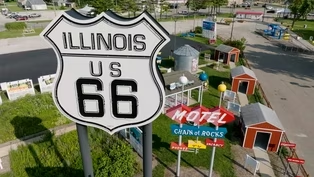
- So we are located on the state fairgrounds here in Illinois on the corner of Route 66 and Salem and Avenue at the Illinois Route 66 Experience.
And it's a micro version of Illinois Route 66.
The purpose is people can come out here, they can walk the entire route, see what's out there, and then plan a trip.
And we just felt that the story, the entire story of 66 and Illinois needed to be in one central location.
And what better place than the Illinois State Fairgrounds?
(rock music) - Today I wanted to get like a little taste.
It's a preview of what I'm going to see in about 10 days.
- [Casey] So there's over 90 communities in Illinois that 66 traverses.
You know, we start in Chicago and go all the way down to Madison, Illinois and all 90 in between.
- [Scott] We like to say that Illinois has more sites and attractions per mile than any state on Route 66.
- [Casey] All communities on Illinois Route 66 are represented in some way, shape, or form out here.
Inside the individual barns, which we know these barns and bridges were very common back in the '20s, '30s, and '40s, which is why we left them in place when we started.
But inside each one of the barns is a geographical section of Route 66.
There's new photographs, so some of the new businesses that are out there are highlighted.
And then we have old photos, photos you can't find anywhere.
- This is my favorite statue here in the park, and this is the reason I came here originally today because I wanted to get a picture of my own picture of it, and I got to see everything else that's around it, so pretty splendid.
And this statue is really creative and kind of modern take on Route 66.
- [Casey] My favorite part is probably Legends Neon Sign Park, right?
It's the culmination of those five signs behind me.
It's become iconic.
It's become just in the couple years it's been open, it's been on a Super Bowl commercial, it's been on the cover of multiple magazines, and it's really becoming a visual representation of Illinois.
(rock music) So here, the experience we feel is the educational component, right?
It's also the "Oh, I had no idea that existed" component.
So we need to make sure that we're educating the students, the young, and we talk about it.
So inviting parents to bring their kids out here, get, you know, conversations going, and then taking them out on road trips.
Even in the dead of winter, I'll come out here and there are people walking around, which is really great, right?
This is not just a nice weather experience, if you will.
It's open 365 days a year, and we get international travelers.
We get locals.
I have a couple locals that tell me they're out here weekly just walking through it because they love it.
(rock music) - It's just a beautiful way of learning about Route 66 because every little building has the little towns that are in Illinois and it's real informative.
- You don't see neons like this much anymore, right, and in a central location.
Back in the '30s and the '40s, you saw them all the time.
They were lining streets.
But to come out here and the barns are lit at night so you can walk in and you can see what's in there, but then just to take a step back and take a photograph with the neons, it's really just kind of, it's heartwarming, and it just brings you back to nostalgia of what the road is.
(rock music) (chill music) - [Scott] You have these 300 miles of amazing Route 66 stretch that they'll really get to experience Route 66 without having to travel the 2,448 miles.
And they'll get a real sense of Americana when they travel through Illinois.
- This is a great opportunity to really honor our past and our history in a way that we don't necessarily always have a chance to do.
- What I would tell someone that's planning a Route 66 trip this year is to take as much time as you can to slow down and to talk to people along the route.
Don't skip over the small towns to just see the big tourist attractions in the big cities.
- [Casey] Just get a visitor guide, head out on the road and see where it takes you.
- There's so many spectacular locations along the way and start making plans.
It's a hundred years since the road was created, and there's no time like the present.
(chill music fades) (exciting jazzy music) (exciting jazzy music continues) (exciting jazzy music continues) (upbeat music)
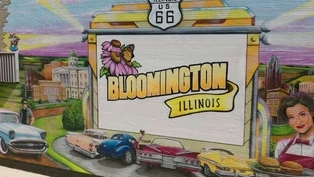
Cruisin’ with Lincoln on Route 66
Video has Closed Captions
Clip: S6 Ep1 | 5m 52s | Bloomington connects Abraham Lincoln, local history and the enduring story of Route 66. (5m 52s)
Video has Closed Captions
Clip: S6 Ep1 | 3m 23s | Lexington preserves an original stretch of Route 66 and the memories built along it. (3m 23s)
Video has Closed Captions
Clip: S6 Ep1 | 3m 22s | Kathryn Harris remembers a family road trip to California along Route 66 in the 1960s. (3m 22s)
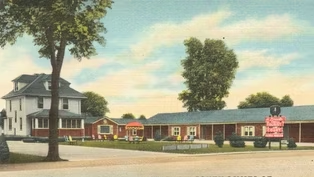
Growing Up at the A. Lincoln Motel
Video has Closed Captions
Clip: S6 Ep1 | 5m 47s | Mary Alice Davis recalls the family business her parents built beside Route 66. (5m 47s)
The People Who Made the Mother Road
Video has Closed Captions
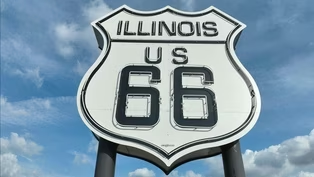
Clip: S6 Ep1 | 4m 57s | The Illinois State Museum preserves personal memories from Route 66’s first century. (4m 57s)
A Road Trip Across Illinois in One Stop
Video has Closed Captions
Clip: S6 Ep1 | 4m 17s | Springfield’s Route 66 Experience previews the historic road across Illinois. (4m 17s)
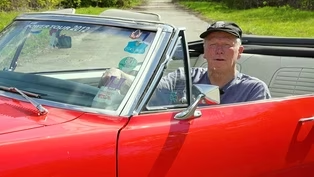
Clip: S6 Ep1 | 2m 22s | Big Dave Sullivan shares a lifelong Route 66 connection and a journey to California. (2m 22s)
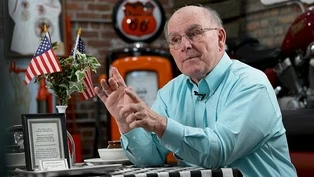
The Stories Inside Pontiac’s Route 66 Museum
Video has Closed Captions
Clip: S6 Ep1 | 4m 32s | Pontiac’s Route 66 museum preserves the people, vehicles and memories of the Mother Road. (4m 32s)
Providing Support for PBS.org
Learn Moreabout PBS online sponsorship New Episode
- News and Public Affairs

Top journalists deliver compelling original analysis of the hour's headlines.
 New Episode
- News and Public Affairs

Today's top journalists discuss Washington's current political events and public affairs.
 New Episode
 New Episode
 New Episode
 New Episode
 New Episode
 New Episode

 New Episode
 New Episode
Support for PBS provided by:
You Gotta See This! is a local public television program presented by WTVP