Docs on Call
Understanding Sleep Disorders and Better Sleep
8/20/2026 | 26m 29sVideo has Closed Captions
A sleep specialist explains sleep apnea, insomnia, restless legs and healthy sleep habits.
Mark Welp talks with Dr. Ravi Kashyap, medical director of the Carle Health Methodist Hospital Sleep Lab in Peoria, about getting better sleep. They discuss how much sleep people need, sleep apnea and testing, CPAP and other treatments, insomnia, healthy sleep habits, blue light, caffeine, sleep aids, restless legs syndrome and naps.
Problems playing video? | Closed Captioning Feedback
Problems playing video? | Closed Captioning Feedback
Docs on Call is a local public television program presented by WTVP
Docs on Call
Understanding Sleep Disorders and Better Sleep
8/20/2026 | 26m 29sVideo has Closed Captions
Mark Welp talks with Dr. Ravi Kashyap, medical director of the Carle Health Methodist Hospital Sleep Lab in Peoria, about getting better sleep. They discuss how much sleep people need, sleep apnea and testing, CPAP and other treatments, insomnia, healthy sleep habits, blue light, caffeine, sleep aids, restless legs syndrome and naps.
Problems playing video? | Closed Captioning Feedback
Where to Watch Docs on Call
Docs on Call is available to stream on pbs.org and the PBS app.
Providing Support for PBS.org
Learn Moreabout PBS online sponsorship- There are more than 100 known sleep disorders including insomnia, sleep apnea, sleepwalking and restless legs.
Tonight, we focus on the effects of these disorders and how to treat them.
(relaxed music) (relaxed music continues) Good evening and thanks for joining us for WTVP's "Docs On Call," I'm Mark Welp.
We spend about 1/3rd of our lives sleeping or trying to sleep.
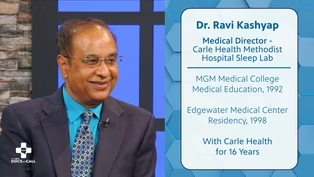
Here to help us get the rest that we need is Dr.
Ravi Kashyap.
He is the Medical Director at the Carle Health Methodist Hospital Sleep Lab in Peoria.
Doctor, how are you?
- Pretty good.
Thanks for asking, how are you doing?
- I'm doing great, thanks.
Well, I don't know, you can tell me if I'm doing great because we're gonna talk about sleep and let's start off by talking about how much sleep people should get and let's kinda start with kids and work our way up there.
- For the kids, of course, like babies, they might sleep for 20 hours a day.
But as we grow like three to four years old, at least 14 hours a day would be good for them and when they grow older, 12 hours, 10 hours in the pediatric population would be reasonable.
Now once they become 12, 13, 14, I would say eight to 10 is the right amount and of course with the school and everything else, they may not be able to get that but at least eight would be essential when they are teenagers.
Adults, we know that for sure eight hours is the minimum or average, I should say.
Between seven to nine hours is the right amount of sleep.
Now everybody needs to know themselves.
Like some people might do quite well with seven hours of sleep.
Some people might need nine hours of sleep and the only way to know that would be some patients will tell me that over the weekend, they're able to sleep in and after nine hours of sleep, they feel much better during the daytime.
They're nine hours people.
Many people say seven hours is good enough for them.
So people need to figure out what's the right amount for them between seven and nine hours.
Less than seven hours is not adequate.
If you're sleeping more than nine hours and you need more than nine hours, there could be a problem.
You definitely need to talk to your doctor to see why after nine hours of sleep, you're still feeling tired and sleepy.
- Sure.
Let's talk about some of these sleep disorders, especially the common ones.
Why don't we talk about sleep apnea?
A lot of people suffer from sleep apnea and give us the definition exactly of what that is.
- So sleep apnea, apnea itself, what it means is stoppage of breathing, right?
And we define that for our purposes for more than 10 seconds.
So if you look at the sleep apnea, that's stoppage of breathing while you're sleeping, right?
When you don't know about it and not to go in too many details at this time, a common one is obstructive sleep apnea because there's obstruction in the airways that stops you from breathing and not so common is called central sleep apnea when for some reason, either some abnormality in the brain or some unknown reason, the brain forgets to breathe.
But that's not so common.
So going to the more common one is obstructive sleep apnea.
There's a narrowing of the airways anywhere from posterior oropharyngeal area to the vocal cord.
So somewhere in between and once the people go to sleep, the neck muscle have excessive relaxation for the people who have sleep apnea and they start snoring and snoring and then they're quiet because they're not breathing, right?
When they don't breathe, there's no airflow to the lungs and the whole body gets deprived of oxygen, right?
So brain wakes up, we call micro-arousal.
Patients are not aware of it.
Make the neck muscle go back to normal.
They will start breathing again, get the oxygen.
The brain says, "My job is done," goes to sleep, right?
Neck muscles go back to relaxing again and the same cycle can repeat itself again and again.
Patient may be completely unaware of it.
They may say, "I wake up a few times a night.
I don't know why I wake up but I go back to sleep and I sleep well."
Their complaint is when they wake up in the morning, they say, "I don't feel well-rested."
Most people would say after lunch hours, it's very hard for them to stay awake and if they're relaxing themself in the evening, watching TV, reading a book, whatever, they're unable to kind of finish what they're doing.
So that's what the lack of sleep is doing because the brain keeps waking up every time they stop breathing.
So if you look at more details on that, so two things are happening at the same time.
When they stop breathing, that results into the brain waking up, micro-arousals and when they stop breathing, they're not getting oxygen.
So there's a lack of oxygen, hypoxia in the medical term.
So that's maybe happening 10, 20, 30, 40, 50, 100 times an hour.
At the worst, I have seen it 180 times an hour.
So that's kind of excessive but it's not uncommon for us to see people stop breathing 30 to 40 times an hour and when I tell them, they say, "No way, I would have known."
But the spouses would concur with me.
Their spouses or significant other or bed partner would say, "Oh, yes, you do that."
Anyway, so let's say 30 times an hour.
I'm just saying one of the numbers.
So 30 times an hour, their brain is waking up, right?
So in the daytime, the brain says, "I did not get my rest."
The whole night, they kept waking up.
So they'll be very sleepy and tired.
So lack of sleep can cause sleepiness, tiredness, fatigue, sometimes short-term memory loss, morning headaches, depression, anxiety, accidents while driving amongst other things.
Now there's lack of oxygen because they're not breathing, right?
And over time, it's gonna affect the heart and the brain amongst other things and things it can cause an increased risk of is high blood pressure, irregular heartbeat, also known as atrial fibrillation, diabetes, heart attacks, stroke, pulmonary hypertension amongst other things.
So that's sleep apnea in general.
- Sure.
So I'm sure you have a lot of spouses tattling on their significant others, saying, "Hey, look, you're snoring way too much.
I can't sleep, go see the doctor."
- Yes.
So when they come, first thing I ask the spouse is that, "Hey, did your wife or husband bring you here?"
And they say, "Yes."
- Yeah.
Tell us a little bit about the sleep test that people do to see if they have sleep apnea.
What all goes into that?
- So there are two major variety of sleep studies.
One is called polysomnography or the polysomnogram or in-lab sleep study where the people go to the lab, sleep lab and go to sleep there and have a sleep study done.
Shorter version would be home sleep study when they can get the sleep apnea study done at home.
So in-lab sleep study, polysomnogram is much more detailed.
It is done in one of the sleep centers where we can do the EEG looking for the brain waves.
EKG are looking for the heart monitoring, snoring monitoring, airflow monitoring, chest wall movement, abdominal movement, leg movement.
So there are a lot of wires hooked all over the body, right?
So much more detailed.
Of course, the main purpose is to diagnose sleep apnea but occasionally we have noticed or diagnosed some patients with unknown seizure disorder because there's an EEG going on or unknown atrial fibrillation which patients were not aware but we look at the heart monitoring, et cetera.
Sometimes REM behavior disorder as well.
On the other hand, home sleep study is much more shorter.
It has a chest belt, we look for the chest wall movement and there's something on the finger to look at the pulse oximetry and something in the nostril to look for the airflow.
So it's a very good study for sleep apnea as well but not as detailed as that would be done in the sleep lab.
But it has its own advantages because then you are getting it done at home.
So you sleep at your known surroundings.
So it makes it easier for many of the patients.
- So a lot of those patients, if they do have sleep apnea, they're prescribed a CPAP machine which if you're not familiar, it's the mask that forces air into you.
Is that the most common way to treat sleep apnea?
- It is, it's the most common way to treat sleep apnea and the most effective way to treat sleep apnea.
As you mentioned, CPAP is a Continuous Positive Airway Pressure.
So as you said, there are different kinds of masks, nose mask, full face mask.
The machine creates the pressure.
A mask has only one purpose, to create a good seal so it can be pushed in.
So of course, there's a learning curve and getting used to it but a majority of the patients who are able to use that, they feel a whole lot better and then after awhile, nothing, they will not go anywhere without it.
I have patients who go to the camping and get some kind of a battery-operated or some kind of adapter to use during the camping as well.
So that's the most common one.
- So a lot of people though have a rough time with the mask and that's why there's different types of masks.
I've gone through all of 'em.
(Dr.
Ravi laughs) But I've also seen things, mouthpieces that supposedly help.
I've seen commercials for an implant.
Are those things legitimate?
- Yes, yes.
So the mouthpiece or the mouth guard we call a mandibular advancement device.
So the mouth guard people know quite well.
It's the same process but it's specialized.
It moves the jaw forward and it adjusts over time, patients adjust by themselves to see how much they can tolerate.
For the mild sleep apnea, it's quite a reasonable thing to do.
Moderate to severe sleep apnea, it will help but I don't know it can eliminate that.
So I always tell my patient, "If you want to go through that route, make sure that you don't do it by yourself."
Because remember, it puts pressure on your teeth.
So I always tell them to go to an orthodontist or dentist who can manage that, prescribe it for them and keep watching any tooth deformity as well.
Now, so yes, it is effective and again, I said in six months once they're fully adjusted, you can have a repeat home sleep study this time with the dental device in so you can see, has it eliminated your sleep apnea or not?
The ENT surgery or Ear, Nose, Throat surgery, especially for the children, it's a decent choice where they can remove the tonsils, adenoids, uvula.
It's a long name, it's called uvulopalatopharyngoplasty.
We call UP3, effective and for adults as well, it's effective.
The only problem with that is that number one, it's very painful, especially for the adults, at least two weeks of misery.
But also it's only effective 50% of the time.
So I tell my patients, "You can go for it but remember, I don't know it's gonna work for you or not."
Now the implant device you're saying is a pacemaker in a way, if you will.
So implant device is that they put a pacemaker just like for the heart, input on right side and what they do is make some kind of surgical intervention to make a hole in the neck.
It's a lot more detailed than that but basically what the ENT surgeons are trying to do is go in and find the nerve called hypoglossal nerve, right?
So the pacemaker is attached to the hypoglossal nerve and once it's all healed up, it may take a few weeks to do that, then of course there's a pacemaker underneath their skin and there's a remote control.
So there's a titration process.
So the way it works is when they turn it on, when they breathe in, it stimulates the, so it kind of, for lack of a better term, zaps it a little bit.
So it gives a zap to the nerve and the tongue moves forward and then when you breathe out, it will move backwards every time they breathe in.
So there's a whole device and mechanism that it figures it out while breathing in and out.
So in general, what it's doing is that it moves the tongue forward and backwards, tongue forward and backwards.
So that's how it prevents, because the tongue is moving forward, there's more space in the back of your throat and it helps to let the air go in.
So it takes a few months overall to fully get adjusted to it.
Has it been effective?
Yes.
Of course, there is a criteria for that that so far the insurance company would have.
Your body mass index has to be less than 32.
Your apnea-hypopnea index has to be between 15 to 60 and you have failed to use a CPAP machine.
So those are three criterias insurance companies require.
So yeah, it is effective.
But again, those are the whole details about the device.
- Very interesting.
We could talk about sleep apnea the whole program but we better get onto some other things.
Let's talk about insomnia.
A lot of people throw that term around.
"Oh, I couldn't sleep last night, I have insomnia."
Is there a medical definition for insomnia that's different than just, "Oh, I had trouble sleeping last night?"
- Yes, insomnia would be on consistent basis that you are unable to fall asleep or maintain sleep on the chronic basis, not one night or two night with no obvious reason.
So you're right.
I just heard that you went for the concert last night.
So if you didn't sleep well, that's not insomnia.
You just had inadequate sleep time.
So sorry.
- Bad choices.
(laughs) - No, it's a good choice.
What I'm saying is that's inadequate sleep, right?
But insomnia would be a chronic basis, they try to go to sleep and they cannot fall asleep and then that's sleep onset insomnia or they fall asleep very quickly but they wake up in the night.
We all do many for whatever reason and they're unable to go back to sleep again for hours.
So sleep maintenance insomnia.
So that's insomnia in general.
There could be medical reasons for that.
Some of our own habits might be doing that.
So it's a very detailed process of evaluating the patients with insomnia to see what's happening and how that can be corrected.
- So when should people be concerned and go to someone like yourself to see if they have an issue?
- So if they are trying to fall asleep and they cannot fall asleep or they're in the bed for eight hours, for example, and even then in the daytime, they say, "I don't think I slept well.
I kept watching my watch and I cannot sleep.
In the daytime, I'm very sleepy because I cannot function properly.
I cannot focus or I tend to doze off at inappropriate times," that means they're not getting enough sleep and that's a good time to go see a doctor and of course, at that time, your family doctor or us as a sleep doctor, we go through the whole details.
When somebody's come in for insomnia, we just don't take their word for it.
We trust them but we go through the whole questionnaire.
Like sleep apnea, maybe sometimes people think they have insomnia or some people may have different and inadequate sleep habits.
So we go through the whole process to diagnose whether something else is going on or they actually have insomnia.
- So what are the more common causes of insomnia that you see?
- So teenagers, teenagers and young adults, most common cause will be inadequate sleep time.
They are not sleeping enough.
So the teenagers, for example, Saturday, they sleep at, I'm just saying 2:00 AM.
Friday, 2:00 AM.
Now Sunday, they want to go back to bed at 11:00 PM or 10:00 PM and their internal clock is reset and you cannot just reset it back by three or four hours in one day.
So on Monday, they're trying to sleep but cannot fall asleep 'til like 12:00 or 1:00 and Tuesday, maybe 12:00 and Wednesday, 11:00 and come Thursday or Friday, Friday, they're back to sleeping at 2:00 AM.
So that's a common one.
Like people try to change their habits based upon the weekends and weekdays and the brain is never able to adjust to that.
So that's one of the common causes.
Of course, the sleep habits, like common things will be to train our brain that this is my sleep room.
This I'm gonna go and sleep.
So do no work in the bedroom, no watching TV.
Light reading is okay but nothing beyond that.
So use the bedroom only for sleeping, not for watching TV, not for doing any work, none of that.
Not for eating, everything outside the bedroom.
Try to maintain the same sleep time or a very similar sleep time during the weekends and the weekdays.
That'll be very helpful.
A comfortable temperature, 68 degrees most people like but some people like a little more, a little less.
So whatever's comfortable for them.
A dark room, quiet room, those are important things.
So this way, they can train themselves to kind of fall asleep properly and if they're maintaining that and if they wake up in the night, sometimes people say, "What did I miss?"
Or open the phone and say, "What did I miss?"
Please don't do that, it perpetuates the insomnia.
So removing those conditions would be the first thing to do and then of course, there could be some medical conditions.
Sometimes depression can cause early morning awakenings.
There are many other things.
Some people may be taking their water pills like Lasix late in the evening.
That could cause them to wake up multiple times.
So it's a very long history that we do to make sure that we address their concerns.
- You mentioned phones and we hear a lot of news reports about blue light and how you shouldn't be on your phone right before you go to bed or your tablet, watching TV or whatever.
Can you expand a little bit more on that and why that's not a good thing?
- Yeah, so the stimulation of the brain, right?
Eyes are the direct communication to the brain.
So stimulating the brain and trying to shut it off, the brain wants to be shut off.
It's just like, for example, in summertime, if you want to sleep at 9:00 or 9:30, it's hard to fall asleep at 9:00 or 9:30 because you just got exposed to sun and you cannot fall asleep.
With the winter, 9:00 or 9:30, if you really want to sleep, you might have an easier time.
So that's part of the blue light stimulating the brain and not letting it slow down as it's supposed to.
- Okay, what about caffeine?
I know some people who they say, "I will not drink caffeine after 4:00 PM.
Otherwise, I won't get to sleep."
I know some people who could drink it all night.
What kind of effect does caffeine have on some people?
- Well definitely, you're right.
I'm a caffeine addict myself, so I know that.
But then you need to figure out what time.
Again, it's very individual.
Like you said, my wife can drink coffee and go to sleep.
Me, if after 5:00 PM I have caffeine, I cannot fall asleep.
So caffeine works for 12 hours.
So the people, some may be drinking caffeine at 12:00 PM and still unable to sleep.
So again, we need to know our own body and figure it out, that okay, why can't I sleep today because I had the caffeine late in the evening?
And if that happens, you should not.
In general, 4:00 to 5:00 PM would be a good time to end any caffeine.
But again, as you said, some people just, they broke all those fibers between caffeine and the brain nerves.
"It's okay, all broken.
I can have caffeine just like water and it doesn't bother me."
- Yeah.
I guess it's trial and error.
You just gotta figure out- - Correct.
- What you can handle and what you can't.
What about over-the-counter medications?
I know melatonin's one that a lot of people swear on.
I've heard magnesium.
What are your opinions on taking over-the-counter medicines to help you sleep better?
- So melatonin is a chemical secreted by our brain in a very minuscule amount and it clearly has shown to be associated with good sleep or making you fall asleep.
So that's melatonin.
Now the over-the-counter medications have much higher dosages.
I haven't seen much of side effects as long as not taken in overdose.
So if you're taking three to five milligrams, up to five milligrams of melatonin a night and if it's helping you to fall asleep, I think it should be okay.
Other over-the-counter, there's so many other medication that it's hard to kind of pinpoint as to which other medications they would be taking.
But if they want to take it, I would definitely recommend to talk to their doctors.
Number one, what the side effects would be.
Number two, which is also important, is what's the drug interaction between that medication and other medications they might be taking?
- And what about prescription medications?
Are those for more extreme cases or how do you judge who should be taking those?
- So after they have ruled out, let's say for example they have insomnia.
They're doing everything they're supposed to do.
There's no medical condition causing insomnia.
They have what we call primary insomnia or the insomnia, just how they are.
So the prescription medications are very helpful for that and again, a shorter-acting medication would be better, which works for five to seven hours would be the preferred medication in my perspective.
For the longest time, we thought it should only be taken for a few days, which is also a good idea.
But we thought taking it on a chronic basis might cause lots of problems but we have seen some patients just, despite everything they have done, once they try to get off the medication, the insomnia comes back.
So if that's the case for them, it's okay to take that as long as they're in touch with their physicians.
But again, lesser the better.
If you can train your brain to sleep at a certain time and then try to get off the medication would be more advisable.
- Okay, one more thing before we go I want to talk about is restless leg syndrome.
That's an interesting one and people I know that have it, it's not a one-size-fits-all thing.
Some have really extreme symptoms.
Others, it's just kind of annoying.
Tell us what that's all about.
- Yeah, so the people with restless leg syndrome, they will know exactly how it is.
So restless leg syndrome would be when they're relaxing.
Like for example, like sitting right now or especially going to bed, so when they get more relaxed, they have an achy sensation in the back of the calf.
So that's part of it, that aching sensation but even for the definition part, the moment they start moving the legs, it goes away.
So restless leg syndrome, that will be people will figure out, like "I have an achy sensation and I have to keep moving so that I don't have the pain."
And that's why they have restless legs.
I have, as you say, extreme cases.
I have seen a patient, I go to the patient's room and they're walking in the exam room because "Doc, I can't sit still."
Or they're sitting and they're constantly moving their legs.
So that's restless leg syndrome.
There's some known causes for that, caffeine is one of them.
Chocolates would be another for them.
Iron deficiency, anemia.
Sometimes the pregnant females have that as well and renal failure.
So those things, some medical conditions are known and that should be corrected first.
Now after taking all those, correcting the iron deficiency and all, if they still have restless legs, then there are medications available for them.
Could be taken once a day or twice in the evening.
So those conditions, there's treatment for that.
- And is there any rhyme or reason as to who gets restless leg syndrome?
- No, other than the medical conditions we talked about, it just happens for people.
There's no genetics involved.
It doesn't run in the family but we do see that.
But no, there's no other, gender or age, none of that is involved with that one.
- What's your stance on naps?
- Yes, naps are very interesting.
The naps, depending about what we call nap.
In an ideal world, right?
Suppose during the lunch hour, if you take a 20 minutes nap, and I mean 20 minutes nap, not 25 or not one hour, may be somewhat beneficial if you can manage a 20 minutes nap if you need to, right?
Japan and others, maybe siesta they're called but that's what they do.
In the office, they have lunch or whatever and they just lie down for 20 minutes.
May not be a bad idea.
It rests your body and you can move on.
Now taking a nap, I said micro-sleep or a long sleep, one to two hours, that's definitely not healthy.
Because you're sleeping now and now you try to go to sleep in the nighttime and then you cannot fall asleep because you had two hours of sleep prior and then you try to sleep, you cannot fall asleep and it becomes a cycle of irregular sleep time.
Especially in the evening, like after 4:00 or 5:00 PM, if you have to take a nap, it has to be 20 minutes or less, not more than 20 minutes.
- Interesting.
Well doctor, we appreciate you coming in.
Dr.
Ravi Kashyap is with Carle Health Methodist Hospital, the Sleep Lab in Peoria.
We appreciate all the great information tonight and thanks for coming in.
- Thank you.
- All right, and you can watch the show again and share it at wtvp.org.
You can find out about future show topics on our Facebook and Instagram pages and we always want to know your questions and topic suggestions.
You can message me on social media or leave a comment.
Thanks for watching and take care of yourself and your family.
(relaxed music) (relaxed music continues) (upbeat chiming tones)

How Blue Light Can Disrupt Your Sleep
Video has Closed Captions
A sleep specialist explains why screens before bed can make it harder to fall asleep. (48s)
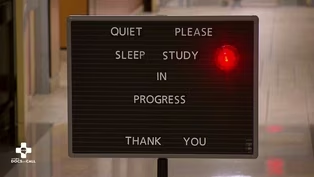
How Sleep Studies Diagnose Sleep Apnea
Video has Closed Captions
A sleep specialist explains how in-lab and home sleep studies test for sleep apnea. (1m 43s)
What Happens During Sleep Apnea?
Video has Closed Captions
A sleep specialist explains what happens when sleep apnea stops breathing during sleep. (2m 10s)
Providing Support for PBS.org
Learn Moreabout PBS online sponsorship New Episode
- Science and Nature

Explore scientific discoveries on television's most acclaimed science documentary series.










 New Season

Support for PBS provided by:
Docs on Call is a local public television program presented by WTVP