WTVP Now
WTVP’s 2025-26 Impact
8/28/2026 | 17m 16sVideo has Closed Captions
A look at WTVP’s 2025-26 impact, growth, local stories and community support.
WTVP President and CEO Jenn Gordon joins James Kerr for a look at WTVP’s 2025-26 Annual Impact Guide. They discuss growth in broadcast and digital audiences, 259 new local programs and specials, expanded community engagement, 2,500 new members and what it means for WTVP to move forward as a 100% community-supported public media organization.
Problems playing video? | Closed Captioning Feedback
Problems playing video? | Closed Captioning Feedback
WTVP Now is a local public television program presented by WTVP
Support provided by:

WTVP Now
WTVP’s 2025-26 Impact
8/28/2026 | 17m 16sVideo has Closed Captions
WTVP President and CEO Jenn Gordon joins James Kerr for a look at WTVP’s 2025-26 Annual Impact Guide. They discuss growth in broadcast and digital audiences, 259 new local programs and specials, expanded community engagement, 2,500 new members and what it means for WTVP to move forward as a 100% community-supported public media organization.
Problems playing video? | Closed Captioning Feedback
Where to Watch WTVP Now
WTVP Now is available to stream on pbs.org and the PBS app.
Providing Support for PBS.org
Learn Moreabout PBS online sponsorship(gentle music) (gentle music continues) - Hello and welcome to "WTVP Now."
I'm James Kerr, chief officer of content and digital media for WTVP.
And joining me today is WTVP president and CEO and my boss, Jenn Gordon.
And we're going to take a look back at WTVP's 2025-26 fiscal year and the impact of our work across central Illinois.
Jenn, thank you for joining me.
- Well, thank you so much for having me, James.
- Now, every year, WTVP puts together an impact guide that takes a look at everything that we've accomplished over the previous fiscal year, which for those of you at home, that goes from July 1st to June 30th.
And when you take a look at this guide, it's two pages, and there are a lot of numbers on it.
- A lot of numbers.
A lot of numbers.
- A little bit of math for me, but I think what's more interesting is the story that these numbers actually say.
So when you take a look at the impact guide as a whole, what stands out to you the most?
- Yeah, absolutely.
So I'm so excited about this year's impact guide.
And even though there are lots of numbers, I do encourage everyone to take a few minutes and read through them because it does tell a story as you said.
And I think the first half of that story is how the community stepped up and met us last year.
And we've talked about that a lot before through the We Believe campaign.
It was this big moment.
We were asking a lot of the community, and we saw that through some numbers, right?
So we know that 2,500 new members.
- Incredible.
- That was a big number from last fiscal year, knowing that that translates into a total of 6,800 members that collectively give to the station.
A big number.
And then just also looking at how we as a station, we were taking those resources that the community was pouring into the station and then turning it into new services and programs.
So the other number that I'm really excited about on this is our content number, right?
So we had- - And we're gonna get to that.
- Okay, great.
So I won't go too deep into it.
- Right, right.
- So I mean that kinda goes back to these promises made and promises kept, right?
So when we launched this campaign last year, we just said we're gonna make the need known to the community But if we're asking the community to dynamically invest in this critical moment, we are also going to deliver more.
And I'm really, really proud that we're able to do that.
- Let's back up just a little bit.
So I think sometimes when we think about WTVP, we primarily only think in terms of television.
But when you look at these numbers, you can see just how much bigger WTVP has become than just what we have on our broadcast stations.
So tell me a little bit about just how much we've grown.
- Yes.
You can take a little pat on the back for this because you did really help move the needle forward in a lot of ways in this department, James.
But broadcast will always be at the heart of what we do, and our numbers with broadcast are really significant.
So when we look at 35,000 hours of quality content being pushed out across our four stations that we have, which is a big deal, 230,000 households.
I'm gonna say that again.
230,000 households tuned in each month.
- It's incredible.
- That's a huge deal.
- That's huge number.
- And 5.89 million views through broadcast programs.
But when we look at the digital space, we know that a lot of people have never once experienced broadcast, which is fascinating, but never once experienced- - I don't know if my kids would know how to use the remote control without going to the streaming apps and everything.
Yeah.
- Yes.
So this is the community space that we're serving.
And so it's our job as a public media engine to be living in that space and meeting viewers where they are.
And I think last year we started to just dip our toe into the water and really start to move that forward.
So with the number from digital streams, 500,000 general audience streams on the website and the app, 500,000 general audience streams.
And then for PBS Kids videos, which we use that app a lot in our house.
- Right, right, same.
- I just absolutely love it.
I've trained my five-year-old to say, "I learned it on WTVP PBS."
- That's good branding.
That's good.
- Yes, it's really, really great.
So 5.2 million PBS kids videos and games were played by people who are localizing to our station.
So when you think about that type of impact that we're having on an educational level for these kids with ABCs, 123s, logic, sequential thinking, literacy skills, it's a big deal.
- It is a big deal.
So what do you think that tells you about the way people in central Illinois are now choosing to connect with public media today?
- Yes.
Yes.
Well, I think people in central Illinois, they're just looking for content as easily as they can get it.
- Of course, of course.
- Right?
And we know that that puts us in the position of having to connect with people across 20 different platforms.
And really, again, we've made some really good progress.
I think that people will see from the impact guide, but this is just the start.
So as we're looking to our promise of this year of meeting people where they are, this is where we're really gonna flex our muscles because people, they're experiencing content in shorter clips on their phones, they're experiencing it while they're multitasking doing other things.
- Right.
- Right.
A lot of people are listening to shows while they're washing the dishes with their mobile phone on over here.
Parents are hyper leveraging tablets and mobile devices with their kids when they're in the car, when they're at home, when they're cooking.
So the space that we can fill is to take this device, our screens that are everywhere nowadays, and to turn that into a learning vehicle and a community connection portal for all of our viewers in central Illinois.
- And what's really interesting with that is that takes you all way back to day one of PBS- - It does.
- And the original purpose of taking this relatively new idea of television and finding a way to take it and do something good with the time that our families are watching it.
So I think one thing that people might not immediately associate with WTVP is just how much of our work happens away from the television screen.
So why is community engagement like that just such an important piece to what we do?
- Yes, yes.
So from day one, when I started here about two years ago, a huge commitment was that this studio space, which is the largest studio space in downstate Illinois, would be a place that the community felt comfortable coming into and being a part of.
And also WTVP, as a public media engine, would have a visible presence in and around the community.
So if it's a space where people are like, "I didn't know we had a public broadcasting station," what's the likelihood that they're ever gonna watch?
- Exactly, exactly.
- So they need to feel like this is theirs and it is theirs.
We're 100% community-funded.
So it is essential that people feel like this space is really important.
And we had some fun numbers with that.
- Yes, we did.
- This is this community engagement piece that we're talking about.
We had 1,500 people in the station this year.
- That's amazing, just walking through our doors, right?
- Yes, through tours, through community events, obviously having live studio audiences in, but we're really trying to activate this space so that community leaders and community groups know that this is a space, this is a resource.
This physical space is a resource.
- And it's your resource.
- Yes, absolutely, without a doubt.
And then also activating in spaces throughout the community This year through the station ambassadors program, our volunteer program, we were able to make strides getting out into the community at like the Riverfront Market and having a presence at some of these bigger festivals in the community.
And it's an opportunity for these young kids and parents and people of all ages to be reminded that there is this dynamic local storytelling resource that is connecting them.
You don't have to be in central Illinois and live in a silo.
You can know your neighbors.
You can know the stories.
Even if you're not- - And they're great stories.
- They're great.
They're phenomenal stories.
We have an amazing production team that is capturing that.
So, yeah, I think it's exciting.
- Okay, just continue on that.
I'm gonna read off my card to make sure I get this number right.
Nearly 200 businesses, organizations, and community groups appeared on our programs or were part of our events last year.
So what does it mean for WTVP to be the place that you've described as the place where all these different parts of central Illinois can come together?
- Yeah, I think it is just underscoring how important it is to have a resource like this.
So sometimes I imagine, well, if we went away, what does our community lose?
And I just think about all of these stories that people would not, I wouldn't know about.
So one of the things with the joys of working here is that I go home at night and I watch our content.
- Right, same.
Yeah.
- Right?
- Right, right.
- And that's a joy and it fills me up.
But I think about all of those individual stories, whether it's stories about farmers or stories about local businesses or stories about these little itty bitty startups, stories about entrepreneurs and inventors, stories about local authors.
It's just endless.
And to be able to provide that in a free context so you don't have to have a subscription, you don't have to... This is free to the community.
And to know that we're able to capture those, preserve those and share them, I think it's just dynamic and essential.
- And just for the record, and it's here in the report, there have been 259 new local specials and episodes of our programs.
That really jumps out at me.
Just this last year alone, that's an incredible amount of content.
- Good job production team.
- Exactly.
So why is creating that much content specifically about central Illinois so important?
- So I think it's really important because today, when you look at the amount of time people spend inputting content, you're receiving content all the time and you're receiving stories all the time, most of those are not local stories.
Most of those are stories from other parts of the world or other parts of the country and they're hitting you like rapid fire.
So the more content, the more local stories that we can be capturing and weaving into people's discoverability stream as they are intaking just too much input honestly- - Right, absolutely.
- Through screens, but it's the world that we live in.
Then our community's culture, our community's presence is not going to get lost.
Everyone's going to, I think, just be able to participate a little bit more accurately and clearly and invest a little bit more in the community right here.
- So WTVP launched four new programs this year.
- [Jenn Gordon] We did.
- What were we trying to accomplish by creating this and continuing to invest in new local content?
- Yeah, so the first thing is being good stewards of our resources, right?
Because we do have this incredible studio.
A lot of things we already had.
So then it's just looking through and saying like, well, what can we do with what we have right now?
We need to do more for the community.
So what can we do right now with a small budget?
We wanna make sure we're being really, really good stewards.
And I think there were just some organic things that popped up right away of like, you know what, it wouldn't take much for us to launch a partnership with the medical community through Docs on Call.
It wouldn't take much for us to launch a show that talks about mental health, living it up in central Illinois.
It's a small thing, but all the time I hear from viewers and members like, "I just wish I knew more about what's happening and what I could do this weekend."
So that was a little way that we could say, "Yeah, we can do that."
That's like what you call it like a nothing burger.
That's like a nothing burger, right?
- Exactly.
- So looking for those types of things that we can do, and then also looking for the game changer types of things.
So really thinking outside of the box.
So with Vibe 309, that was a different kind of pivot for us and so excited to be able to do that.
So I think there's some... I think we did a really good job being good stewards of the limited resources that we had, knowing that the community was sacrificially giving to the station.
- So let's talk a little bit about that.
We have been saying quite a lot lately that WTVP is 100% community supported, but what does that actually mean for someone watching at home hearing us say it?
What does it mean when we say that?
- Yeah, it means that we are not airing commercials.
This is a commercial-free... So I always tell people, "WTVP is other, PBS is other."
- Other.
- There's no other category for it.
So we have the same optics of a Netflix or a broadcast station in a lot of ways, but we are other.
We are completely community-funded, which means that members drive our capacity to produce a local content, drive our capacity to air programs that we get from PBS.
And we are a PBS affiliate station because we receive member donations that then we are able to pay PBS so that we can air PBS programs.
So that's kind of the funnel of funding there.
And historically, PBS launched with this private-public partnership through tax dollars that were granted out through the CPB.
And so now last year was a test to see, can we be 100% community-funded?
This year we can say we are 100% community-funded.
Now it's gonna be... This is the start of the journey, right?
- Right, right.
- When it's 100% community-funded, that means that every year we have to make it 100% community-funded.
We have this wonderful volunteer, Wyvonne, and she did this beautiful little testimonial and she said, "If everyone just takes a little piece, then we can make this beautiful resource available for over 900,000 people in 17 counties in central Illinois."
Right now we have 6,800 members.
So I am fully confident that this community will be able to sustain this resource.
- So going on membership, 2,500 people became new members during this past fiscal year.
What does that tell you about the response to public media here in central Illinois?
- I think people do not want to lose it.
I think they absolutely love public media.
I heard from a lot of people last year, like, "I didn't realize that you needed my support."
And that's fair because- - It's fair.
- There's so many wonderful organizations that are doing so much good that you could give your money to.
But knowing that, as I see WTVP positioned to be an amplifier for so many nonprofits, an amplifier for so many businesses and so many individuals capturing these stories, I think people realize there's this super value when you give $10 a month to WTVP that it also is going to be then elevating this group, and this group, and this group and this group, and this group just by nature of capturing those stories and lifting up our community.
- I just have one last question for you today, Jenn.
So if this impact guide is our report card telling you where we've been, What do you hope you and I are talking about when we sit in these chairs a year from now?
- Oh, I hope we are talking about how we have just dove into discoverability.
So I hope that we have a metric that we can say, "Wow, more people found us than ever."
Right?
I'm not exactly sure how we're gonna posture that metric, but knowing that there are people who have never experienced WTVP, and because of that, they're less connected with their local community, they're less connected with what's happening in our community, and the amazing people and places that we have here and resources that we have here.
So my hope is that more people, like our viewership will just have exploded because more people will have found us because we will have made good on our promise of meeting people where they are.
- Exactly.
All right, that's all we have.
Jenn, thank you so much for sitting down with me today.
And you can explore the 2025-26 WTVP Annual Impact Guide on our website, wtvp.org.
And also, for our members, you can find it in the September program guide.
I'm James Kerr.
And from all of us at WTVP, thank you for watching.
(bright music) (bright music continues) (bright music continues) (bright music continues)
Meeting Viewers Where They Are
Video has Closed Captions
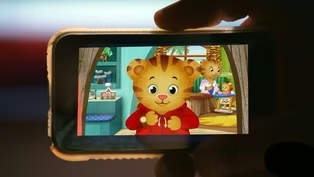
WTVP looks at how audiences are finding and using public media across platforms. (1m 20s)
What 100% Community Supported Means
Video has Closed Captions
Jenn Gordon explains what it means for WTVP to be 100% community supported. (1m 25s)
Jenn Gordon explains why telling Central Illinois stories matters more than ever. (1m 11s)
Providing Support for PBS.org
Learn Moreabout PBS online sponsorship New Episode
- News and Public Affairs

Top journalists deliver compelling original analysis of the hour's headlines.

- News and Public Affairs

FRONTLINE is investigative journalism that questions, explains and changes our world.
 New Season
 New Episode
 New Episode
 New Episode
 New Episode
 New Episode
 New Episode
 New Episode

 New Episode
 New Episode
Support for PBS provided by:
WTVP Now is a local public television program presented by WTVP